
Acetaminophen
Acetaminophen is available in Japan in OTC products such as Tylenol A. This section also includes medicines that combine acetaminophen with other active ingredients; their age limits and directions differ.
Norshin White Tablets

Active ingredients (per 2 tablets):
- Acetaminophen 300 mg
- Ethenzamide 380 mg
- Caffeine hydrate 60 mg
Ages 15 and over. Under 15: Do not take this medicine.
- While taking this medicine, do not take other pain relievers/fever reducers, cold medicines, or sedatives.
- Do not drink alcohol before or after taking it.
- Do not use it for a long period.
Directions & precautions
Active ingredients (per 2 tablets):
- Acetaminophen 300 mg
- Ethenzamide 380 mg
- Caffeine hydrate 60 mg
Inactive ingredients:
Aluminum silicate, calcium glycerophosphate, partially pregelatinized starch, hydroxypropyl cellulose, povidone, magnesium stearate.
Uses:
Relief of headache, menstrual pain, toothache, nerve pain, joint pain, lower back pain, pain from stiff shoulders, sore throat, earache, pain after tooth extraction, muscle pain, bruises, sprains, fractures, and injuries. Fever reduction for chills and fever.
Instructions for use:
- Ages 15 and over: Take 2 tablets per dose, up to 2 times a day. Leave at least 6 hours between doses.
- Under 15: Do not take this medicine.
- Avoid taking it on an empty stomach whenever possible.
- Follow the dosage directions strictly. Push the tablets through the foil backing of the blister pack and remove them before taking them. Swallowing the blister packaging can injure the lining of the esophagus.
Do not use:
- If you have had an allergic reaction to this medicine or any of its ingredients.
- If you have developed asthma after taking this medicine, another pain reliever/fever reducer, or a cold medicine.
While taking this medicine, do not take other pain relievers/fever reducers, cold medicines, or sedatives. Do not drink alcohol before or after taking it. Do not use it for a long period.
Consult a doctor, dentist, pharmacist, or registered salesperson before use if you:
- Are receiving treatment from a doctor or dentist.
- Are pregnant or may be pregnant.
- Are elderly.
- Have had an allergic reaction to a medicine or other substance.
- Have been diagnosed with heart disease, kidney disease, liver disease, or a stomach or duodenal ulcer.
When to stop and seek advice:
Stop taking this medicine immediately and consult a doctor, pharmacist, or registered salesperson with the package insert if you develop any of the following symptoms:
- Rash, redness, or itching.
- Nausea, vomiting, or loss of appetite.
- Dizziness or an excessive drop in body temperature.
Rare but serious reactions may occur. Seek medical attention immediately if you develop the following symptoms:
- Shock (anaphylaxis): Itchy skin, hives, a hoarse voice, sneezing, an itchy throat, difficulty breathing, palpitations, or clouded consciousness soon after taking the medicine.
- Severe skin reactions (Stevens-Johnson syndrome, toxic epidermal necrolysis, acute generalized exanthematous pustulosis): High fever, red eyes, eye discharge, sore lips, sore throat, widespread rash or redness, small pustules on reddened skin, general fatigue, or loss of appetite that persists or suddenly worsens.
- Drug-induced hypersensitivity syndrome: Widespread skin redness, a rash over the body, fever, fatigue, or swollen lymph nodes in the neck, armpits, groin, or elsewhere.
- Liver dysfunction: Fever, itching, rash, yellowing of the skin or whites of the eyes, brown urine, general fatigue, or loss of appetite.
- Kidney problems: Fever, rash, reduced urine output, swelling throughout the body, general fatigue, joint pain, or diarrhea.
- Interstitial pneumonia: Shortness of breath or difficulty breathing when climbing stairs or with slight exertion, a dry cough, or fever that appears suddenly or persists.
- Asthma: Wheezing or difficulty breathing.
If symptoms do not improve after 5 to 6 doses, stop taking this medicine and consult a doctor, dentist, pharmacist, or registered salesperson with the package insert.
Storage:
Store in a cool place with low humidity, away from direct sunlight. Keep out of reach of children. Do not transfer to another container, as this may cause misuse or affect the quality. Do not use after the expiry date.
Source: Japanese package insert (PDF) · Manufacturer product page
Translated from the Japanese insert, revised January 2023. Norshin White Tablets information checked September 28, 2026.
Norshin Tablets

Active ingredients (per 2 tablets):
- Acetaminophen 300 mg
- Ethenzamide 160 mg
- Caffeine hydrate 70 mg
Ages 15 and over. Under 15: Do not take this medicine.
- While taking this medicine, do not take other pain relievers/fever reducers, cold medicines, or sedatives.
- Do not drink alcohol before or after taking it.
- Do not use it for a long period.
Directions & precautions
Active ingredients (per 2 tablets):
- Acetaminophen 300 mg
- Ethenzamide 160 mg
- Caffeine hydrate 70 mg
Inactive ingredients:
Hydroxypropyl cellulose, calcium silicate, pregelatinized starch, magnesium stearate.
Uses:
Relief of headache, menstrual pain, toothache, nerve pain, joint pain, lower back pain, pain from stiff shoulders, sore throat, earache, pain after tooth extraction, muscle pain, bruises, sprains, fractures, and injuries. Fever reduction for chills and fever.
Instructions for use:
- Ages 15 and over: Take 2 tablets per dose, up to 3 times a day. Leave at least 4 hours between doses.
- Under 15: Do not take this medicine.
- Avoid taking it on an empty stomach whenever possible.
- Follow the dosage directions strictly. Push the tablets through the foil backing of the blister pack and remove them before taking them. Swallowing the blister packaging can injure the lining of the esophagus.
Do not use:
- If you have had an allergic reaction to this medicine or any of its ingredients.
- If you have developed asthma after taking this medicine, another pain reliever/fever reducer, or a cold medicine.
While taking this medicine, do not take other pain relievers/fever reducers, cold medicines, or sedatives. Do not drink alcohol before or after taking it. Do not use it for a long period.
Consult a doctor, dentist, pharmacist, or registered salesperson before use if you:
- Are receiving treatment from a doctor or dentist.
- Are pregnant or may be pregnant.
- Are elderly.
- Have had an allergic reaction to a medicine or other substance.
- Have been diagnosed with heart disease, kidney disease, liver disease, or a stomach or duodenal ulcer.
When to stop and seek advice:
Stop taking this medicine immediately and consult a doctor, pharmacist, or registered salesperson with the package insert if you develop any of the following symptoms:
- Rash, redness, or itching.
- Nausea, vomiting, or loss of appetite.
- Dizziness or an excessive drop in body temperature.
Rare but serious reactions may occur. Seek medical attention immediately if you develop the following symptoms:
- Shock (anaphylaxis): Itchy skin, hives, a hoarse voice, sneezing, an itchy throat, difficulty breathing, palpitations, or clouded consciousness soon after taking the medicine.
- Severe skin reactions (Stevens-Johnson syndrome, toxic epidermal necrolysis, acute generalized exanthematous pustulosis): High fever, red eyes, eye discharge, sore lips, sore throat, widespread rash or redness, small pustules on reddened skin, general fatigue, or loss of appetite that persists or suddenly worsens.
- Drug-induced hypersensitivity syndrome: Widespread skin redness, a rash over the body, fever, fatigue, or swollen lymph nodes in the neck, armpits, groin, or elsewhere.
- Liver dysfunction: Fever, itching, rash, yellowing of the skin or whites of the eyes, brown urine, general fatigue, or loss of appetite.
- Kidney problems: Fever, rash, reduced urine output, swelling throughout the body, general fatigue, joint pain, or diarrhea.
- Interstitial pneumonia: Shortness of breath or difficulty breathing when climbing stairs or with slight exertion, a dry cough, or fever that appears suddenly or persists.
- Asthma: Wheezing or difficulty breathing.
If symptoms do not improve after 5 to 6 doses, stop taking this medicine and consult a doctor, dentist, pharmacist, or registered salesperson with the package insert.
Storage:
Store in a cool place with low humidity, away from direct sunlight. Keep out of reach of children. Do not transfer to another container, as this may cause misuse or affect the quality. Do not use after the expiry date.
Source: Japanese package insert (PDF) · Manufacturer product page
Translated from the Japanese insert, revised January 2023. Norshin Tablets information checked September 28, 2026.
Norshin Pure Junior

For children aged 7 to 14.
Active ingredients (per 2 tablets):
- Acetaminophen 200 mg
- Allylisopropylacetylurea 30 mg
- Anhydrous caffeine 40 mg
For children aged 7 to 14. Under 7: Do not take this medicine.
- While taking this medicine, do not take other pain relievers/fever reducers, cold medicines, sedatives, or motion sickness medicines.
- Do not drive or operate machinery after taking it, as drowsiness may occur.
- Do not drink alcohol before or after taking it.
- Do not use it for a long period.
Directions & precautions
For children aged 7 to 14.
Active ingredients (per 2 tablets):
- Acetaminophen 200 mg
- Allylisopropylacetylurea 30 mg
- Anhydrous caffeine 40 mg
Inactive ingredients:
Cellulose, hydroxypropyl cellulose, anhydrous silica, carmellose calcium, magnesium stearate, carnauba wax, hypromellose, titanium dioxide.
Uses:
Relief of headache, menstrual pain, toothache, nerve pain, joint pain, lower back pain, pain from stiff shoulders, sore throat, earache, pain after tooth extraction, muscle pain, bruises, sprains, fractures, and injuries. Fever reduction for chills and fever.
Instructions for use:
- Ages 11 to 14: Take 2 tablets per dose.
- Ages 7 to 10: Take 1 tablet per dose.
- Under 7: Do not take this medicine.
- For both age groups, take up to 3 doses a day. Leave at least 4 hours between doses.
- Children must take this medicine under the guidance and supervision of a parent or guardian.
- Avoid taking it on an empty stomach whenever possible.
- Follow the dosage directions strictly. Push the tablets through the foil backing of the blister pack and remove them before taking them. Swallowing the blister packaging can injure the lining of the esophagus.
The Japanese insert includes general precautions for pain relievers/fever reducers, although this product is intended for children.
Do not use:
- If you have had an allergic reaction to this medicine or any of its ingredients.
- If you have developed asthma after taking this medicine, another pain reliever/fever reducer, or a cold medicine.
While taking this medicine, do not take other pain relievers/fever reducers, cold medicines, sedatives, or motion sickness medicines. Do not drive or operate machinery after taking it, as drowsiness may occur. Do not drink alcohol before or after taking it. Do not use it for a long period.
Consult a doctor, dentist, pharmacist, or registered salesperson before use if you:
- Are receiving treatment from a doctor or dentist.
- Are pregnant or may be pregnant.
- Are elderly.
- Have had an allergic reaction to a medicine or other substance.
- Have been diagnosed with heart disease, kidney disease, liver disease, or a stomach or duodenal ulcer.
When to stop and seek advice:
Stop taking this medicine immediately and consult a doctor, pharmacist, or registered salesperson with the package insert if you develop any of the following symptoms:
- Rash, redness, or itching.
- Nausea, vomiting, or loss of appetite.
- Dizziness or an excessive drop in body temperature.
Rare but serious reactions may occur. Seek medical attention immediately if you develop the following symptoms:
- Shock (anaphylaxis): Itchy skin, hives, a hoarse voice, sneezing, an itchy throat, difficulty breathing, palpitations, or clouded consciousness soon after taking the medicine.
- Severe skin reactions (Stevens-Johnson syndrome, toxic epidermal necrolysis, acute generalized exanthematous pustulosis): High fever, red eyes, eye discharge, sore lips, sore throat, widespread rash or redness, small pustules on reddened skin, general fatigue, or loss of appetite that persists or suddenly worsens.
- Drug-induced hypersensitivity syndrome: Widespread skin redness, a rash over the body, fever, fatigue, or swollen lymph nodes in the neck, armpits, groin, or elsewhere.
- Liver dysfunction: Fever, itching, rash, yellowing of the skin or whites of the eyes, brown urine, general fatigue, or loss of appetite.
- Kidney problems: Fever, rash, reduced urine output, swelling throughout the body, general fatigue, joint pain, or diarrhea.
- Interstitial pneumonia: Shortness of breath or difficulty breathing when climbing stairs or with slight exertion, a dry cough, or fever that appears suddenly or persists.
- Asthma: Wheezing or difficulty breathing.
Drowsiness may occur. If it persists or worsens, stop taking this medicine and consult a doctor, pharmacist, or registered salesperson with the package insert.
If symptoms do not improve after 5 to 6 doses, stop taking this medicine and consult a doctor, dentist, pharmacist, or registered salesperson with the package insert.
Storage:
Store in a cool place with low humidity, away from direct sunlight. Keep out of reach of children. Do not transfer to another container, as this may cause misuse or affect the quality. Do not use after the expiry date.
Source: Japanese package insert (PDF) · Manufacturer product page
Translated from the Japanese insert, revised January 2023. Norshin Pure Junior information checked September 28, 2026.
Naron Tablets

Active ingredients (per 2 tablets):
- Acetaminophen 265 mg
- Ethenzamide 300 mg
- Bromovalerylurea 200 mg
- Anhydrous caffeine 50 mg
Ages 8 and over. Under 8: Do not take this medicine.
- While taking this medicine, do not take other pain relievers/fever reducers, cold medicines, sedatives, or motion sickness medicines.
- Do not drive or operate machinery after taking it, as drowsiness may occur.
- Do not drink alcohol before or after taking it.
- Do not use it for a long period.
- Do not take more than the recommended dose.
Directions & precautions
Active ingredients (per 2 tablets):
- Acetaminophen 265 mg
- Ethenzamide 300 mg
- Bromovalerylurea 200 mg
- Anhydrous caffeine 50 mg
Inactive ingredients:
Cellulose, carmellose calcium, hydroxypropyl cellulose, magnesium stearate, hydrogenated oil.
Uses:
Relief of headache, menstrual pain, toothache, nerve pain, joint pain, lower back pain, pain from stiff shoulders, sore throat, earache, pain after tooth extraction, muscle pain, bruises, sprains, fractures, and injuries. Fever reduction for chills and fever.
Instructions for use:
- Ages 15 and over: Take 2 tablets per dose.
- Ages 8 to 14: Take 1 tablet per dose.
- Under 8: Do not take this medicine.
- For both age groups, take with water or lukewarm water, up to 3 doses a day. Leave at least 4 hours between doses.
- Children must take this medicine under the guidance and supervision of a parent or guardian.
- Avoid taking it on an empty stomach whenever possible.
- Follow the dosage directions strictly. Push the tablets through the foil backing of the blister pack and remove them before taking them. Swallowing the blister packaging can injure the lining of the esophagus.
Do not use:
- If you have had an allergic reaction to this medicine or any of its ingredients.
- If you have developed asthma after taking this medicine, another pain reliever/fever reducer, or a cold medicine.
While taking this medicine, do not take other pain relievers/fever reducers, cold medicines, sedatives, or motion sickness medicines. Do not drive or operate machinery after taking it, as drowsiness may occur. Do not drink alcohol before or after taking it. Do not use it for a long period. Do not take more than the recommended dose.
Consult a doctor, dentist, pharmacist, or registered salesperson before use if you:
- Are receiving treatment from a doctor or dentist.
- Are pregnant or may be pregnant.
- Are under 15 and have, or are suspected of having, chickenpox or influenza.
- Are elderly.
- Have had an allergic reaction to a medicine or other substance.
- Have been diagnosed with heart disease, kidney disease, liver disease, or a stomach or duodenal ulcer.
When to stop and seek advice:
Stop taking this medicine immediately and consult a doctor, pharmacist, or registered salesperson with the package insert if you develop any of the following symptoms:
- Rash, redness, or itching.
- Nausea, vomiting, or loss of appetite.
- Dizziness or an excessive drop in body temperature.
Rare but serious reactions may occur. Seek medical attention immediately if you develop the following symptoms:
- Shock (anaphylaxis): Itchy skin, hives, a hoarse voice, sneezing, an itchy throat, difficulty breathing, palpitations, or clouded consciousness soon after taking the medicine.
- Severe skin reactions (Stevens-Johnson syndrome, toxic epidermal necrolysis, acute generalized exanthematous pustulosis): High fever, red eyes, eye discharge, sore lips, sore throat, widespread rash or redness, small pustules on reddened skin, general fatigue, or loss of appetite that persists or suddenly worsens.
- Drug-induced hypersensitivity syndrome: Widespread skin redness, a rash over the body, fever, fatigue, or swollen lymph nodes in the neck, armpits, groin, or elsewhere.
- Liver dysfunction: Fever, itching, rash, yellowing of the skin or whites of the eyes, brown urine, general fatigue, or loss of appetite.
- Kidney problems: Fever, rash, reduced urine output, swelling throughout the body, general fatigue, joint pain, or diarrhea.
- Interstitial pneumonia: Shortness of breath or difficulty breathing when climbing stairs or with slight exertion, a dry cough, or fever that appears suddenly or persists.
- Asthma: Wheezing or difficulty breathing.
Drowsiness may occur. If it persists or worsens, stop taking this medicine and consult a doctor, pharmacist, or registered salesperson with the package insert.
If symptoms do not improve after 5 to 6 doses, stop taking this medicine and consult a doctor, dentist, pharmacist, or registered salesperson with the package insert.
Storage:
Store in a cool place with low humidity, away from direct sunlight. Keep out of reach of children. Do not transfer to another container, as this may cause misuse or affect the quality. Do not use after the expiry date.
Source: Japanese package insert (PDF) · Manufacturer product page
Translated from the Japanese insert, revised April 2026. Naron Tablets information checked September 28, 2026.
Tylenol A
タイレノールA

Active ingredient (per tablet):
Acetaminophen 300 mg
Ages 15 and over. Under 15: do not take this medicine.
- Do not take with other pain relievers/fever reducers, cold medicines, or sedatives.
- Do not drink alcohol before or after taking it.
- Do not use it continuously for a long period.
Directions & precautions
Do not use:
- If you have had an allergic reaction to this medicine or any of its ingredients.
- If you have developed asthma after taking this medicine, another pain reliever/fever reducer, or a cold medicine.
Instructions for use:
- Ages 15 and over: Take 1 tablet per dose, up to 3 times a day. Leave at least 4 hours between doses.
- Under 15: Do not take this medicine.
- When taking it for chills or fever caused by a cold, avoid taking it on an empty stomach whenever possible.
- Follow the dosage directions strictly. Push the tablet through the foil backing of the blister pack and remove it before taking it. Swallowing the blister packaging can injure the lining of the esophagus.
Inactive ingredients:
Cellulose, pregelatinized starch, hydroxypropyl cellulose, carmellose calcium, magnesium stearate, hypromellose, D-mannitol, titanium dioxide, talc, carnauba wax.
Uses:
Relief of headache, menstrual pain, toothache, pain after tooth extraction, sore throat, earache, joint pain, nerve pain, lower back pain, muscle pain, pain from stiff shoulders, bruises, fractures, sprains, and injuries. Relief of chills and fever.
Consult a doctor, dentist, pharmacist, or registered salesperson before use if you:
- Are receiving treatment from a doctor or dentist.
- Are pregnant or may be pregnant.
- Are elderly.
- Have had an allergic reaction to a medicine or other substance.
- Have been diagnosed with heart disease, kidney disease, liver disease, or a stomach or duodenal ulcer.
When to stop and seek advice:
Stop taking this medicine immediately and consult a doctor, pharmacist, or registered salesperson with the package insert if you develop a rash, redness, itching, nausea, vomiting, loss of appetite, dizziness, or an excessive drop in body temperature.
Rare but serious reactions may occur. Seek medical attention immediately if you develop the following symptoms:
- Shock (anaphylaxis): Itchy skin, hives, a hoarse voice, sneezing, an itchy throat, difficulty breathing, palpitations, or clouded consciousness soon after taking the medicine.
- Severe skin reactions (Stevens-Johnson syndrome, toxic epidermal necrolysis, acute generalized exanthematous pustulosis): High fever, red eyes, eye discharge, sore lips, sore throat, widespread rash or redness, small pustules on reddened skin, general fatigue, or loss of appetite that persists or suddenly worsens.
- Drug-induced hypersensitivity syndrome: Widespread redness, a rash over the whole body, fever, fatigue, or swollen lymph nodes in the neck, armpits, or groin.
- Liver dysfunction: Fever, itching, rash, yellowing of the skin or whites of the eyes, brown urine, general fatigue, or loss of appetite.
- Kidney problems: Fever, rash, reduced urine output, swelling throughout the body, general fatigue, joint pain, or diarrhea.
- Interstitial pneumonia: Shortness of breath or difficulty breathing when climbing stairs or exerting yourself slightly, a dry cough, or fever, appearing suddenly or persisting.
- Asthma: Wheezing or difficulty breathing.
If symptoms do not improve after 5 to 6 doses, stop taking this medicine and consult a doctor, dentist, pharmacist, or registered salesperson with the package insert.
Storage:
Store in a cool place with low humidity, away from direct sunlight. Keep out of reach of children. Do not transfer to another container, as this may cause misuse or affect the quality. Do not use after the expiry date.
Source: Japanese package insert (PDF) · Manufacturer product page
Translated from the Japanese insert, revised January 2023. Tylenol A information checked September 28, 2026.
Sedes V

Active ingredients (per 1 tablet):
- Ethenzamide 200 mg
- Acetaminophen 80 mg
- Allylisopropylacetylurea 30 mg
- Anhydrous caffeine 40 mg
- Cetotiamine hydrochloride hydrate (vitamin B1 derivative) 4 mg
Ages 7 and over. Under 7: Do not take this medicine.
- While taking this medicine, do not take other pain relievers/fever reducers, cold medicines, sedatives, or motion sickness medicines.
- Do not drive or operate machinery after taking it, as drowsiness may occur.
- Do not drink alcohol before or after taking it.
- Do not use it for a long period.
Directions & precautions
Active ingredients (per 1 tablet):
- Ethenzamide 200 mg
- Acetaminophen 80 mg
- Allylisopropylacetylurea 30 mg
- Anhydrous caffeine 40 mg
- Cetotiamine hydrochloride hydrate (vitamin B1 derivative) 4 mg
Inactive ingredients:
Carmellose calcium, microcrystalline cellulose, hydroxypropyl cellulose, magnesium stearate.
Uses:
Relief of headache, menstrual pain, toothache, nerve pain, joint pain, lower back pain, pain from stiff shoulders, sore throat, earache, pain after tooth extraction, muscle pain, bruises, sprains, fractures, and injuries. Fever reduction for chills and fever.
Instructions for use:
- Ages 15 and over: Take 2 tablets per dose.
- Ages 7 to 14: Take 1 tablet per dose.
- Under 7: Do not take this medicine.
- For both age groups, take with water or lukewarm water, up to 3 doses a day. Leave at least 4 hours between doses.
- Children must take this medicine under the guidance and supervision of a parent or guardian.
- Avoid taking it on an empty stomach whenever possible.
- Follow the dosage directions strictly. Push the tablets through the foil backing of the blister pack and remove them before taking them. Swallowing the blister packaging can injure the lining of the esophagus.
Do not use:
- If you have had an allergic reaction to this medicine or any of its ingredients.
- If you have developed asthma after taking this medicine, another pain reliever/fever reducer, or a cold medicine.
While taking this medicine, do not take other pain relievers/fever reducers, cold medicines, sedatives, or motion sickness medicines. Do not drive or operate machinery after taking it, as drowsiness may occur. Do not drink alcohol before or after taking it. Do not use it for a long period.
Consult a doctor, dentist, pharmacist, or registered salesperson before use if you:
- Are receiving treatment from a doctor or dentist.
- Are pregnant or may be pregnant.
- Are under 15 and have, or are suspected of having, chickenpox or influenza.
- Are elderly.
- Have had an allergic reaction to a medicine or other substance.
- Have been diagnosed with heart disease, kidney disease, liver disease, or a stomach or duodenal ulcer.
When to stop and seek advice:
Stop taking this medicine immediately and consult a doctor, pharmacist, or registered salesperson with the package insert if you develop any of the following symptoms:
- Rash, redness, or itching.
- Nausea, vomiting, or loss of appetite.
- Dizziness or an excessive drop in body temperature.
Rare but serious reactions may occur. Seek medical attention immediately if you develop the following symptoms:
- Shock (anaphylaxis): Itchy skin, hives, a hoarse voice, sneezing, an itchy throat, difficulty breathing, palpitations, or clouded consciousness soon after taking the medicine.
- Severe skin reactions (Stevens-Johnson syndrome, toxic epidermal necrolysis, acute generalized exanthematous pustulosis): High fever, red eyes, eye discharge, sore lips, sore throat, widespread rash or redness, small pustules on reddened skin, general fatigue, or loss of appetite that persists or suddenly worsens.
- Drug-induced hypersensitivity syndrome: Widespread skin redness, a rash over the body, fever, fatigue, or swollen lymph nodes in the neck, armpits, groin, or elsewhere.
- Liver dysfunction: Fever, itching, rash, yellowing of the skin or whites of the eyes, brown urine, general fatigue, or loss of appetite.
- Kidney problems: Fever, rash, reduced urine output, swelling throughout the body, general fatigue, joint pain, or diarrhea.
- Interstitial pneumonia: Shortness of breath or difficulty breathing when climbing stairs or with slight exertion, a dry cough, or fever that appears suddenly or persists.
- Asthma: Wheezing or difficulty breathing.
Drowsiness may occur. If it persists or worsens, stop taking this medicine and consult a doctor, pharmacist, or registered salesperson with the package insert.
If symptoms do not improve after 5 to 6 doses, stop taking this medicine and consult a doctor, dentist, pharmacist, or registered salesperson with the package insert.
Storage:
Store in a cool place with low humidity, away from direct sunlight. Keep out of reach of children. Do not remove the tablets from their blister sheets and transfer them to another container, as this may cause misuse or affect the quality. Do not use after the expiry date.
Source: Japanese package insert (PDF) · Manufacturer product page
Translated from the current Japanese insert (document version 9; revision date not printed). Sedes V information checked September 28, 2026.
Sedes High

Active ingredients (per 1 tablet):
- Isopropylantipyrine (IPA) 75 mg
- Acetaminophen 125 mg
- Allylisopropylacetylurea 30 mg
- Anhydrous caffeine 25 mg
Ages 15 and over. Under 15: Do not take this medicine.
- While taking this medicine, do not take other pain relievers/fever reducers, cold medicines, sedatives, or motion sickness medicines.
- Do not drive or operate machinery after taking it, as drowsiness may occur.
- Do not drink alcohol before or after taking it.
- Do not use it for a long period.
Directions & precautions
Active ingredients (per 1 tablet):
- Isopropylantipyrine (IPA) 75 mg
- Acetaminophen 125 mg
- Allylisopropylacetylurea 30 mg
- Anhydrous caffeine 25 mg
Inactive ingredients:
Carmellose calcium, croscarmellose sodium, povidone, magnesium stearate, microcrystalline cellulose, corn starch, lactose hydrate, hydroxypropyl cellulose.
Uses:
Relief of headache, menstrual pain, toothache, nerve pain, joint pain, lower back pain, pain from stiff shoulders, sore throat, earache, pain after tooth extraction, muscle pain, bruises, sprains, fractures, and injuries. Fever reduction for chills and fever.
Instructions for use:
- Ages 15 and over: Take 2 tablets per dose.
- Under 15: Do not take this medicine.
- Take with water or lukewarm water, up to 3 doses a day. Leave at least 4 hours between doses.
- Avoid taking it on an empty stomach whenever possible.
- Follow the dosage directions strictly. Push the tablets through the foil backing of the blister pack and remove them before taking them. Swallowing the blister packaging can injure the lining of the esophagus.
Do not use:
- If you have had an allergic reaction to this medicine or any of its ingredients.
- If you have developed asthma after taking this medicine, another pain reliever/fever reducer, or a cold medicine.
While taking this medicine, do not take other pain relievers/fever reducers, cold medicines, sedatives, or motion sickness medicines. Do not drive or operate machinery after taking it, as drowsiness may occur. Do not drink alcohol before or after taking it. Do not use it for a long period.
Consult a doctor, dentist, pharmacist, or registered salesperson before use if you:
- Are receiving treatment from a doctor or dentist.
- Are pregnant or may be pregnant.
- Are elderly.
- Have had an allergic reaction to a medicine or other substance.
- Have been diagnosed with heart disease, kidney disease, liver disease, or a stomach or duodenal ulcer.
When to stop and seek advice:
Stop taking this medicine immediately and consult a doctor, pharmacist, or registered salesperson with the package insert if you develop any of the following symptoms:
- Rash, redness, or itching.
- Nausea, vomiting, or loss of appetite.
- Dizziness or an excessive drop in body temperature.
Rare but serious reactions may occur. Seek medical attention immediately if you develop the following symptoms:
- Shock (anaphylaxis): Itchy skin, hives, a hoarse voice, sneezing, an itchy throat, difficulty breathing, palpitations, or clouded consciousness soon after taking the medicine.
- Severe skin reactions (Stevens-Johnson syndrome, toxic epidermal necrolysis, acute generalized exanthematous pustulosis): High fever, red eyes, eye discharge, sore lips, sore throat, widespread rash or redness, small pustules on reddened skin, general fatigue, or loss of appetite that persists or suddenly worsens.
- Drug-induced hypersensitivity syndrome: Widespread skin redness, a rash over the body, fever, fatigue, or swollen lymph nodes in the neck, armpits, groin, or elsewhere.
- Liver dysfunction: Fever, itching, rash, yellowing of the skin or whites of the eyes, brown urine, general fatigue, or loss of appetite.
- Kidney problems: Fever, rash, reduced urine output, swelling throughout the body, general fatigue, joint pain, or diarrhea.
- Interstitial pneumonia: Shortness of breath or difficulty breathing when climbing stairs or with slight exertion, a dry cough, or fever that appears suddenly or persists.
- Asthma: Wheezing or difficulty breathing.
Drowsiness may occur. If it persists or worsens, stop taking this medicine and consult a doctor, pharmacist, or registered salesperson with the package insert.
If symptoms do not improve after 5 to 6 doses, stop taking this medicine and consult a doctor, dentist, pharmacist, or registered salesperson with the package insert.
Storage:
Store in a cool place with low humidity, away from direct sunlight. Keep out of reach of children. Do not remove the tablets from their blister sheets and transfer them to another container, as this may cause misuse or affect the quality. Do not use after the expiry date.
Source: Japanese package insert (PDF) · Manufacturer product page
Translated from the current Japanese insert (document version 22; revision date not printed). Sedes High information checked September 28, 2026.
New Sedes Tablets
新セデス錠

Active ingredients (per 1 tablet):
- Ethenzamide 200 mg
- Acetaminophen 80 mg
- Allylisopropylacetylurea 30 mg
- Anhydrous caffeine 40 mg
Ages 7 and over. Under 7: do not take this medicine. Children require parent or guardian supervision.
- While taking this medicine, do not take other pain relievers/fever reducers, cold medicines, sedatives, or motion sickness medicines.
- Do not drive or operate machinery after taking it, as drowsiness may occur.
- Do not drink alcohol before or after taking it.
- Do not use it for a long period.
Directions & precautions
Do not use:
- If you have had an allergic reaction to this medicine or any of its ingredients.
- If you have developed asthma after taking this medicine, another pain reliever/fever reducer, or a cold medicine.
Instructions for use:
- Ages 15 and over: Take 2 tablets per dose.
- Ages 7 to 14: Take 1 tablet per dose.
- Under 7: Do not take this medicine.
- For both age groups, take with water or lukewarm water, up to 3 doses a day. Leave at least 4 hours between doses.
- Children must take this medicine under the guidance and supervision of a parent or guardian.
- Avoid taking it on an empty stomach whenever possible.
- Follow the dosage directions strictly. Push the tablets through the foil backing of the blister pack and remove them before taking them. Swallowing the blister packaging can injure the lining of the esophagus.
Inactive ingredients:
Lactose hydrate, carmellose calcium, croscarmellose sodium, hydroxypropyl cellulose, magnesium stearate.
Uses:
Relief of headache, menstrual pain, toothache, nerve pain, joint pain, lower back pain, pain from stiff shoulders, sore throat, earache, pain after tooth extraction, muscle pain, bruises, sprains, fractures, and injuries. Fever reduction for chills and fever.
Consult a doctor, dentist, pharmacist, or registered salesperson before use if you:
- Are receiving treatment from a doctor or dentist.
- Are pregnant or may be pregnant.
- Are under 15 and have, or are suspected of having, chickenpox or influenza.
- Are elderly.
- Have had an allergic reaction to a medicine or other substance.
- Have been diagnosed with heart disease, kidney disease, liver disease, or a stomach or duodenal ulcer.
When to stop and seek advice:
Stop taking this medicine immediately and consult a doctor, pharmacist, or registered salesperson with the package insert if you develop any of the following symptoms:
- Rash, redness, or itching.
- Nausea, vomiting, or loss of appetite.
- Dizziness or an excessive drop in body temperature.
Rare but serious reactions may occur. Seek medical attention immediately if you develop the following symptoms:
- Shock (anaphylaxis): Itchy skin, hives, a hoarse voice, sneezing, an itchy throat, difficulty breathing, palpitations, or clouded consciousness soon after taking the medicine.
- Severe skin reactions (Stevens-Johnson syndrome, toxic epidermal necrolysis, acute generalized exanthematous pustulosis): High fever, red eyes, eye discharge, sore lips, sore throat, widespread rash or redness, small pustules on reddened skin, general fatigue, or loss of appetite that persists or suddenly worsens.
- Drug-induced hypersensitivity syndrome: Widespread skin redness, a rash over the body, fever, fatigue, or swollen lymph nodes in the neck, armpits, groin, or elsewhere.
- Liver dysfunction: Fever, itching, rash, yellowing of the skin or whites of the eyes, brown urine, general fatigue, or loss of appetite.
- Kidney problems: Fever, rash, reduced urine output, swelling throughout the body, general fatigue, joint pain, or diarrhea.
- Interstitial pneumonia: Shortness of breath or difficulty breathing when climbing stairs or with slight exertion, a dry cough, or fever that appears suddenly or persists.
- Asthma: Wheezing or difficulty breathing.
Drowsiness may occur. If it persists or worsens, stop taking this medicine and consult a doctor, pharmacist, or registered salesperson with the package insert.
If symptoms do not improve after 5 to 6 doses, stop taking this medicine and consult a doctor, dentist, pharmacist, or registered salesperson with the package insert.
Storage:
Store in a cool place with low humidity, away from direct sunlight. Keep out of reach of children. Do not remove the tablets from their blister sheets and transfer them to another container, as this may cause misuse or affect the quality. Do not use after the expiry date.
Source: Japanese package insert (PDF) · Manufacturer product page
Translated from the current Japanese insert (document version 21; revision date not printed). New Sedes Tablets information checked September 28, 2026.
Aspirin
Bufferin A contains aspirin (acetylsalicylic acid). Other Bufferin products contain different active ingredients, so check the full product name rather than the brand alone.
Bufferin A

Active ingredients (per 2 tablets):
- Aspirin (acetylsalicylic acid) 660 mg
- Synthetic hydrotalcite (Dibuffer HT) 200 mg
Bufferin products contain different active ingredients. When consulting a doctor, dentist, pharmacist, or registered salesperson, tell them that Bufferin A contains aspirin (acetylsalicylic acid).
Ages 15 and over. Under 15: Do not take this medicine.
- While taking this medicine, do not take other pain relievers/fever reducers, cold medicines, or sedatives.
- Do not drink alcohol before or after taking it.
- Do not use it continuously for a long period.
Directions & precautions
Active ingredients (per 2 tablets):
- Aspirin (acetylsalicylic acid) 660 mg
- Synthetic hydrotalcite (Dibuffer HT) 200 mg
Bufferin products contain different active ingredients. When consulting a doctor, dentist, pharmacist, or registered salesperson, tell them that Bufferin A contains aspirin (acetylsalicylic acid).
Inactive ingredients:
Corn starch, magnesium stearate, hypromellose, titanium dioxide, macrogol, Blue No. 1. Contains no pyrazolone-type ingredients.
Uses:
Relief of headache, menstrual pain, joint pain, nerve pain, lower back pain, muscle pain, pain from stiff shoulders, sore throat, toothache, pain after tooth extraction, bruises, sprains, fractures, injuries, and earache. Fever reduction for chills and fever.
Instructions for use:
- Ages 15 and over: Take 2 tablets per dose with water or lukewarm water, up to 2 times a day. Leave at least 6 hours between doses.
- Under 15: Do not take this medicine.
- Avoid taking it on an empty stomach whenever possible.
- Follow the dosage directions strictly. Push the tablets through the foil backing of the blister pack and remove them before taking them. Swallowing the blister packaging can injure the lining of the esophagus.
Do not use:
- If you have had an allergic reaction to this medicine or any of its ingredients.
- If you have developed asthma after taking this medicine, another pain reliever/fever reducer, or a cold medicine.
- If you are under 15.
- If you are pregnant and within 12 weeks of your expected delivery date.
While taking this medicine, do not take other pain relievers/fever reducers, cold medicines, or sedatives. Do not drink alcohol before or after taking it. Do not use it continuously for a long period.
Consult a doctor, dentist, pharmacist, or registered salesperson before use if you:
- Are receiving treatment from a doctor or dentist.
- Are pregnant or may be pregnant.
- Are breastfeeding.
- Are elderly.
- Have had an allergic reaction to a medicine or other substance.
- Have been diagnosed with heart disease, kidney disease, liver disease, or a stomach or duodenal ulcer.
When to stop and seek advice:
Stop taking this medicine immediately and consult a doctor, pharmacist, or registered salesperson with the package insert if you develop any of the following symptoms:
- Rash, redness, itching, or bruising.
- Nausea, vomiting, loss of appetite, heartburn, a heavy feeling in the stomach, gastrointestinal bleeding, abdominal pain, diarrhea, or bloody stools.
- Dizziness.
- Nosebleeds, bleeding gums, bleeding that is difficult to stop, other bleeding, fever, sore throat, back pain, or an excessive drop in body temperature.
Rare but serious reactions may occur. Seek medical attention immediately if you develop the following symptoms:
- Shock (anaphylaxis): Itchy skin, hives, a hoarse voice, sneezing, an itchy throat, difficulty breathing, palpitations, or clouded consciousness soon after taking the medicine.
- Severe skin reactions (Stevens-Johnson syndrome, toxic epidermal necrolysis): High fever, red eyes, eye discharge, sore lips, sore throat, or widespread rash or redness that persists or suddenly worsens.
- Acute coronary syndrome associated with an allergic reaction: Tight chest pain, difficulty breathing, a feeling of strong pressure on the chest, jaw pain, left arm pain, chills, lightheadedness, sweating, fever, reduced consciousness, swelling around the lips, itching, hives, rash, an itchy throat, or palpitations.
- Liver dysfunction: Fever, itching, rash, yellowing of the skin or whites of the eyes, brown urine, general fatigue, or loss of appetite.
- Asthma: Wheezing or difficulty breathing.
- Aplastic anemia: Bruising, nosebleeds, bleeding gums, fever, pale skin or mucous membranes, fatigue, palpitations, shortness of breath, feeling unwell and faint, or blood in the urine.
If symptoms do not improve after 5 to 6 doses, stop taking this medicine and consult a doctor, dentist, pharmacist, or registered salesperson with the package insert.
Storage:
Store in a cool place with low humidity, away from direct sunlight. Keep out of reach of children. Do not transfer to another container, as this may cause misuse or affect the quality. Do not use after the expiry date. Avoid damaging the foil backing behind tablets you are not taking, as this may cause deterioration.
Source: Japanese package insert (PDF) · Manufacturer product page
Translated from the Japanese insert, revised January 2026. Bufferin A information checked September 28, 2026.
Ibuprofen
The ibuprofen products below include capsules, tablets, and medicines with additional active ingredients. The amount per dose and dosing instructions differ by product.
Norshin Pure

Active ingredients (per 2 tablets):
- Ibuprofen 150 mg
- Allylisopropylacetylurea 60 mg
- Anhydrous caffeine 80 mg
Ages 15 and over. Under 15: Do not take this medicine.
- While taking this medicine, do not take other pain relievers/fever reducers, cold medicines, sedatives, or motion sickness medicines.
- Do not drive or operate machinery after taking it, as drowsiness may occur.
- Do not drink alcohol before or after taking it.
- Do not use it for a long period.
Directions & precautions
Active ingredients (per 2 tablets):
- Ibuprofen 150 mg
- Allylisopropylacetylurea 60 mg
- Anhydrous caffeine 80 mg
Inactive ingredients:
Anhydrous silica, hydroxypropyl cellulose, croscarmellose sodium, cellulose, magnesium stearate, hypromellose, titanium dioxide, talc, macrogol, carnauba wax.
Uses:
Relief of menstrual pain, headache, toothache, sore throat, joint pain, muscle pain, nerve pain, lower back pain, pain from stiff shoulders, pain after tooth extraction, bruises, earache, fractures, sprains, and injuries. Fever reduction for chills and fever.
Instructions for use:
- Ages 15 and over: Take 2 tablets per dose, up to 3 times a day. Leave at least 4 hours between doses.
- Under 15: Do not take this medicine.
- Avoid taking it on an empty stomach whenever possible.
- Follow the dosage directions strictly. Push the tablets through the foil backing of the blister pack and remove them before taking them. Swallowing the blister packaging can injure the lining of the esophagus.
Do not use:
- If you have had an allergic reaction to this medicine or any of its ingredients.
- If you have developed asthma after taking this medicine, another pain reliever/fever reducer, or a cold medicine.
- If you are under 15.
- If you are pregnant and within 12 weeks of your expected delivery date.
While taking this medicine, do not take other pain relievers/fever reducers, cold medicines, sedatives, or motion sickness medicines. Do not drive or operate machinery after taking it, as drowsiness may occur. Do not drink alcohol before or after taking it. Do not use it for a long period.
Consult a doctor, dentist, pharmacist, or registered salesperson before use if you:
- Are receiving treatment from a doctor or dentist.
- Are pregnant or may be pregnant.
- Are breastfeeding.
- Are elderly.
- Have had an allergic reaction to a medicine or other substance.
- Have been diagnosed with heart disease, kidney disease, liver disease, systemic lupus erythematosus, or mixed connective tissue disease.
- Have a history of a stomach or duodenal ulcer, ulcerative colitis, or Crohn's disease.
When to stop and seek advice:
Stop taking this medicine immediately and consult a doctor, dentist, pharmacist, or registered salesperson with the package insert if you develop any of the following symptoms:
- Rash, redness, itching, or bruising.
- Nausea, vomiting, loss of appetite, stomach discomfort, stomach pain, mouth sores, heartburn, a heavy feeling in the stomach, gastrointestinal bleeding, abdominal pain, diarrhea, or bloody stools.
- Dizziness, palpitations, or shortness of breath.
- Blurred vision, ringing in the ears, swelling, nosebleeds, bleeding gums, bleeding that is difficult to stop, other bleeding, back pain, an excessive drop in body temperature, or fatigue.
Rare but serious reactions may occur. Seek medical attention immediately if you develop the following symptoms:
- Shock (anaphylaxis): Itchy skin, hives, a hoarse voice, sneezing, an itchy throat, difficulty breathing, palpitations, or clouded consciousness soon after taking the medicine.
- Severe skin reactions (Stevens-Johnson syndrome, toxic epidermal necrolysis): High fever, red eyes, eye discharge, sore lips, sore throat, or widespread rash or redness that persists or suddenly worsens.
- Liver dysfunction: Fever, itching, rash, yellowing of the skin or whites of the eyes, brown urine, general fatigue, or loss of appetite.
- Kidney problems: Fever, rash, reduced urine output, swelling throughout the body, general fatigue, joint pain, or diarrhea.
- Aseptic meningitis: Severe headache with a stiff neck, fever, nausea, or vomiting. These symptoms have been reported particularly often in people being treated for systemic lupus erythematosus or mixed connective tissue disease.
- Heart attack: Tight chest pain, difficulty breathing, or cold sweats.
- Cerebrovascular disorder: Sudden reduced or lost consciousness, difficulty moving the limbs on one side, headache, vomiting, dizziness, difficulty speaking, or difficulty getting words out.
- Asthma: Wheezing or difficulty breathing.
- Aplastic anemia: Bruising, nosebleeds, bleeding gums, fever, pale skin or mucous membranes, fatigue, palpitations, shortness of breath, feeling unwell and faint, or blood in the urine.
- Agranulocytosis: Sudden high fever, chills, or sore throat.
Constipation or drowsiness may occur. If these symptoms persist or worsen, stop taking this medicine and consult a doctor, pharmacist, or registered salesperson with the package insert.
If symptoms do not improve after 5 to 6 doses, stop taking this medicine and consult a doctor, dentist, pharmacist, or registered salesperson with the package insert.
Storage:
Store in a cool place with low humidity, away from direct sunlight. Keep out of reach of children. Do not transfer to another container, as this may cause misuse or affect the quality. Do not use after the expiry date. Do not leave this medicine in hot places, such as inside a car.
Source: Japanese package insert (PDF) · Manufacturer product page
Translated from the Japanese insert, revised October 2024. Norshin Pure information checked September 28, 2026.
Naron Ace T

Active ingredients (per 2 tablets):
- Ibuprofen 144 mg
- Ethenzamide 84 mg
- Bromovalerylurea 200 mg
- Anhydrous caffeine 50 mg
Ages 15 and over. Under 15: Do not take this medicine.
- While taking this medicine, do not take other pain relievers/fever reducers, cold medicines, sedatives, or motion sickness medicines.
- Do not drive or operate machinery after taking it, as drowsiness may occur.
- Do not drink alcohol before or after taking it.
- Do not use it for a long period.
- Do not take more than the recommended dose.
Directions & precautions
Active ingredients (per 2 tablets):
- Ibuprofen 144 mg
- Ethenzamide 84 mg
- Bromovalerylurea 200 mg
- Anhydrous caffeine 50 mg
Inactive ingredients:
Anhydrous silica, hydroxypropyl cellulose, hypromellose, croscarmellose sodium, talc, magnesium stearate, lactose, Yellow No. 5, cellulose.
Uses:
Relief of menstrual pain, headache, toothache, sore throat, joint pain, muscle pain, nerve pain, lower back pain, pain from stiff shoulders, pain after tooth extraction, bruises, earache, fractures, sprains, and injuries. Fever reduction for chills and fever.
Instructions for use:
- Ages 15 and over: Take 2 tablets per dose with a glass of water or lukewarm water, up to 3 times a day. Leave at least 4 hours between doses.
- Under 15: Do not take this medicine.
- Avoid taking it on an empty stomach whenever possible.
- Follow the dosage directions strictly. Push the tablets through the foil backing of the blister pack and remove them before taking them. Swallowing the blister packaging can injure the lining of the esophagus.
Do not use:
- If you have had an allergic reaction to this medicine or any of its ingredients.
- If you have developed asthma after taking this medicine, another pain reliever/fever reducer, or a cold medicine.
- If you are under 15.
- If you are pregnant and within 12 weeks of your expected delivery date.
While taking this medicine, do not take other pain relievers/fever reducers, cold medicines, sedatives, or motion sickness medicines. Do not drive or operate machinery after taking it, as drowsiness may occur. Do not drink alcohol before or after taking it. Do not use it for a long period. Do not take more than the recommended dose.
Consult a doctor, dentist, pharmacist, or registered salesperson before use if you:
- Are receiving treatment from a doctor or dentist.
- Are pregnant or may be pregnant.
- Are breastfeeding.
- Are elderly.
- Have had an allergic reaction to a medicine or other substance.
- Have been diagnosed with heart disease, kidney disease, liver disease, systemic lupus erythematosus, or mixed connective tissue disease.
- Have a history of a stomach or duodenal ulcer, ulcerative colitis, or Crohn's disease.
When to stop and seek advice:
Stop taking this medicine immediately and consult a doctor, dentist, pharmacist, or registered salesperson with the package insert if you develop any of the following symptoms:
- Rash, redness, itching, or bruising.
- Nausea, vomiting, loss of appetite, stomach discomfort, stomach pain, mouth sores, heartburn, a heavy feeling in the stomach, gastrointestinal bleeding, abdominal pain, diarrhea, or bloody stools.
- Dizziness, palpitations, or shortness of breath.
- Blurred vision, ringing in the ears, swelling, nosebleeds, bleeding gums, bleeding that is difficult to stop, other bleeding, back pain, an excessive drop in body temperature, or fatigue.
Rare but serious reactions may occur. Seek medical attention immediately if you develop the following symptoms:
- Shock (anaphylaxis): Itchy skin, hives, a hoarse voice, sneezing, an itchy throat, difficulty breathing, palpitations, or clouded consciousness soon after taking the medicine.
- Severe skin reactions (Stevens-Johnson syndrome, toxic epidermal necrolysis): High fever, red eyes, eye discharge, sore lips, sore throat, or widespread rash or redness that persists or suddenly worsens.
- Liver dysfunction: Fever, itching, rash, yellowing of the skin or whites of the eyes, brown urine, general fatigue, or loss of appetite.
- Kidney problems: Fever, rash, reduced urine output, swelling throughout the body, general fatigue, joint pain, or diarrhea.
- Aseptic meningitis: Severe headache with a stiff neck, fever, nausea, or vomiting. These symptoms have been reported particularly often in people being treated for systemic lupus erythematosus or mixed connective tissue disease.
- Heart attack: Tight chest pain, difficulty breathing, or cold sweats.
- Cerebrovascular disorder: Sudden reduced or lost consciousness, difficulty moving the limbs on one side, headache, vomiting, dizziness, difficulty speaking, or difficulty getting words out.
- Asthma: Wheezing or difficulty breathing.
- Aplastic anemia: Bruising, nosebleeds, bleeding gums, fever, pale skin or mucous membranes, fatigue, palpitations, shortness of breath, feeling unwell and faint, or blood in the urine.
- Agranulocytosis: Sudden high fever, chills, or sore throat.
Constipation or drowsiness may occur. If these symptoms persist or worsen, stop taking this medicine and consult a doctor, pharmacist, or registered salesperson with the package insert.
If symptoms do not improve after 5 to 6 doses, stop taking this medicine and consult a doctor, dentist, pharmacist, or registered salesperson with the package insert.
Storage:
Store in a cool place with low humidity, away from direct sunlight. Keep out of reach of children. Do not transfer to another container, as this may cause misuse or affect the quality. Do not use after the expiry date.
Source: Japanese package insert (PDF) · Manufacturer product page
Translated from the Japanese insert, revised May 2026. Naron Ace T information checked September 28, 2026.
Ringl IB

Active ingredient (per 1 capsule):
- Ibuprofen 150 mg
Ages 15 and over. Under 15: Do not take this medicine.
- While taking this medicine, do not take other pain relievers/fever reducers, cold medicines, or sedatives.
- Do not drink alcohol before or after taking it.
- Do not use it for a long period.
Directions & precautions
Active ingredient (per 1 capsule):
- Ibuprofen 150 mg
Inactive ingredients:
Polysorbate 80, potassium hydroxide, gelatin, succinylated gelatin, corn starch-derived sugar alcohol, gardenia pigment.
Uses:
Relief of headache, menstrual pain, pain from stiff shoulders, lower back pain, joint pain, nerve pain, muscle pain, sore throat, toothache, pain after tooth extraction, bruises, sprains, fractures, injuries, and earache. Fever reduction for chills and fever.
Instructions for use:
- Ages 15 and over: Take 1 capsule per dose, up to 3 times a day. Leave at least 4 hours between doses.
- Under 15: Do not take this medicine.
- Avoid taking it on an empty stomach whenever possible.
- Follow the dosage directions strictly. Push the capsule through the foil backing of the blister pack and remove it before taking it. Swallowing the blister packaging can injure the lining of the esophagus.
Do not use:
- If you have had an allergic reaction to this medicine or any of its ingredients.
- If you have developed asthma after taking this medicine, another pain reliever/fever reducer, or a cold medicine.
- If you are under 15.
- If you are pregnant and within 12 weeks of your expected delivery date.
While taking this medicine, do not take other pain relievers/fever reducers, cold medicines, or sedatives. Do not drink alcohol before or after taking it. Do not use it for a long period.
Consult a doctor, dentist, pharmacist, or registered salesperson before use if you:
- Are receiving treatment from a doctor or dentist.
- Are pregnant or may be pregnant.
- Are breastfeeding.
- Are elderly.
- Have had an allergic reaction to a medicine or other substance.
- Have been diagnosed with heart disease, kidney disease, liver disease, systemic lupus erythematosus, or mixed connective tissue disease.
- Have a history of a stomach or duodenal ulcer, ulcerative colitis, or Crohn's disease.
When to stop and seek advice:
Stop taking this medicine immediately and consult a doctor, dentist, pharmacist, or registered salesperson with the package insert if you develop any of the following symptoms:
- Rash, redness, itching, or bruising.
- Nausea, vomiting, loss of appetite, stomach discomfort, stomach pain, mouth sores, heartburn, a heavy feeling in the stomach, gastrointestinal bleeding, abdominal pain, diarrhea, or bloody stools.
- Dizziness, palpitations, or shortness of breath.
- Blurred vision, ringing in the ears, swelling, nosebleeds, bleeding gums, bleeding that is difficult to stop, other bleeding, back pain, an excessive drop in body temperature, or fatigue.
Rare but serious reactions may occur. Seek medical attention immediately if you develop the following symptoms:
- Shock (anaphylaxis): Itchy skin, hives, a hoarse voice, sneezing, an itchy throat, difficulty breathing, palpitations, or clouded consciousness soon after taking the medicine.
- Severe skin reactions (Stevens-Johnson syndrome, toxic epidermal necrolysis): High fever, red eyes, eye discharge, sore lips, sore throat, widespread rash or redness that persists or suddenly worsens.
- Liver dysfunction: Fever, itching, rash, yellowing of the skin or whites of the eyes, brown urine, general fatigue, or loss of appetite.
- Kidney problems: Fever, rash, reduced urine output, swelling throughout the body, general fatigue, joint pain, or diarrhea.
- Aseptic meningitis: Severe headache with a stiff neck, fever, nausea, or vomiting. These symptoms have been reported particularly often in people being treated for systemic lupus erythematosus or mixed connective tissue disease.
- Heart attack: Tight chest pain, difficulty breathing, or cold sweats.
- Cerebrovascular disorder: Sudden reduced or lost consciousness, difficulty moving the limbs on one side, headache, vomiting, dizziness, difficulty speaking, or difficulty getting words out.
- Asthma: Wheezing or difficulty breathing.
- Aplastic anemia: Bruising, nosebleeds, bleeding gums, fever, pale skin or mucous membranes, fatigue, palpitations, shortness of breath, feeling unwell and faint, or blood in the urine.
- Agranulocytosis: Sudden high fever, chills, or sore throat.
Constipation may occur. If it persists or worsens, stop taking this medicine and consult a doctor, pharmacist, or registered salesperson with the package insert.
If symptoms do not improve after 5 to 6 doses, stop taking this medicine and consult a doctor, dentist, pharmacist, or registered salesperson with the package insert.
Storage:
Store in a cool place with low humidity, away from direct sunlight. Keep out of reach of children. Do not transfer to another container, as this may cause misuse or affect the quality. Do not use after the expiry date. Avoid touching the capsules with wet hands, as they readily absorb moisture.
Source: Japanese package insert (PDF) · Manufacturer product page
Translated from the Japanese insert, revised October 2024. Ringl IB information checked September 28, 2026.
Ringl IB α200

Active ingredient (per 1 capsule):
- Ibuprofen 200 mg
Ages 15 and over. Under 15: Do not take this medicine.
- While taking this medicine, do not take other pain relievers/fever reducers, cold medicines, or sedatives.
- Do not drink alcohol before or after taking it.
- Do not use it for a long period.
Directions & precautions
Active ingredient (per 1 capsule):
- Ibuprofen 200 mg
Inactive ingredients:
Polysorbate 80, potassium hydroxide, gelatin, succinylated gelatin, corn starch-derived sugar alcohol, gardenia pigment.
Uses:
Relief of headache, menstrual pain, pain from stiff shoulders, lower back pain, joint pain, nerve pain, muscle pain, sore throat, toothache, pain after tooth extraction, bruises, sprains, fractures, injuries, and earache. Fever reduction for chills and fever.
Instructions for use:
- Ages 15 and over: Take 1 capsule per dose when symptoms occur, up to 2 times a day. A third dose may be taken if symptoms return. Leave at least 4 hours between doses.
- Under 15: Do not take this medicine.
- Avoid taking it on an empty stomach whenever possible.
- Follow the dosage directions strictly. Push the capsule through the foil backing of the blister pack and remove it before taking it. Swallowing the blister packaging can injure the lining of the esophagus.
Do not use:
- If you have had an allergic reaction to this medicine or any of its ingredients.
- If you have developed asthma after taking this medicine, another pain reliever/fever reducer, or a cold medicine.
- If you are under 15.
- If you are receiving medical treatment for a stomach or duodenal ulcer, a blood disorder, liver disease, kidney disease, heart disease, or high blood pressure, or are being given zidovudine (Retrovir).
- If you are pregnant and within 12 weeks of your expected delivery date.
While taking this medicine, do not take other pain relievers/fever reducers, cold medicines, or sedatives. Do not drink alcohol before or after taking it. Do not use it for a long period.
Consult a doctor, dentist, pharmacist, or registered salesperson before use if you:
- Are receiving treatment from a doctor or dentist.
- Are pregnant or may be pregnant.
- Are breastfeeding.
- Are elderly.
- Have had an allergic reaction to a medicine or other substance.
- Have been diagnosed with, or have a history of, a stomach or duodenal ulcer, a blood disorder, liver disease, kidney disease, heart disease, high blood pressure, bronchial asthma, systemic lupus erythematosus, mixed connective tissue disease, ulcerative colitis, or Crohn's disease.
When to stop and seek advice:
Stop taking this medicine immediately and consult a doctor, dentist, pharmacist, or registered salesperson with the package insert if you develop any of the following symptoms:
- Rash, redness, itching, or bruising.
- Nausea, vomiting, loss of appetite, stomach discomfort, stomach pain, mouth sores, heartburn, a heavy feeling in the stomach, gastrointestinal bleeding, abdominal pain, diarrhea, or bloody stools.
- Dizziness, drowsiness, insomnia, low mood, palpitations, or shortness of breath.
- Blurred vision, ringing in the ears, swelling, nosebleeds, bleeding gums, bleeding that is difficult to stop, other bleeding, back pain, an excessive drop in body temperature, or fatigue.
Rare but serious reactions may occur. Seek medical attention immediately if you develop the following symptoms:
- Shock (anaphylaxis): Itchy skin, hives, a hoarse voice, sneezing, an itchy throat, difficulty breathing, palpitations, or clouded consciousness soon after taking the medicine.
- Severe skin reactions (Stevens-Johnson syndrome, toxic epidermal necrolysis): High fever, red eyes, eye discharge, sore lips, sore throat, widespread rash or redness that persists or suddenly worsens.
- Gastrointestinal disorders: Black stools, vomiting blood, bloody stools, or loose stools containing blood, mucus, or pus.
- Liver dysfunction: Fever, itching, rash, yellowing of the skin or whites of the eyes, brown urine, general fatigue, or loss of appetite.
- Kidney problems: Fever, rash, reduced urine output, swelling throughout the body, general fatigue, joint pain, or diarrhea.
- Aseptic meningitis: Severe headache with a stiff neck, fever, nausea, or vomiting. These symptoms have been reported particularly often in people being treated for systemic lupus erythematosus or mixed connective tissue disease.
- Heart attack: Tight chest pain, difficulty breathing, or cold sweats.
- Cerebrovascular disorder: Sudden reduced or lost consciousness, difficulty moving the limbs on one side, headache, vomiting, dizziness, difficulty speaking, or difficulty getting words out.
- Asthma: Wheezing or difficulty breathing.
- Aplastic anemia: Bruising, nosebleeds, bleeding gums, fever, pale skin or mucous membranes, fatigue, palpitations, shortness of breath, feeling unwell and faint, or blood in the urine.
- Agranulocytosis: Sudden high fever, chills, or sore throat.
Constipation or dry mouth may occur. If these symptoms persist or worsen, stop taking this medicine and consult a doctor, pharmacist, or registered salesperson with the package insert.
If your temperature falls below normal, you feel markedly weak, or your hands and feet become cold after taking this medicine, stop taking it immediately, keep warm with a blanket or similar covering, and consult a doctor, pharmacist, or registered salesperson with the package insert.
If symptoms do not improve after 3 to 4 doses, stop taking this medicine and consult a doctor, dentist, pharmacist, or registered salesperson with the package insert.
Storage:
Store in a cool place with low humidity, away from direct sunlight. Keep out of reach of children. Do not transfer to another container, as this may cause misuse or affect the quality. Do not use after the expiry date. Avoid touching the capsules with wet hands, as they readily absorb moisture.
Source: Japanese package insert (PDF) · Manufacturer product page
Translated from the Japanese insert, revised October 2024. Ringl IB α200 information checked September 28, 2026.
Ringl IB Tablets α200

Active ingredient (per 1 tablet):
- Ibuprofen 200 mg
Ages 15 and over. Under 15: Do not take this medicine.
- While taking this medicine, do not take other pain relievers/fever reducers, cold medicines, or sedatives.
- Do not drink alcohol before or after taking it.
- Do not use it for a long period.
Directions & precautions
Active ingredient (per 1 tablet):
- Ibuprofen 200 mg
Inactive ingredients:
Silicon dioxide, hydroxypropyl cellulose, aluminum silicate, croscarmellose sodium, magnesium stearate, hypromellose, macrogol, titanium dioxide.
Uses:
Relief of headache, menstrual pain, pain from stiff shoulders, lower back pain, joint pain, nerve pain, muscle pain, sore throat, toothache, pain after tooth extraction, bruises, sprains, fractures, injuries, and earache. Fever reduction for chills and fever.
Instructions for use:
- Ages 15 and over: Take 1 tablet per dose when symptoms occur, up to 2 times a day. A third dose may be taken if symptoms return. Leave at least 4 hours between doses.
- Under 15: Do not take this medicine.
- Avoid taking it on an empty stomach whenever possible.
- Follow the dosage directions strictly. Push the tablet through the foil backing of the blister pack and remove it before taking it. Swallowing the blister packaging can injure the lining of the esophagus.
Do not use:
- If you have had an allergic reaction to this medicine or any of its ingredients.
- If you have developed asthma after taking this medicine, another pain reliever/fever reducer, or a cold medicine.
- If you are under 15.
- If you are receiving medical treatment for a stomach or duodenal ulcer, a blood disorder, liver disease, kidney disease, heart disease, or high blood pressure, or are being given zidovudine (Retrovir).
- If you are pregnant and within 12 weeks of your expected delivery date.
While taking this medicine, do not take other pain relievers/fever reducers, cold medicines, or sedatives. Do not drink alcohol before or after taking it. Do not use it for a long period.
Consult a doctor, dentist, pharmacist, or registered salesperson before use if you:
- Are receiving treatment from a doctor or dentist.
- Are pregnant or may be pregnant.
- Are breastfeeding.
- Are elderly.
- Have had an allergic reaction to a medicine or other substance.
- Have been diagnosed with, or have a history of, a stomach or duodenal ulcer, a blood disorder, liver disease, kidney disease, heart disease, high blood pressure, bronchial asthma, systemic lupus erythematosus, mixed connective tissue disease, ulcerative colitis, or Crohn's disease.
When to stop and seek advice:
Stop taking this medicine immediately and consult a doctor, dentist, pharmacist, or registered salesperson with the package insert if you develop any of the following symptoms:
- Rash, redness, itching, or bruising.
- Nausea, vomiting, loss of appetite, stomach discomfort, stomach pain, mouth sores, heartburn, a heavy feeling in the stomach, gastrointestinal bleeding, abdominal pain, diarrhea, or bloody stools.
- Dizziness, drowsiness, insomnia, low mood, palpitations, or shortness of breath.
- Blurred vision, ringing in the ears, swelling, nosebleeds, bleeding gums, bleeding that is difficult to stop, other bleeding, back pain, an excessive drop in body temperature, or fatigue.
Rare but serious reactions may occur. Seek medical attention immediately if you develop the following symptoms:
- Shock (anaphylaxis): Itchy skin, hives, a hoarse voice, sneezing, an itchy throat, difficulty breathing, palpitations, or clouded consciousness soon after taking the medicine.
- Severe skin reactions (Stevens-Johnson syndrome, toxic epidermal necrolysis): High fever, red eyes, eye discharge, sore lips, sore throat, widespread rash or redness that persists or suddenly worsens.
- Gastrointestinal disorders: Black stools, vomiting blood, bloody stools, or loose stools containing blood, mucus, or pus.
- Liver dysfunction: Fever, itching, rash, yellowing of the skin or whites of the eyes, brown urine, general fatigue, or loss of appetite.
- Kidney problems: Fever, rash, reduced urine output, swelling throughout the body, general fatigue, joint pain, or diarrhea.
- Aseptic meningitis: Severe headache with a stiff neck, fever, nausea, or vomiting. These symptoms have been reported particularly often in people being treated for systemic lupus erythematosus or mixed connective tissue disease.
- Heart attack: Tight chest pain, difficulty breathing, or cold sweats.
- Cerebrovascular disorder: Sudden reduced or lost consciousness, difficulty moving the limbs on one side, headache, vomiting, dizziness, difficulty speaking, or difficulty getting words out.
- Asthma: Wheezing or difficulty breathing.
- Aplastic anemia: Bruising, nosebleeds, bleeding gums, fever, pale skin or mucous membranes, fatigue, palpitations, shortness of breath, feeling unwell and faint, or blood in the urine.
- Agranulocytosis: Sudden high fever, chills, or sore throat.
Constipation or dry mouth may occur. If these symptoms persist or worsen, stop taking this medicine and consult a doctor, pharmacist, or registered salesperson with the package insert.
If your temperature falls below normal, you feel markedly weak, or your hands and feet become cold after taking this medicine, stop taking it immediately, keep warm with a blanket or similar covering, and consult a doctor, pharmacist, or registered salesperson with the package insert.
If symptoms do not improve after 3 to 4 doses, stop taking this medicine and consult a doctor, dentist, pharmacist, or registered salesperson with the package insert.
Storage:
Store in a cool place with low humidity, away from direct sunlight. Keep out of reach of children. Do not transfer to another container, as this may cause misuse or affect the quality. Do not use after the expiry date.
Source: Japanese package insert (PDF) · Manufacturer product page
Translated from the Japanese insert, revised October 2024. Ringl IB Tablets α200 information checked September 28, 2026.
Loxoprofen
Loxonin S contains loxoprofen sodium hydrate. Loxonin S Plus also contains magnesium oxide. Check the exact product's ingredients and precautions before use.
Loxonin S

This is a Class 1 OTC medicine. Receive an explanation from a pharmacist and read the precautions before use.
Active ingredient (per 1 tablet):
- Loxoprofen sodium hydrate 68.1 mg (equivalent to 60 mg of anhydrous loxoprofen sodium)
Ages 15 and over. Under 15: Do not take this medicine.
- While taking this medicine, do not take other pain relievers/fever reducers, cold medicines, or sedatives.
- Do not drink alcohol before or after taking it.
- Do not take it continuously for a long period.
- If pain or other symptoms keep recurring after 3 to 5 days of use, stop taking it and see a doctor.
Directions & precautions
This is a Class 1 OTC medicine. Receive an explanation from a pharmacist and read the precautions before use.
Active ingredient (per 1 tablet):
- Loxoprofen sodium hydrate 68.1 mg (equivalent to 60 mg of anhydrous loxoprofen sodium)
Inactive ingredients:
Hydroxypropyl cellulose, magnesium stearate, lactose hydrate, ferric oxide.
Some tablets may have red specks from the inactive ingredients.
Uses:
Relief of headache, menstrual pain, toothache, pain after tooth extraction, sore throat, lower back pain, joint pain, nerve pain, muscle pain, pain from stiff shoulders, earache, bruises, fractures, sprains, and injuries. Fever reduction for chills and fever.
Instructions for use:
- Ages 15 and over: Take 1 tablet per dose with water or warm water when symptoms occur, up to 2 times a day. A third dose may be taken if symptoms return. Leave at least 4 hours between doses.
- Under 15: Do not take this medicine.
- Avoid taking it on an empty stomach whenever possible.
- Follow the dosage directions strictly. Push the tablet through the foil backing of the blister pack and remove it before taking it. Swallowing the blister packaging can injure the lining of the esophagus.
Do not use:
- If you have had an allergic reaction to this medicine or any of its ingredients.
- If you have developed asthma after taking this medicine, another pain reliever/fever reducer, or a cold medicine.
- If you are under 15.
- If you are receiving medical treatment for a stomach or duodenal ulcer, liver disease, kidney disease, or heart disease.
- If a doctor has told you that you have a blood disorder, such as a low red blood cell count (anemia), low platelets (easy bleeding or bleeding that is difficult to stop), or a low white blood cell count.
- If you are pregnant and within 12 weeks of your expected delivery date.
While taking this medicine, do not take other pain relievers/fever reducers, cold medicines, or sedatives. Do not drink alcohol before or after taking it. Do not take it continuously for a long period. If pain or other symptoms keep recurring after 3 to 5 days of use, stop taking it and see a doctor.
Consult a doctor, dentist, or pharmacist before use if you:
- Are receiving treatment from a doctor or dentist.
- Are pregnant or may be pregnant.
- Are breastfeeding.
- Are elderly.
- Have had an allergic reaction to a medicine or other substance.
- Have been diagnosed with bronchial asthma, ulcerative colitis, Crohn's disease, systemic lupus erythematosus, or mixed connective tissue disease.
- Have a history of a stomach or duodenal ulcer, liver disease, kidney disease, or a blood disorder.
When to stop and seek advice:
Stop taking this medicine immediately and consult a doctor, dentist, or pharmacist with the package insert if you develop any of the following:
- An excessive drop in body temperature, marked weakness, or cold hands and feet.
- A peptic ulcer or swelling.
- Rash, redness, or itching.
- Abdominal pain, stomach discomfort, loss of appetite, nausea, vomiting, abdominal bloating, heartburn, mouth sores, or indigestion.
- Raised blood pressure or palpitations.
- Drowsiness, numbness, dizziness, or headache.
- Chest pain, fatigue, facial flushing, fever, anemia, or blood in the urine.
Rare but serious reactions may occur. Seek medical attention immediately if you develop the following symptoms:
- Gastrointestinal bleeding: Vomiting blood, nausea, vomiting, abdominal pain, black tarry stools, or bloody stools.
- Gastrointestinal perforation: Nausea, vomiting, or severe abdominal pain caused by a hole in the digestive tract.
- Narrowing or blockage of the small or large intestine: Nausea, vomiting, abdominal pain, or abdominal bloating.
- Shock (anaphylaxis): Itchy skin, hives, a hoarse voice, sneezing, an itchy throat, difficulty breathing, palpitations, or clouded consciousness soon after taking the medicine.
- Blood disorders: Sore throat, fever, general fatigue, a pale face or pale inner eyelids, easy bleeding such as bleeding gums or nosebleeds, or bruising that does not fade when pressed.
- Severe skin reactions (Stevens-Johnson syndrome, toxic epidermal necrolysis, erythema multiforme, acute generalized exanthematous pustulosis): High fever, red eyes, eye discharge, sore lips, sore throat, widespread rash or redness, blisters on red areas of skin, small pus-filled bumps on red skin, general fatigue, or loss of appetite that persists or suddenly worsens.
- Kidney problems: Fever, rash, reduced urine output, swelling throughout the body, general fatigue, joint pain, or diarrhea.
- Congestive heart failure: General fatigue, palpitations, shortness of breath, chest discomfort, chest pain, dizziness, or fainting.
- Heart attack: Tight chest pain, difficulty breathing, or cold sweats.
- Cerebrovascular disorder: Sudden reduced or lost consciousness, difficulty moving the limbs on one side, headache, vomiting, dizziness, difficulty speaking, or difficulty getting words out.
- Interstitial pneumonia: Shortness of breath or difficulty breathing when climbing stairs or with slight exertion, a dry cough, or fever that appears suddenly or persists.
- Liver dysfunction: Fever, itching, rash, yellowing of the skin or whites of the eyes, brown urine, general fatigue, or loss of appetite.
- Rhabdomyolysis: Muscle pain in the limbs, shoulders, or lower back, numbness in the limbs, weakness, stiffness, general fatigue, or reddish-brown urine.
- Aseptic meningitis: Severe headache with a stiff neck, fever, nausea, or vomiting. These symptoms have been reported particularly often in people being treated for systemic lupus erythematosus or mixed connective tissue disease.
- Asthma: Wheezing or difficulty breathing.
Dry mouth, constipation, or diarrhea may occur. If these symptoms persist or worsen, stop taking this medicine and consult a doctor or pharmacist with the package insert.
If symptoms do not improve after 1 to 2 doses, stop taking this medicine and consult a doctor, dentist, or pharmacist with the package insert, as another illness may be the cause.
Storage:
Store in a cool place with low humidity, away from direct sunlight. Keep out of reach of children. Do not transfer to another container, as this may cause misuse or affect the quality. Do not use after the expiry date.
Source: Japanese package insert (PDF) · Manufacturer product page
Translated from the Japanese insert, revised October 2024. Loxonin S information checked September 28, 2026.
Loxonin S Plus

This is a Class 1 OTC medicine. Receive an explanation from a pharmacist and read the precautions before use.
Active ingredients (per 1 tablet):
- Loxoprofen sodium hydrate 68.1 mg (equivalent to 60 mg of anhydrous loxoprofen sodium)
- Magnesium oxide 33.3 mg
Ages 15 and over. Under 15: Do not take this medicine.
- While taking this medicine, do not take other pain relievers/fever reducers, cold medicines, or sedatives.
- Do not drink alcohol before or after taking it.
- Do not take it continuously for a long period.
- If pain or other symptoms keep recurring after 3 to 5 days of use, stop taking it and see a doctor.
Directions & precautions
This is a Class 1 OTC medicine. Receive an explanation from a pharmacist and read the precautions before use.
Active ingredients (per 1 tablet):
- Loxoprofen sodium hydrate 68.1 mg (equivalent to 60 mg of anhydrous loxoprofen sodium)
- Magnesium oxide 33.3 mg
Inactive ingredients:
Lactose, cellulose, hydroxypropyl cellulose, croscarmellose sodium, calcium stearate, hypromellose, titanium dioxide, ferric oxide, carnauba wax.
Uses:
Relief of menstrual pain, headache, toothache, pain after tooth extraction, sore throat, lower back pain, joint pain, nerve pain, muscle pain, pain from stiff shoulders, earache, bruises, fractures, sprains, and injuries. Fever reduction for chills and fever.
Instructions for use:
- Ages 15 and over: Take 1 tablet per dose with water or lukewarm water when symptoms occur, up to 2 times a day. A third dose may be taken if symptoms return. Leave at least 4 hours between doses.
- Under 15: Do not take this medicine.
- Avoid taking it on an empty stomach whenever possible.
- Follow the dosage directions strictly. Push the tablet through the foil backing of the blister pack and remove it before taking it. Swallowing the blister packaging can injure the lining of the esophagus.
Do not use:
- If you have had an allergic reaction to this medicine or any of its ingredients.
- If you have developed asthma after taking this medicine, another pain reliever/fever reducer, or a cold medicine.
- If you are under 15.
- If you are receiving medical treatment for a stomach or duodenal ulcer, liver disease, kidney disease, or heart disease.
- If a doctor has told you that you have a blood disorder, such as a low red blood cell count (anemia), low platelets (easy bleeding or bleeding that is difficult to stop), or a low white blood cell count.
- If you are pregnant and within 12 weeks of your expected delivery date.
While taking this medicine, do not take other pain relievers/fever reducers, cold medicines, or sedatives. Do not drink alcohol before or after taking it. Do not take it continuously for a long period. If pain or other symptoms keep recurring after 3 to 5 days of use, stop taking it and see a doctor.
Consult a doctor, dentist, or pharmacist before use if you:
- Are receiving treatment from a doctor or dentist.
- Are pregnant or may be pregnant.
- Are breastfeeding.
- Are elderly.
- Have had an allergic reaction to a medicine or other substance.
- Have been diagnosed with bronchial asthma, ulcerative colitis, Crohn's disease, systemic lupus erythematosus, or mixed connective tissue disease.
- Have a history of a stomach or duodenal ulcer, liver disease, kidney disease, or a blood disorder.
When to stop and seek advice:
Stop taking this medicine immediately and consult a doctor, dentist, or pharmacist with the package insert if you develop any of the following:
- An excessive drop in body temperature, marked weakness, or cold hands and feet.
- A peptic ulcer or swelling.
- Rash, redness, or itching.
- Abdominal pain, stomach discomfort, loss of appetite, nausea, vomiting, abdominal bloating, heartburn, mouth sores, or indigestion.
- Raised blood pressure or palpitations.
- Drowsiness, numbness, dizziness, or headache.
- Chest pain, fatigue, facial flushing, fever, anemia, or blood in the urine.
Rare but serious reactions may occur. Seek medical attention immediately if you develop the following symptoms:
- Gastrointestinal bleeding: Vomiting blood, nausea, vomiting, abdominal pain, black tarry stools, or bloody stools.
- Gastrointestinal perforation: Nausea, vomiting, or severe abdominal pain caused by a hole in the digestive tract.
- Narrowing or blockage of the small or large intestine: Nausea, vomiting, abdominal pain, or abdominal bloating.
- Shock (anaphylaxis): Itchy skin, hives, a hoarse voice, sneezing, an itchy throat, difficulty breathing, palpitations, or clouded consciousness soon after taking the medicine.
- Blood disorders: Sore throat, fever, general fatigue, a pale face or pale inner eyelids, easy bleeding such as bleeding gums or nosebleeds, or bruising that does not fade when pressed.
- Severe skin reactions (Stevens-Johnson syndrome, toxic epidermal necrolysis, erythema multiforme, acute generalized exanthematous pustulosis): High fever, red eyes, eye discharge, sore lips, sore throat, widespread rash or redness, blisters on red areas of skin, small pus-filled bumps on red skin, general fatigue, or loss of appetite that persists or suddenly worsens.
- Kidney problems: Fever, rash, reduced urine output, swelling throughout the body, general fatigue, joint pain, or diarrhea.
- Congestive heart failure: General fatigue, palpitations, shortness of breath, chest discomfort, chest pain, dizziness, or fainting.
- Heart attack: Tight chest pain, difficulty breathing, or cold sweats.
- Cerebrovascular disorder: Sudden reduced or lost consciousness, difficulty moving the limbs on one side, headache, vomiting, dizziness, difficulty speaking, or difficulty getting words out.
- Interstitial pneumonia: Shortness of breath or difficulty breathing when climbing stairs or with slight exertion, a dry cough, or fever that appears suddenly or persists.
- Liver dysfunction: Fever, itching, rash, yellowing of the skin or whites of the eyes, brown urine, general fatigue, or loss of appetite.
- Rhabdomyolysis: Muscle pain in the limbs, shoulders, or lower back, numbness in the limbs, weakness, stiffness, general fatigue, or reddish-brown urine.
- Aseptic meningitis: Severe headache with a stiff neck, fever, nausea, or vomiting. These symptoms have been reported particularly often in people being treated for systemic lupus erythematosus or mixed connective tissue disease.
- Asthma: Wheezing or difficulty breathing.
Dry mouth, constipation, or diarrhea may occur. If these symptoms persist or worsen, stop taking this medicine and consult a doctor or pharmacist with the package insert.
If symptoms do not improve after 1 to 2 doses, stop taking this medicine and consult a doctor, dentist, or pharmacist with the package insert, as another illness may be the cause.
Storage:
Store in a cool place with low humidity, away from direct sunlight. Keep out of reach of children. Do not transfer to another container, as this may cause misuse or affect the quality. Do not use after the expiry date. Use within 12 months after opening the aluminum pouch, and write the pouch-opening date in the space provided on the box.
Source: Japanese package insert (PDF) · Manufacturer product page
Translated from the Japanese insert, revised October 2024. Loxonin S Plus information checked September 28, 2026.
Combination Treatment
The products below contain multiple active ingredients in different combinations. Some include ingredients associated with drowsiness and prohibit driving after use. Follow the precautions for the exact product.
Bufferin Premium
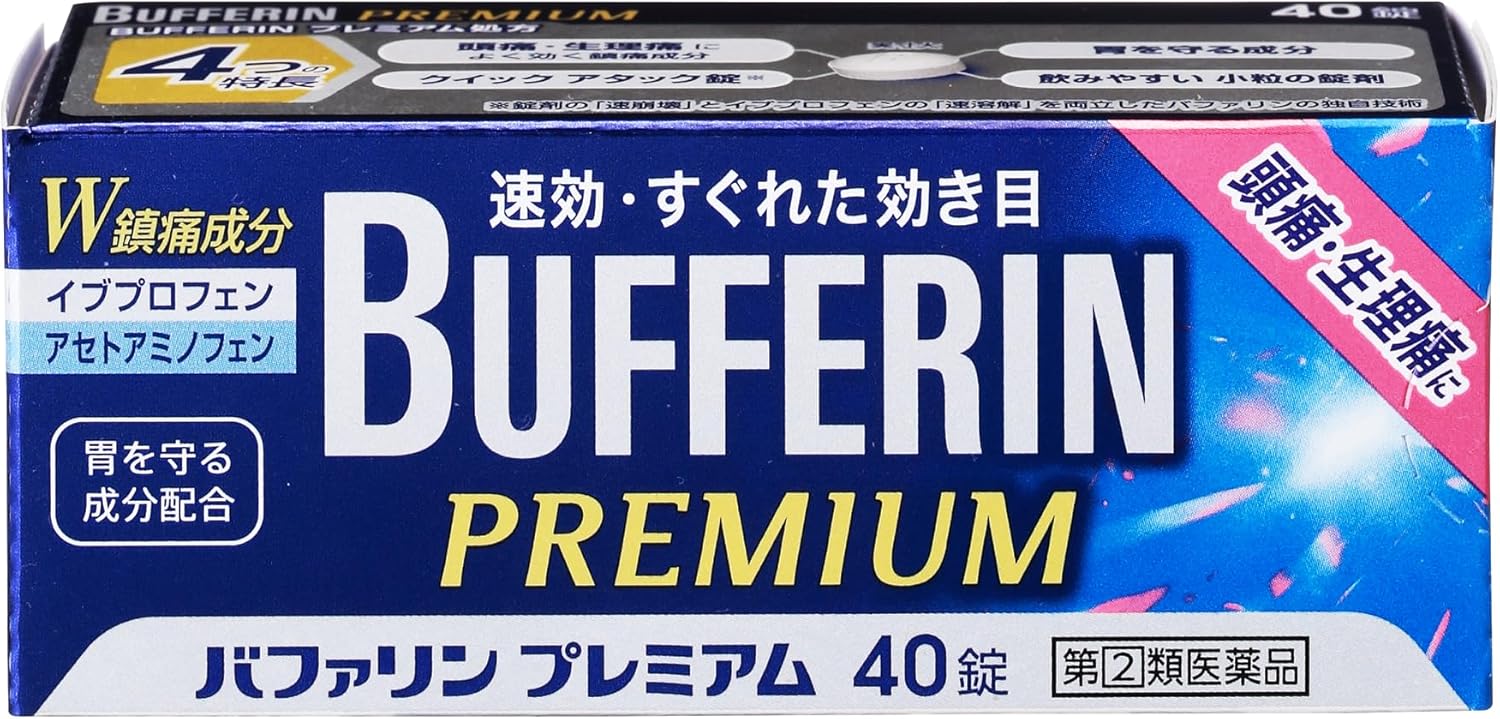
Active ingredients (per 2 tablets):
- Ibuprofen 130 mg
- Acetaminophen 130 mg
- Allylisopropylacetylurea 60 mg
- Anhydrous caffeine 80 mg
- Dried aluminum hydroxide gel 70 mg
Ages 15 and over. Under 15: Do not take this medicine.
- While taking this medicine, do not take other pain relievers/fever reducers, cold medicines, sedatives, or motion sickness medicines.
- Do not drive or operate machinery after taking it, as drowsiness may occur.
- Do not drink alcohol before or after taking it.
- Do not use it for a long period.
Bufferin Luna i

Active ingredients (per 2 tablets):
- Ibuprofen 130 mg
- Acetaminophen 130 mg
- Anhydrous caffeine 80 mg
- Dried aluminum hydroxide gel 70 mg
Ages 15 and over. Under 15: Do not take this medicine.
- While taking this medicine, do not take other pain relievers/fever reducers, cold medicines, or sedatives.
- Do not drink alcohol before or after taking it.
- Do not use it for a long period.
Directions & precautions
Active ingredients (per 2 tablets):
- Ibuprofen 130 mg
- Acetaminophen 130 mg
- Anhydrous caffeine 80 mg
- Dried aluminum hydroxide gel 70 mg
Inactive ingredients:
Hydroxypropyl cellulose, D-mannitol, lactic acid, magnesium stearate, polyvinyl alcohol (partially hydrolyzed), talc, titanium dioxide, glycerin fatty acid esters, sodium lauryl sulfate.
Uses:
Relief of headache, menstrual pain, pain from stiff shoulders, lower back pain, joint pain, nerve pain, muscle pain, sore throat, toothache, pain after tooth extraction, bruises, sprains, fractures, injuries, and earache. Fever reduction for chills and fever.
Instructions for use:
- Ages 15 and over: Take 2 tablets per dose with water or lukewarm water, up to 3 times a day. Leave at least 4 hours between doses.
- Under 15: Do not take this medicine.
- Avoid taking it on an empty stomach whenever possible.
- Follow the dosage directions strictly. Push the tablets through the foil backing of the blister pack and remove them before taking them. Swallowing the blister packaging can injure the lining of the esophagus.
Do not use:
- If you have had an allergic reaction to this medicine or any of its ingredients.
- If you have developed asthma after taking this medicine, another pain reliever/fever reducer, or a cold medicine.
- If you are under 15.
- If you are pregnant and within 12 weeks of your expected delivery date.
While taking this medicine, do not take other pain relievers/fever reducers, cold medicines, or sedatives. Do not drink alcohol before or after taking it. Do not use it for a long period.
Consult a doctor, dentist, pharmacist, or registered salesperson before use if you:
- Are receiving treatment from a doctor or dentist.
- Are pregnant or may be pregnant.
- Are breastfeeding.
- Are elderly.
- Have had an allergic reaction to a medicine or other substance.
- Have been diagnosed with heart disease, kidney disease, liver disease, systemic lupus erythematosus, or mixed connective tissue disease.
- Have a history of a stomach or duodenal ulcer, ulcerative colitis, or Crohn's disease.
When to stop and seek advice:
Stop taking this medicine immediately and consult a doctor, dentist, pharmacist, or registered salesperson with the package insert if you develop any of the following symptoms:
- Rash, redness, itching, or bruising.
- Nausea, vomiting, loss of appetite, stomach discomfort, stomach pain, mouth sores, heartburn, a heavy feeling in the stomach, gastrointestinal bleeding, abdominal pain, diarrhea, or bloody stools.
- Dizziness, palpitations, or shortness of breath.
- Blurred vision, ringing in the ears, swelling, nosebleeds, bleeding gums, bleeding that is difficult to stop, other bleeding, back pain, an excessive drop in body temperature, or fatigue.
Rare but serious reactions may occur. Seek medical attention immediately if you develop the following symptoms:
- Shock (anaphylaxis): Itchy skin, hives, a hoarse voice, sneezing, an itchy throat, difficulty breathing, palpitations, or clouded consciousness soon after taking the medicine.
- Severe skin reactions (Stevens-Johnson syndrome, toxic epidermal necrolysis, acute generalized exanthematous pustulosis): High fever, red eyes, eye discharge, sore lips, sore throat, widespread rash or redness, small pus-filled bumps on red skin, general fatigue, or loss of appetite that persists or suddenly worsens.
- Drug-induced hypersensitivity syndrome: Widespread skin redness, a rash over the whole body, fever, fatigue, or swollen lymph nodes, such as in the neck, armpits, or groin.
- Liver dysfunction: Fever, itching, rash, yellowing of the skin or whites of the eyes, brown urine, general fatigue, or loss of appetite.
- Kidney problems: Fever, rash, reduced urine output, swelling throughout the body, general fatigue, joint pain, or diarrhea.
- Aseptic meningitis: Severe headache with a stiff neck, fever, nausea, or vomiting. These symptoms have been reported particularly often in people being treated for systemic lupus erythematosus or mixed connective tissue disease.
- Heart attack: Tight chest pain, difficulty breathing, or cold sweats.
- Cerebrovascular disorder: Sudden reduced or lost consciousness, difficulty moving the limbs on one side, headache, vomiting, dizziness, difficulty speaking, or difficulty getting words out.
- Interstitial pneumonia: Shortness of breath or difficulty breathing when climbing stairs or with slight exertion, a dry cough, or fever that appears suddenly or persists.
- Asthma: Wheezing or difficulty breathing.
- Aplastic anemia: Bruising, nosebleeds, bleeding gums, fever, pale skin or mucous membranes, fatigue, palpitations, shortness of breath, feeling unwell and faint, or blood in the urine.
- Agranulocytosis: Sudden high fever, chills, or sore throat.
Constipation may occur. If it persists or worsens, stop taking this medicine and consult a doctor, pharmacist, or registered salesperson with the package insert.
If symptoms do not improve after 5 to 6 doses, stop taking this medicine and consult a doctor, dentist, pharmacist, or registered salesperson with the package insert.
Storage:
Store in a cool place with low humidity, away from direct sunlight. Keep out of reach of children. Do not transfer to another container, as this may cause misuse or affect the quality. Do not use after the expiry date. Do not damage the foil backing behind tablets you are not taking, as this may affect their quality.
Source: Japanese package insert (PDF) · Manufacturer product page
Translated from the Japanese insert, revised October 2024. Bufferin Luna i information checked September 28, 2026.
Loxonin S Premium

This is a Class 1 OTC medicine. Receive an explanation from a pharmacist and read the precautions before use.
Active ingredients (per 2 tablets):
- Loxoprofen sodium hydrate 68.1 mg (equivalent to 60 mg of anhydrous loxoprofen sodium)
- Allylisopropylacetylurea 60 mg
- Anhydrous caffeine 50 mg
- Magnesium aluminometasilicate 100 mg
Ages 15 and over. Under 15: Do not take this medicine.
- While taking this medicine, do not take other pain relievers/fever reducers, cold medicines, sedatives, or motion sickness medicines.
- Do not drive or operate machinery after taking it, as drowsiness may occur.
- Do not drink alcohol before or after taking it.
- Do not take it continuously for a long period.
- If pain or other symptoms keep recurring after 3 to 5 days of use, stop taking it and see a doctor.
Eve A

Active ingredients (per 2 tablets):
- Ibuprofen 150 mg
- Allylisopropylacetylurea 60 mg
- Anhydrous caffeine 80 mg
Ages 15 and over. Under 15: Do not take this medicine.
- While taking this medicine, do not take other pain relievers/fever reducers, cold medicines, sedatives, or motion sickness medicines.
- Do not drive or operate machinery after taking it, as drowsiness may occur.
- Do not drink alcohol before or after taking it.
- Do not use it for a long period.
Directions & precautions
Active ingredients (per 2 tablets):
- Ibuprofen 150 mg
- Allylisopropylacetylurea 60 mg
- Anhydrous caffeine 80 mg
Inactive ingredients:
Croscarmellose sodium, anhydrous silica, cellulose, hydroxypropyl cellulose, hypromellose, macrogol, magnesium stearate, talc, titanium dioxide.
Uses:
Relief of menstrual pain, headache, toothache, sore throat, joint pain, muscle pain, nerve pain, lower back pain, pain from stiff shoulders, pain after tooth extraction, bruises, earache, fractures, sprains, and injuries. Fever reduction for chills and fever.
Instructions for use:
- Ages 15 and over: Take 2 tablets per dose with water or lukewarm water, up to 3 times a day. Leave at least 4 hours between doses.
- Under 15: Do not take this medicine.
- Avoid taking it on an empty stomach whenever possible.
- Follow the dosage directions strictly. Push the tablets through the foil backing of the blister pack and remove them before taking them. Swallowing the blister packaging can injure the lining of the esophagus.
Do not use:
- If you have had an allergic reaction to this medicine or any of its ingredients.
- If you have developed asthma after taking this medicine, another pain reliever/fever reducer, or a cold medicine.
- If you are under 15.
- If you are pregnant and within 12 weeks of your expected delivery date.
While taking this medicine, do not take other pain relievers/fever reducers, cold medicines, sedatives, or motion sickness medicines. Do not drive or operate machinery after taking it, as drowsiness may occur. Do not drink alcohol before or after taking it. Do not use it for a long period.
Consult a doctor, dentist, pharmacist, or registered salesperson before use if you:
- Are receiving treatment from a doctor or dentist.
- Are pregnant or may be pregnant.
- Are breastfeeding.
- Are elderly.
- Have had an allergic reaction to a medicine or other substance.
- Have been diagnosed with heart disease, kidney disease, liver disease, systemic lupus erythematosus, or mixed connective tissue disease.
- Have a history of a stomach or duodenal ulcer, ulcerative colitis, or Crohn's disease.
When to stop and seek advice:
Stop taking this medicine immediately and consult a doctor, dentist, pharmacist, or registered salesperson with the package insert if you develop any of the following symptoms:
- Rash, redness, itching, or bruising.
- Nausea, vomiting, loss of appetite, stomach discomfort, stomach pain, mouth sores, heartburn, a heavy feeling in the stomach, gastrointestinal bleeding, abdominal pain, diarrhea, or bloody stools.
- Dizziness, palpitations, or shortness of breath.
- Blurred vision, ringing in the ears, swelling, nosebleeds, bleeding gums, bleeding that is difficult to stop, other bleeding, back pain, an excessive drop in body temperature, or fatigue.
Rare but serious reactions may occur. Seek medical attention immediately if you develop the following symptoms:
- Shock (anaphylaxis): Itchy skin, hives, a hoarse voice, sneezing, an itchy throat, difficulty breathing, palpitations, or clouded consciousness soon after taking the medicine.
- Severe skin reactions (Stevens-Johnson syndrome, toxic epidermal necrolysis): High fever, red eyes, eye discharge, sore lips, sore throat, or widespread rash or redness that persists or suddenly worsens.
- Liver dysfunction: Fever, itching, rash, yellowing of the skin or whites of the eyes, brown urine, general fatigue, or loss of appetite.
- Kidney problems: Fever, rash, reduced urine output, swelling throughout the body, general fatigue, joint pain, or diarrhea.
- Aseptic meningitis: Severe headache with a stiff neck, fever, nausea, or vomiting. These symptoms have been reported particularly often in people being treated for systemic lupus erythematosus or mixed connective tissue disease.
- Heart attack: Tight chest pain, difficulty breathing, or cold sweats.
- Cerebrovascular disorder: Sudden reduced or lost consciousness, difficulty moving the limbs on one side, headache, vomiting, dizziness, difficulty speaking, or difficulty getting words out.
- Asthma: Wheezing or difficulty breathing.
- Aplastic anemia: Bruising, nosebleeds, bleeding gums, fever, pale skin or mucous membranes, fatigue, palpitations, shortness of breath, feeling unwell and faint, or blood in the urine.
- Agranulocytosis: Sudden high fever, chills, or sore throat.
Constipation or drowsiness may occur. If these symptoms persist or worsen, stop taking this medicine and consult a doctor, pharmacist, or registered salesperson with the package insert.
If symptoms do not improve after 5 to 6 doses, stop taking this medicine and consult a doctor, dentist, pharmacist, or registered salesperson with the package insert.
Storage:
Store in a cool place with low humidity, away from direct sunlight. Keep out of reach of children. Do not transfer to another container, as this may cause misuse or affect the quality. Do not use after the expiry date.
Source: Japanese package insert (PDF) · Manufacturer product page
Translated from the Japanese insert, revised October 2024. Eve A information checked September 28, 2026.
Eve A EX

Active ingredients (per 2 tablets):
- Ibuprofen 200 mg
- Allylisopropylacetylurea 60 mg
- Anhydrous caffeine 80 mg
Ages 15 and over. Under 15: Do not take this medicine.
- While taking this medicine, do not take other pain relievers/fever reducers, cold medicines, sedatives, or motion sickness medicines.
- Do not drive or operate machinery after taking it, as drowsiness may occur.
- Do not drink alcohol before or after taking it.
- Do not use it for a long period.
Directions & precautions
Active ingredients (per 2 tablets):
- Ibuprofen 200 mg
- Allylisopropylacetylurea 60 mg
- Anhydrous caffeine 80 mg
Inactive ingredients:
Anhydrous silica, cellulose, croscarmellose sodium, polyvinyl alcohol-acrylic acid-methyl methacrylate copolymer, talc, magnesium stearate, hydroxypropyl cellulose, hypromellose, macrogol, titanium dioxide.
Uses:
Relief of menstrual pain, headache, toothache, sore throat, joint pain, muscle pain, nerve pain, lower back pain, pain from stiff shoulders, pain after tooth extraction, bruises, earache, fractures, sprains, and injuries. Fever reduction for chills and fever.
Instructions for use:
- Ages 15 and over: Take 2 tablets per dose with water or lukewarm water, up to 2 times a day. Leave at least 6 hours between doses.
- Under 15: Do not take this medicine.
- Avoid taking it on an empty stomach whenever possible.
- Follow the dosage directions strictly. Push the tablets through the foil backing of the blister pack and remove them before taking them. Swallowing the blister packaging can injure the lining of the esophagus.
Do not use:
- If you have had an allergic reaction to this medicine or any of its ingredients.
- If you have developed asthma after taking this medicine, another pain reliever/fever reducer, or a cold medicine.
- If you are under 15.
- If you are pregnant and within 12 weeks of your expected delivery date.
While taking this medicine, do not take other pain relievers/fever reducers, cold medicines, sedatives, or motion sickness medicines. Do not drive or operate machinery after taking it, as drowsiness may occur. Do not drink alcohol before or after taking it. Do not use it for a long period.
Consult a doctor, dentist, pharmacist, or registered salesperson before use if you:
- Are receiving treatment from a doctor or dentist.
- Are pregnant or may be pregnant.
- Are breastfeeding.
- Are elderly.
- Have had an allergic reaction to a medicine or other substance.
- Have been diagnosed with heart disease, kidney disease, liver disease, systemic lupus erythematosus, or mixed connective tissue disease.
- Have a history of a stomach or duodenal ulcer, ulcerative colitis, or Crohn's disease.
When to stop and seek advice:
Stop taking this medicine immediately and consult a doctor, dentist, pharmacist, or registered salesperson with the package insert if you develop any of the following symptoms:
- Rash, redness, itching, or bruising.
- Nausea, vomiting, loss of appetite, stomach discomfort, stomach pain, mouth sores, heartburn, a heavy feeling in the stomach, gastrointestinal bleeding, abdominal pain, diarrhea, or bloody stools.
- Dizziness, palpitations, or shortness of breath.
- Blurred vision, ringing in the ears, swelling, nosebleeds, bleeding gums, bleeding that is difficult to stop, other bleeding, back pain, an excessive drop in body temperature, or fatigue.
Rare but serious reactions may occur. Seek medical attention immediately if you develop the following symptoms:
- Shock (anaphylaxis): Itchy skin, hives, a hoarse voice, sneezing, an itchy throat, difficulty breathing, palpitations, or clouded consciousness soon after taking the medicine.
- Severe skin reactions (Stevens-Johnson syndrome, toxic epidermal necrolysis): High fever, red eyes, eye discharge, sore lips, sore throat, or widespread rash or redness that persists or suddenly worsens.
- Liver dysfunction: Fever, itching, rash, yellowing of the skin or whites of the eyes, brown urine, general fatigue, or loss of appetite.
- Kidney problems: Fever, rash, reduced urine output, swelling throughout the body, general fatigue, joint pain, or diarrhea.
- Aseptic meningitis: Severe headache with a stiff neck, fever, nausea, or vomiting. These symptoms have been reported particularly often in people being treated for systemic lupus erythematosus or mixed connective tissue disease.
- Heart attack: Tight chest pain, difficulty breathing, or cold sweats.
- Cerebrovascular disorder: Sudden reduced or lost consciousness, difficulty moving the limbs on one side, headache, vomiting, dizziness, difficulty speaking, or difficulty getting words out.
- Asthma: Wheezing or difficulty breathing.
- Aplastic anemia: Bruising, nosebleeds, bleeding gums, fever, pale skin or mucous membranes, fatigue, palpitations, shortness of breath, feeling unwell and faint, or blood in the urine.
- Agranulocytosis: Sudden high fever, chills, or sore throat.
Constipation or drowsiness may occur. If these symptoms persist or worsen, stop taking this medicine and consult a doctor, pharmacist, or registered salesperson with the package insert.
If symptoms do not improve after 3 to 4 doses, stop taking this medicine and consult a doctor, dentist, pharmacist, or registered salesperson with the package insert.
Storage:
Store in a cool place with low humidity, away from direct sunlight. Keep out of reach of children. Do not transfer to another container, as this may cause misuse or affect the quality. Do not use after the expiry date.
Source: Japanese package insert (PDF) · Manufacturer product page
Translated from the Japanese insert, revised October 2024. Eve A EX information checked September 28, 2026.
Eve Quick

Active ingredients (per 2 tablets):
- Ibuprofen 150 mg
- Magnesium oxide 100 mg
- Allylisopropylacetylurea 60 mg
- Anhydrous caffeine 80 mg
Ages 15 and over. Under 15: Do not take this medicine.
- While taking this medicine, do not take other pain relievers/fever reducers, cold medicines, sedatives, or motion sickness medicines.
- Do not drive or operate machinery after taking it, as drowsiness may occur.
- Do not drink alcohol before or after taking it.
- Do not use it for a long period.
Directions & precautions
Active ingredients (per 2 tablets):
- Ibuprofen 150 mg
- Magnesium oxide 100 mg
- Allylisopropylacetylurea 60 mg
- Anhydrous caffeine 80 mg
Inactive ingredients:
Anhydrous silica, cellulose, hydroxypropyl cellulose, hypromellose, macrogol, magnesium stearate, talc, titanium dioxide.
Uses:
Relief of headache, pain from stiff shoulders, toothache, menstrual pain, sore throat, joint pain, muscle pain, nerve pain, lower back pain, pain after tooth extraction, bruises, earache, fractures, sprains, and injuries. Fever reduction for chills and fever.
Instructions for use:
- Ages 15 and over: Take 2 tablets per dose with water or lukewarm water, up to 3 times a day. Leave at least 4 hours between doses.
- Under 15: Do not take this medicine.
- Avoid taking it on an empty stomach whenever possible.
- Follow the dosage directions strictly. Push the tablets through the foil backing of the blister pack and remove them before taking them. Swallowing the blister packaging can injure the lining of the esophagus.
Do not use:
- If you have had an allergic reaction to this medicine or any of its ingredients.
- If you have developed asthma after taking this medicine, another pain reliever/fever reducer, or a cold medicine.
- If you are under 15.
- If you are pregnant and within 12 weeks of your expected delivery date.
While taking this medicine, do not take other pain relievers/fever reducers, cold medicines, sedatives, or motion sickness medicines. Do not drive or operate machinery after taking it, as drowsiness may occur. Do not drink alcohol before or after taking it. Do not use it for a long period.
Consult a doctor, dentist, pharmacist, or registered salesperson before use if you:
- Are receiving treatment from a doctor or dentist.
- Are pregnant or may be pregnant.
- Are breastfeeding.
- Are elderly.
- Have had an allergic reaction to a medicine or other substance.
- Have been diagnosed with heart disease, kidney disease, liver disease, systemic lupus erythematosus, or mixed connective tissue disease.
- Have a history of a stomach or duodenal ulcer, ulcerative colitis, or Crohn's disease.
When to stop and seek advice:
Stop taking this medicine immediately and consult a doctor, dentist, pharmacist, or registered salesperson with the package insert if you develop any of the following symptoms:
- Rash, redness, itching, or bruising.
- Nausea, vomiting, loss of appetite, stomach discomfort, stomach pain, mouth sores, heartburn, a heavy feeling in the stomach, gastrointestinal bleeding, abdominal pain, diarrhea, or bloody stools.
- Dizziness, palpitations, or shortness of breath.
- Blurred vision, ringing in the ears, swelling, nosebleeds, bleeding gums, bleeding that is difficult to stop, other bleeding, back pain, an excessive drop in body temperature, or fatigue.
Rare but serious reactions may occur. Seek medical attention immediately if you develop the following symptoms:
- Shock (anaphylaxis): Itchy skin, hives, a hoarse voice, sneezing, an itchy throat, difficulty breathing, palpitations, or clouded consciousness soon after taking the medicine.
- Severe skin reactions (Stevens-Johnson syndrome, toxic epidermal necrolysis): High fever, red eyes, eye discharge, sore lips, sore throat, or widespread rash or redness that persists or suddenly worsens.
- Liver dysfunction: Fever, itching, rash, yellowing of the skin or whites of the eyes, brown urine, general fatigue, or loss of appetite.
- Kidney problems: Fever, rash, reduced urine output, swelling throughout the body, general fatigue, joint pain, or diarrhea.
- Aseptic meningitis: Severe headache with a stiff neck, fever, nausea, or vomiting. These symptoms have been reported particularly often in people being treated for systemic lupus erythematosus or mixed connective tissue disease.
- Heart attack: Tight chest pain, difficulty breathing, or cold sweats.
- Cerebrovascular disorder: Sudden reduced or lost consciousness, difficulty moving the limbs on one side, headache, vomiting, dizziness, difficulty speaking, or difficulty getting words out.
- Asthma: Wheezing or difficulty breathing.
- Aplastic anemia: Bruising, nosebleeds, bleeding gums, fever, pale skin or mucous membranes, fatigue, palpitations, shortness of breath, feeling unwell and faint, or blood in the urine.
- Agranulocytosis: Sudden high fever, chills, or sore throat.
Constipation or drowsiness may occur. If these symptoms persist or worsen, stop taking this medicine and consult a doctor, pharmacist, or registered salesperson with the package insert.
If symptoms do not improve after 5 to 6 doses, stop taking this medicine and consult a doctor, dentist, pharmacist, or registered salesperson with the package insert.
Storage:
Store in a cool place with low humidity, away from direct sunlight. Keep out of reach of children. Do not transfer to another container, as this may cause misuse or affect the quality. Do not use after the expiry date.
Source: Japanese package insert (PDF) · Manufacturer product page
Translated from the Japanese insert, revised October 2024. Eve Quick information checked September 28, 2026.
Eve Quick DX

Active ingredients (per 2 tablets):
- Ibuprofen 200 mg
- Magnesium oxide 100 mg
- Allylisopropylacetylurea 60 mg
- Anhydrous caffeine 80 mg
Ages 15 and over. Under 15: Do not take this medicine.
- While taking this medicine, do not take other pain relievers/fever reducers, cold medicines, sedatives, or motion sickness medicines.
- Do not drive or operate machinery after taking it, as drowsiness may occur.
- Do not drink alcohol before or after taking it.
- Do not use it for a long period.
Directions & precautions
Active ingredients (per 2 tablets):
- Ibuprofen 200 mg
- Magnesium oxide 100 mg
- Allylisopropylacetylurea 60 mg
- Anhydrous caffeine 80 mg
Inactive ingredients:
Anhydrous silica, cellulose, hydroxypropyl cellulose, hypromellose, crospovidone, macrogol, magnesium stearate, talc, titanium dioxide, sodium lauryl sulfate.
Uses:
Relief of headache, pain from stiff shoulders, toothache, menstrual pain, sore throat, joint pain, muscle pain, nerve pain, lower back pain, pain after tooth extraction, bruises, earache, fractures, sprains, and injuries. Fever reduction for chills and fever.
Instructions for use:
- Ages 15 and over: Take 2 tablets per dose with water or lukewarm water, up to 2 times a day. Leave at least 6 hours between doses.
- Under 15: Do not take this medicine.
- Avoid taking it on an empty stomach whenever possible.
- Follow the dosage directions strictly. Push the tablets through the foil backing of the blister pack and remove them before taking them. Swallowing the blister packaging can injure the lining of the esophagus.
Do not use:
- If you have had an allergic reaction to this medicine or any of its ingredients.
- If you have developed asthma after taking this medicine, another pain reliever/fever reducer, or a cold medicine.
- If you are under 15.
- If you are pregnant and within 12 weeks of your expected delivery date.
While taking this medicine, do not take other pain relievers/fever reducers, cold medicines, sedatives, or motion sickness medicines. Do not drive or operate machinery after taking it, as drowsiness may occur. Do not drink alcohol before or after taking it. Do not use it for a long period.
Consult a doctor, dentist, pharmacist, or registered salesperson before use if you:
- Are receiving treatment from a doctor or dentist.
- Are pregnant or may be pregnant.
- Are breastfeeding.
- Are elderly.
- Have had an allergic reaction to a medicine or other substance.
- Have been diagnosed with heart disease, kidney disease, liver disease, systemic lupus erythematosus, or mixed connective tissue disease.
- Have a history of a stomach or duodenal ulcer, ulcerative colitis, or Crohn's disease.
When to stop and seek advice:
Stop taking this medicine immediately and consult a doctor, dentist, pharmacist, or registered salesperson with the package insert if you develop any of the following symptoms:
- Rash, redness, itching, or bruising.
- Nausea, vomiting, loss of appetite, stomach discomfort, stomach pain, mouth sores, heartburn, a heavy feeling in the stomach, gastrointestinal bleeding, abdominal pain, diarrhea, or bloody stools.
- Dizziness, palpitations, or shortness of breath.
- Blurred vision, ringing in the ears, swelling, nosebleeds, bleeding gums, bleeding that is difficult to stop, other bleeding, back pain, an excessive drop in body temperature, or fatigue.
Rare but serious reactions may occur. Seek medical attention immediately if you develop the following symptoms:
- Shock (anaphylaxis): Itchy skin, hives, a hoarse voice, sneezing, an itchy throat, difficulty breathing, palpitations, or clouded consciousness soon after taking the medicine.
- Severe skin reactions (Stevens-Johnson syndrome, toxic epidermal necrolysis): High fever, red eyes, eye discharge, sore lips, sore throat, or widespread rash or redness that persists or suddenly worsens.
- Liver dysfunction: Fever, itching, rash, yellowing of the skin or whites of the eyes, brown urine, general fatigue, or loss of appetite.
- Kidney problems: Fever, rash, reduced urine output, swelling throughout the body, general fatigue, joint pain, or diarrhea.
- Aseptic meningitis: Severe headache with a stiff neck, fever, nausea, or vomiting. These symptoms have been reported particularly often in people being treated for systemic lupus erythematosus or mixed connective tissue disease.
- Heart attack: Tight chest pain, difficulty breathing, or cold sweats.
- Cerebrovascular disorder: Sudden reduced or lost consciousness, difficulty moving the limbs on one side, headache, vomiting, dizziness, difficulty speaking, or difficulty getting words out.
- Asthma: Wheezing or difficulty breathing.
- Aplastic anemia: Bruising, nosebleeds, bleeding gums, fever, pale skin or mucous membranes, fatigue, palpitations, shortness of breath, feeling unwell and faint, or blood in the urine.
- Agranulocytosis: Sudden high fever, chills, or sore throat.
Constipation or drowsiness may occur. If these symptoms persist or worsen, stop taking this medicine and consult a doctor, pharmacist, or registered salesperson with the package insert.
If symptoms do not improve after 3 to 4 doses, stop taking this medicine and consult a doctor, dentist, pharmacist, or registered salesperson with the package insert.
Storage:
Store in a cool place with low humidity, away from direct sunlight. Keep out of reach of children. Do not transfer to another container, as this may cause misuse or affect the quality. Do not use after the expiry date.
Source: Japanese package insert (PDF) · Manufacturer product page
Translated from the Japanese insert, revised October 2024. Eve Quick DX information checked September 28, 2026.