Public transportation in Japan is extremely convenient, so much so that many people do not even have a driver's license, let alone a car. You can go almost anywhere in the country using public transport, so don't let your lack of a car or friend with a license keep you from exploring.
Check out this section to learn more about Japan's railways, train lines and schedules in your area, how to buy a train ticket, and how to use the bus.
Public transportation in Japan is far more advanced than in other countries, and owning a car is unnecessary in urban and suburban areas. For more information on the railways in your area, check out the English sites below. You can find rail maps, schedules, fare information, and other information on the train lines near you.
Getting around in Japan is easy, and train passes make this even easier. In addition to forgoing the need to buy physical tickets, train fares are actually cheaper if you use an IC (integrated circuit) Card train pass.
Physical IC cards cost ¥1,000 to purchase (¥500 deposit + ¥500 usable balance), and you can top them up at ticket and charging machines throughout stations. Cash is accepted at all machines; some machines may also accept credit or debit cards depending on the station. Most machines have an English option — if you're unsure how to use one, switch it to English first.
Smartphone-based IC cards such as Mobile Suica and Mobile PASMO are also available. Please check each service's official website for the latest setup instructions and supported devices, as availability may vary.
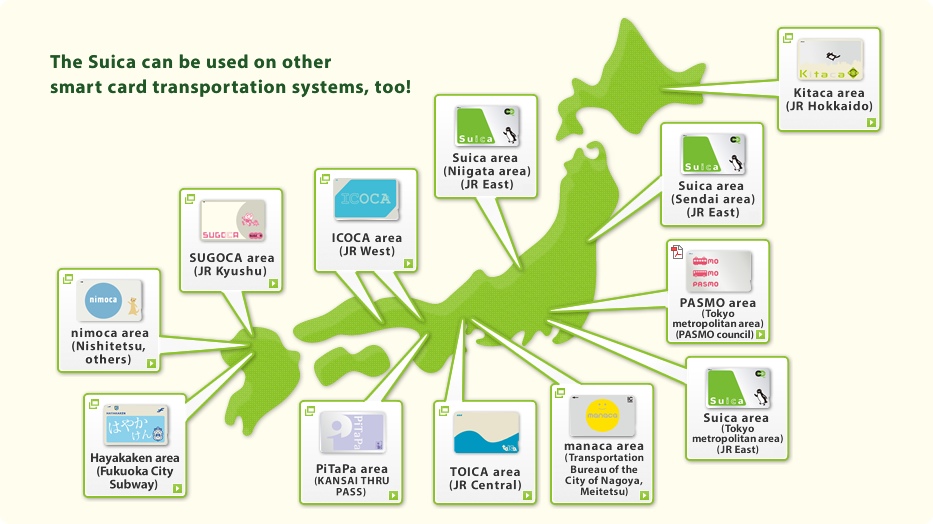
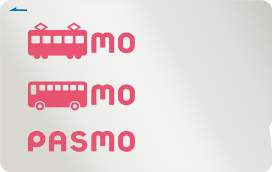
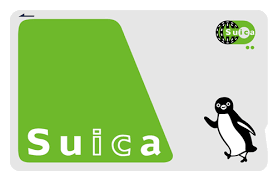
The following cards are the most popular nationally:
※ To learn more about these cards, please visit the English sites listed beneath the pictures.
Using IC Cards
When using for trains and buses, simply touch the card to the blue IC sensor at the ticket gate (for trains), or touch the card to the blue IC sensor when you get on, and again when you get off (for buses). Some taxis may also accept IC Cards — look for the IC sensor inside the cab.
IC Cards can also be used to make purchases at convenience stores, vending machines, restaurants near stations, and coin lockers in large stations.
Buying Train Tickets
Most ticket machines these days have an English option, but in the event that the station you're using does not have English-capable ticket machines, the following steps are pretty universal.
Find the station you are going to on the map above the ticket machines and take note of the cost. If you are buying an adult ticket, the more expensive price will be the adult cost.
Put your money in the ticket machine and select the fare cost you're looking for.
If you are NOT changing train lines at any point between boarding and your last stop, you can select the fare directly from this screen.
If you WILL need to change train lines at any point between boarding and your last stop, please tap the Transfer Ticket (私鉄のりかえ) button, select the fare cost, select the station at which you will transfer, and the ticket will be dispensed.
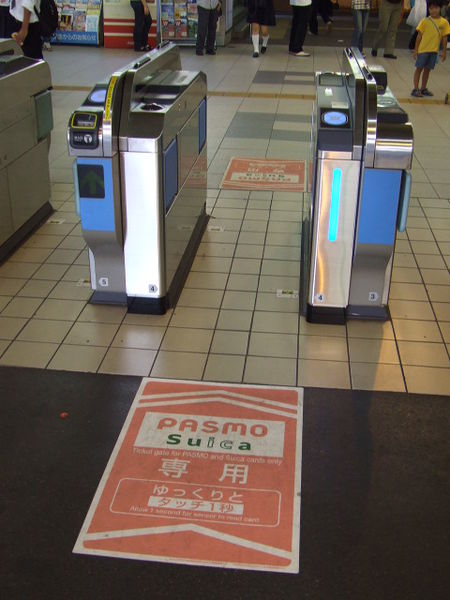
※ When using physical tickets instead of an IC Card, be sure to check the ticket gate you are lining up for, as not all gates accept tickets these days. The number of IC ONLY gates are increasing, so please be careful.
The left gate in this picture is for use of physical tickets AND IC Cards. The right gate is IC ONLY.
Japanese
Romaji
English
電車 でんしゃ
Densha
Train
きっぷ
Kippu
Ticket
改札 かいさつ
Kaisatsu
Ticket gate
IC専用 ICせんよう
IC senyou
IC ONLY
乗る のる
Noru
Get on (train, bus, etc.)
降りる おりる
Oriru
Get off (train, bus, etc.)
乗り換え のりかえ
Norikae
Change trains / transfer
乗車 じょうしゃ
Jousha
Boarding
降車 こうしゃ
Kousha
Disembarking (getting off)
発車 はっしゃ
Hassha
Departing, moving again after stopping
Taking the Bus
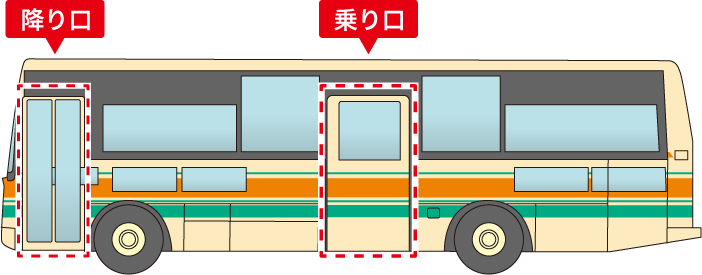
When you take a bus, the door to board will be either at the front or middle, depending on the company. If you're not sure which door is for boarding, check where other people are going. The following are the steps for riding the bus.
Step 1
After determining which door is for boarding, get on the bus.
Step 2
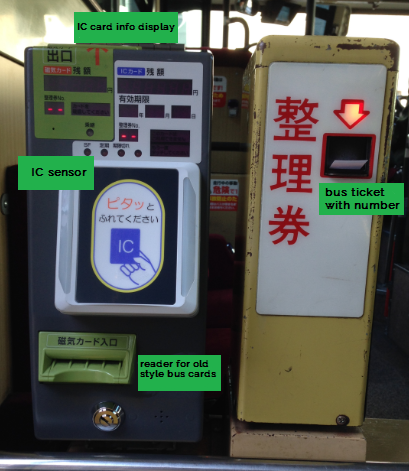
In the doorway, there will be a machine with a ticket, and maybe a blue IC Card sensor. Not every bus is equipped with IC capability, so do not depend on your card every time you take the bus. Always have cash on hand.
If there is an IC Card sensor, touch your IC Card to it to register yourself as a passenger.
If you cannot or do not use an IC Card, take the paper ticket from the machine. Do not lose it. This ticket has a number on it that will determine your fare. Take your seat. (If you used an IC Card, skip to Step 5.)
Step 3
When the driver announces the name of a bus stop, there will be a stop soon.
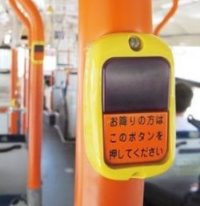
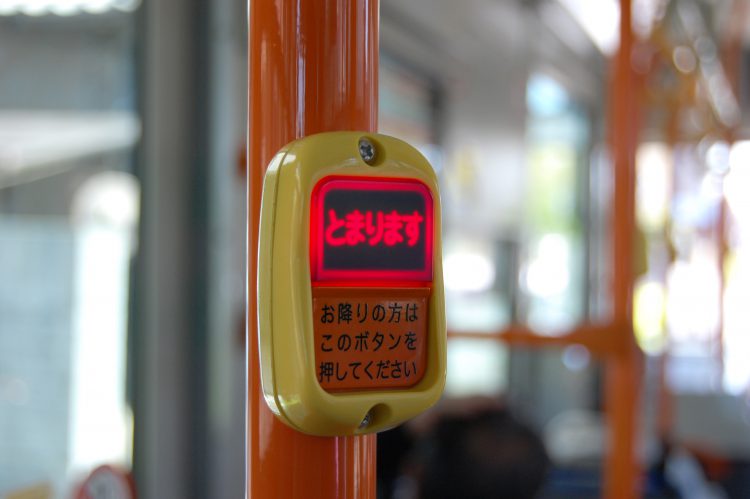
Push a "disembark" (とまります) button to let the driver know you are getting off at the stop he just announced.
If no one pushes a button before a given stop, the driver will not stop the bus, so listen carefully.
Step 4
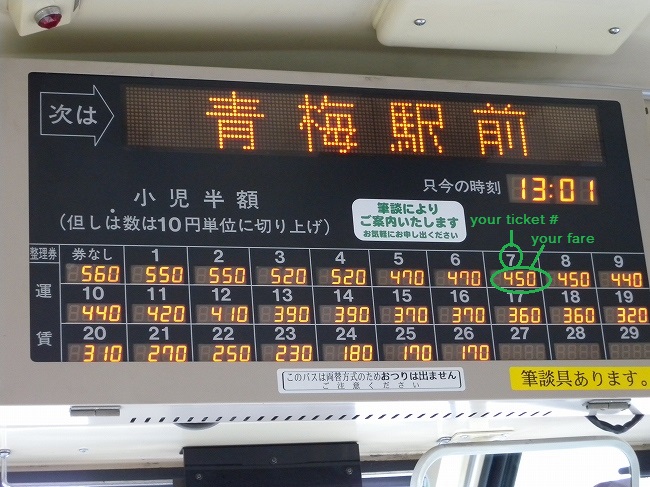
There will be a board at the front with ticket numbers and fares.
When the bus is about to make your stop, check the board for your number, and get your change ready.
Step 5
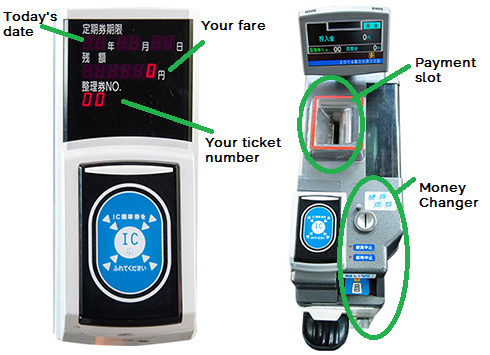
When the bus stops, go to the exit door and put your money in the machine.
If you do not have exact change, it's no problem. Just put your money in the money changer, collect your coins, and put exact change in the payment slot.
If you boarded with an IC Card, tap your card on the sensor.
Step 6
Say "Thank you." (ありがとうございます) to the driver and get off the bus. Watch your step!
Japanese
Romaji
English
バス
Basu
Bus
乗車口 じょうしゃぐち
Joushaguchi
Door for boarding
降車口 こうしゃぐち
Koushaguchi
Door for disembarking (getting off)
整理券 せいりけん
Seiriken
Bus ticket (taken on boarding, not bought in advance)
優先席 ゆうせんせき
Yuusenseki
Priority seating (for the elderly, injured, handicapped, and pregnant)