Hay fever, seasonal allergies, or a reaction to plants you never met before moving to Japan: allergy medicine is good to have on hand. Here are the pills, eye drops and eye wash sold at Japanese drugstores, each with its Japanese name so you can match it to the box. Use the tabs to see one type, or scroll to see them all.

Looking for more detailed info? OTC Guide Japan — Allergy has more products, full ingredient breakdowns, and dosage guides.
Allergy Medicines
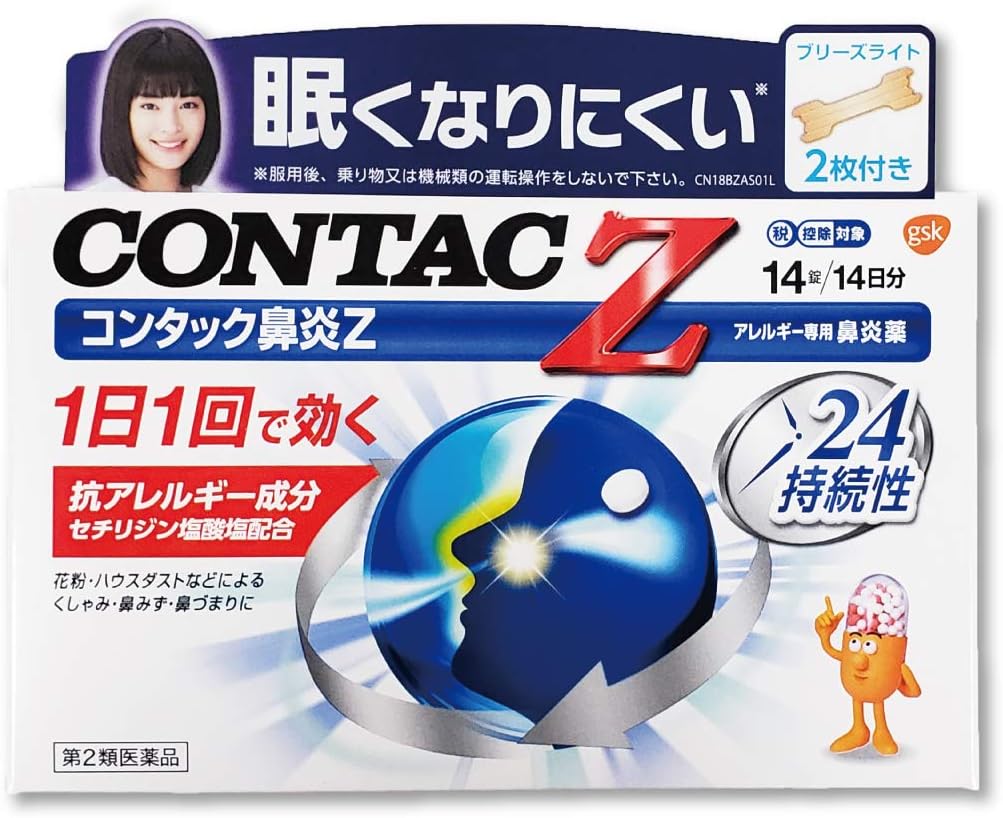
Contac Z
コンタック鼻炎Z
Uses:
Relief of these nasal allergy symptoms caused by pollen, house dust, and similar: sneezing, runny nose, and stuffy nose. The insert is headed 新コンタック鼻炎Z and calls it an allergy-only rhinitis medicine (アレルギー専用鼻炎薬), taken once a day before bed, with a second-generation antihistamine ingredient. The tablet is small, about 7 mm across.
Active ingredient (per tablet):
- Cetirizine hydrochloride (セチリジン塩酸塩) 10 mg, which holds back sneezing, runny nose, and stuffy nose from pollen and house dust
Ages 15 and over. Under 15: Do not take this medicine.
- Do not take it with other allergy medicines, oral antihistamines, or medicines that contain theophylline, ritonavir, or pilsicainide.
- Do not drive or operate machinery after taking it. Drowsiness may occur.
- Do not drink alcohol before or after taking it.
- If you are breastfeeding, do not take it, or avoid breastfeeding while you take it.
- If symptoms have not improved after about 1 week, stop and consult a doctor, pharmacist, or registered salesperson.
View on Amazon Japan
Directions & precautions
Classification:
Class 2 medicine (第2類医薬品). Sold with a pharmacist or registered salesperson on duty; you can take it off the shelf yourself.
Do not take:
- If you have had an allergic reaction to this medicine, its ingredients, or a piperazine derivative (including levocetirizine and hydroxyzine).
- If you have been diagnosed with kidney disease.
- If you are under 15.
Do not take with:
- Other allergy medicines (including skin medicines and oral rhinitis medicines), and oral medicines that contain an antihistamine (cold medicines, cough and phlegm medicines, motion sickness medicines, sleep aids and sedatives, and so on). Also, oral medicines that contain theophylline, ritonavir, or pilsicainide hydrochloride hydrate.
Do not:
- Drive or operate machinery after taking it. Drowsiness may occur.
- Breastfeed. If you are breastfeeding, do not take it, or avoid breastfeeding while you take it.
- Drink alcohol before or after taking it.
Instructions for use:
Take the dose below with water or hot water.
- Ages 15 and over: Take 1 tablet once a day, before going to bed.
- Under 15: Do not take this medicine.
- Follow the dosage directions strictly.
- For seasonal allergic rhinitis such as hay fever, starting early works best: begin once the pollen season arrives and your symptoms first appear, while they are still mild.
- Press the raised part of the tablet on the blister sheet firmly with your fingertip to break the foil on the back, then take the tablet out. Swallowing the sheet by mistake can pierce the esophagus and cause an accident.
Inactive ingredients:
Lactose, hydroxypropylcellulose, hypromellose, macrogol, titanium oxide, magnesium stearate, cellulose, silicic anhydride.
Consult a doctor, pharmacist, or registered salesperson before use if you:
- Are receiving treatment from a doctor.
- Have been diagnosed with liver disease or epilepsy.
- Have had a convulsion.
- Are pregnant or may be pregnant.
- Are elderly.
- Have had an allergic reaction to a medicine or other substance.
- Are not sure whether your symptoms come from an allergy or another cause.
- Have been diagnosed with asthma, atopic dermatitis, or another allergic disease.
When to stop and seek advice:
If any of the following appear after taking this medicine, they may be side effects. Stop taking it at once and consult a doctor, pharmacist, or registered salesperson, taking the package insert with you:
- Nervous system: Fatigue, headache, a heavy head, light-headedness, numbness, dizziness, a floating feeling, insomnia, tremor, depression, suicidal thoughts, agitation, aggression, a lack of strength, abnormal sensations, hallucinations, involuntary body movements, loss of consciousness, memory loss, or nightmares.
- Digestive: Nausea, vomiting, loss of appetite, stomach discomfort, indigestion, abdominal pain, stomach pain, inflamed or dry lips, abnormal taste, mouth sores, a bloated abdomen, increased appetite, or a swollen tongue.
- Circulation: Palpitations, higher blood pressure, or an irregular pulse.
- Skin: Rash, redness, hives, swelling, rash from contact, itching, or blisters.
- Eyes: Redness, blurred vision, abnormal eye movements, or swollen eyelids.
- Respiratory: Shortness of breath or cough.
- Urinary: Protein or sugar in the urine, frequent urination, blood in the urine, difficulty urinating, or incontinence.
- Other: Ringing in the ears, abnormal periods, chest pain, flushing, joint pain, stiff hands and feet, abnormal sense of smell, nosebleed, hair loss, weight gain, muscle pain, or fever.
Rare but serious reactions may occur. Seek medical attention immediately if you develop the following symptoms:
- Shock (anaphylaxis): Itchy skin, hives, a hoarse voice, sneezing, an itchy throat, difficulty breathing, palpitations, or clouded consciousness soon after taking the medicine.
- Convulsions: Sudden, attack-like muscle contractions.
- Liver damage: Fever, itching, rash, jaundice (yellow skin and whites of the eyes), brown urine, fatigue, or loss of appetite.
- Low platelets: A drop in blood platelets can cause nosebleeds, bleeding gums, bruising, and other signs of bleeding.
If dry mouth, constipation, diarrhea, or drowsiness appears and keeps up or gets worse, stop taking this medicine and consult a doctor, pharmacist, or registered salesperson, taking the package insert with you.
If your symptoms have not improved after about 1 week, or if you will take it for more than 2 weeks even though they have improved, consult a doctor, pharmacist, or registered salesperson, taking the package insert with you.
Storage:
Store in a cool, dry place out of direct sunlight. Keep out of reach of children. Do not transfer it to another container, as this may cause misuse or affect the quality. Do not use it after the expiry date.
Source: Japanese package insert (PDF) · Manufacturer product page
Translated from the Japanese insert (no revision date is printed on it) and the product page. Contac Z information checked October 2, 2026.
Allegra FX
アレグラFX

Uses:
Relief of these nasal allergy symptoms caused by pollen, house dust, and similar: sneezing, runny nose, and stuffy nose. The insert calls it an allergy-only rhinitis medicine with a second-generation antihistamine, fexofenadine hydrochloride. It says the medicine is less likely to cause drowsiness and to cause "impaired performance" (a drop in concentration, judgment, and work efficiency), and that it can be taken on an empty stomach.
Active ingredient (per daily dose of 2 tablets):
- Fexofenadine hydrochloride (フェキソフェナジン塩酸塩) 120 mg
Ages 15 and over. Under 15: Do not take this medicine.
- Do not take it with other allergy medicines, oral antihistamines, antacids that contain aluminum or magnesium hydroxide, erythromycin, or apalutamide.
- Do not drink alcohol before or after taking it.
- If you are breastfeeding, do not take it, or avoid breastfeeding while you take it.
- Consult a doctor, pharmacist, or registered salesperson before use if you have a strongly blocked nose, or are not sure the symptoms are allergic rhinitis.
- If symptoms have not improved after 1 week, stop and consult a doctor, pharmacist, or registered salesperson.
View on Amazon Japan
Directions & precautions
Classification:
Class 2 medicine (第2類医薬品). Sold with a pharmacist or registered salesperson on duty; you can take it off the shelf yourself.
Do not take:
- If you have had an allergic reaction to this medicine or any of its ingredients.
- If you are under 15.
Do not take with:
- Other allergy medicines (including skin medicines and oral rhinitis medicines), and oral medicines that contain an antihistamine (cold medicines, cough and phlegm medicines, motion sickness medicines, sleep aids and sedatives, and so on).
- Antacids that contain aluminum hydroxide or magnesium hydroxide.
- Erythromycin (an antibiotic).
- Apalutamide (a prostate cancer medicine). (Added in the manufacturer's revision of 2024.)
Do not:
- Drink alcohol before or after taking it.
- Breastfeed. If you are breastfeeding, do not take it, or avoid breastfeeding while you take it. Transfer into breast milk was seen in animal studies.
Instructions for use:
Take the dose below in the morning and in the evening.
- Ages 15 and over: Take 1 tablet per dose, 2 times a day (morning and evening).
- Under 15: Do not take this medicine.
- Follow the dosage directions strictly.
- Taking it every day is what gives the effect.
- It can be taken on an empty stomach.
- For seasonal allergic rhinitis such as hay fever, starting early works best: begin from the predicted start of the pollen season, or as soon as your symptoms start.
- Press the raised part of the tablet on the blister sheet firmly with your fingertip to break the foil on the back, then take the tablet out. Swallowing the sheet by mistake can pierce the esophagus and cause an accident.
Inactive ingredients:
Crystalline cellulose, partially pregelatinized starch, croscarmellose sodium, magnesium stearate, light anhydrous silicic acid, hypromellose, povidone, titanium oxide, macrogol 400, iron sesquioxide, yellow iron sesquioxide.
Consult a doctor, pharmacist, or registered salesperson before use if you:
- Are receiving treatment from a doctor.
- Are not sure whether your symptoms come from allergic rhinitis or another cause such as a cold.
- Have been diagnosed with asthma, atopic dermatitis, or another allergic disease.
- Have a severe stuffy nose.
- Are pregnant or may be pregnant.
- Are elderly.
- Have had an allergic reaction to a medicine or other substance.
When to stop and seek advice:
If any of the following appear after taking this medicine, they may be side effects. Stop taking it at once and consult a doctor, pharmacist, or registered salesperson, taking the package insert with you:
- Skin: Swelling of the throat, eyelids, or lips, rash, itching, hives, or redness.
- Digestive: Nausea, vomiting, abdominal pain, or indigestion.
- Nervous system: Numbness, headache, fatigue, a worn-out feeling, dizziness, insomnia, nervousness, nightmares, or sleep disturbance.
- Urinary: Frequent urination or difficulty urinating.
- Other: Palpitations, abnormal taste, swelling, chest pain, difficulty breathing, higher blood pressure, or abnormal periods.
Rare but serious reactions may occur. Seek medical attention immediately if you develop the following symptoms:
- Shock (anaphylaxis): Itchy skin, hives, a hoarse voice, sneezing, an itchy throat, difficulty breathing, palpitations, or clouded consciousness soon after taking the medicine.
- Liver damage: Fever, itching, rash, jaundice (yellow skin and whites of the eyes), brown urine, fatigue, or loss of appetite.
- Agranulocytosis, low white blood cells, low neutrophils: Sudden high fever, chills, or a sore throat.
If dry mouth, constipation, diarrhea, or drowsiness appears and keeps up or gets worse, stop taking this medicine and consult a doctor, pharmacist, or registered salesperson, taking the package insert with you.
If your symptoms have not improved after about 1 week, or if you will take it for more than 2 weeks even though they have improved, consult a doctor, pharmacist, or registered salesperson, taking the package insert with you.
Storage:
Store in a cool, dry place out of direct sunlight. Keep out of reach of children. Do not transfer it to another container, as this may cause misuse or affect the quality. Do not use it after the expiry date.
Source: Japanese package insert (PDF) · Manufacturer product page
Translated from the Japanese insert (revised May 2024) and the product page. Allegra FX information checked October 2, 2026.
Pabron Rhinitis Capsule Sα
パブロン鼻炎カプセルSα

Uses:
Relief of these symptoms from acute rhinitis, allergic rhinitis, or sinusitis (副鼻腔炎): sneezing, runny nose (excess nasal discharge), stuffy nose, watery eyes, sore throat, and a heavy head (頭重). The insert calls it a rhinitis medicine taken twice a day. The white granules in the capsule dissolve quickly and start working, and the orange granules dissolve slowly and work later.
Active ingredients (per 2 capsules, the dose):
- Pseudoephedrine hydrochloride (塩酸プソイドエフェドリン) 60 mg, narrows blood vessels to reduce swelling of the nasal lining and ease a stuffy nose
- Carbinoxamine maleate (マレイン酸カルビノキサミン) 6 mg, an antihistamine that holds back sneezing, runny nose, and stuffiness
- Belladonna total alkaloids (ベラドンナ総アルカロイド), reduce secretions, which dries a runny nose and eases watery eyes 0.2 mg
- Anhydrous caffeine (無水カフェイン), relieves the heavy head that comes with rhinitis 50 mg
Ages 15 and over. Under 15: Do not take this medicine.
- Do not take it with other oral rhinitis medicines, oral medicines that contain an antihistamine, oral medicines that contain pseudoephedrine, or stomach and intestinal antispasmodics.
- Do not drive or operate machinery after taking it. Drowsiness, blurred vision, or unusual sensitivity to glare may occur.
- Do not take it for a long time, or take more than the dose.
- Do not take it if you have difficulty urinating from an enlarged prostate, or have been diagnosed with high blood pressure, heart disease, a thyroid disorder, or diabetes.
- If symptoms have not improved after 5 to 6 days, stop taking it and consult a doctor, pharmacist, or registered salesperson.
View on Amazon Japan
Directions & precautions
Classification:
Designated Class 2 medicine (指定第2類医薬品). The Taisho catalog lists it as 指定第2類医薬品, and so does the Amazon listing.
Do not take:
- If you have had an allergic reaction to this medicine or any of its ingredients.
- If you have difficulty urinating because of an enlarged prostate.
- If you have been diagnosed with high blood pressure, heart disease, a thyroid disorder, or diabetes.
- If you are under 15.
Do not take with:
- Other oral rhinitis medicines.
- Oral medicines that contain an antihistamine (cold medicines, cough and phlegm medicines, motion sickness medicines, allergy medicines, and so on).
- Oral medicines that contain pseudoephedrine hydrochloride or pseudoephedrine sulfate.
- Stomach and intestinal antispasmodics (胃腸鎮痛鎮痙薬).
Do not:
- Drive or operate machinery after taking it. Drowsiness, blurred vision, or unusual sensitivity to glare may occur.
- Take it for a long time.
- Take more than the dose. (This item was added in the manufacturer's revision of May 2026.)
Instructions for use:
Take the dose below every 12 hours, with water or lukewarm water.
- Ages 15 and over: Take 2 capsules per dose, 2 times a day.
- Under 15: Do not take this medicine.
- Follow the dosage directions strictly.
- Press the raised part of the capsule on the blister sheet firmly with your fingertip to break the foil on the back, then take the capsule out. Swallowing the sheet by mistake can pierce the esophagus and cause an accident.
Inactive ingredients:
Aluminum magnesium metasilicate, sucrose, corn starch, hydroxypropylcellulose, magnesium stearate, cellulose, talc, ammonioalkyl methacrylate copolymer, stearyl alcohol, sorbitan trioleate, Yellow No. 5, gelatin, sodium lauryl sulfate.
Consult a doctor, pharmacist, or registered salesperson before use if you:
- Are receiving treatment from a doctor.
- Are pregnant or may be pregnant.
- Are breastfeeding.
- Are elderly.
- Have had an allergic reaction to a medicine or other substance.
- Have had insomnia, dizziness, a weak feeling, tremor, or palpitations from a cold medicine, cough and phlegm medicine, or oral rhinitis medicine.
- Have a high fever or difficulty urinating.
- Have been diagnosed with glaucoma or kidney disease.
- Are being treated with a monoamine oxidase inhibitor such as selegiline hydrochloride (used to treat Parkinson's disease).
When to stop and seek advice:
If any of the following appear after taking this medicine, they may be side effects. Stop taking it at once and consult a doctor, pharmacist, or registered salesperson, taking the package insert with you:
- Skin: Rash, redness, or itching.
- Digestive: Nausea, vomiting, or loss of appetite.
- Nervous system: Dizziness, insomnia, nervousness, headache, or convulsions.
- Urinary: Difficulty urinating.
- Other: Facial flushing or unusual sensitivity to glare.
Rare but serious reactions may occur. Seek medical attention immediately if you develop the following symptoms:
- Acute generalized exanthematous pustulosis: High fever, a widespread rash or redness of the skin, small pustules on the red skin, fatigue, or loss of appetite that persist or suddenly get worse.
If dry mouth, drowsiness, constipation, or blurred vision appears and keeps up or gets worse, stop taking this medicine and consult a doctor, pharmacist, or registered salesperson, taking the package insert with you.
If symptoms have not improved after 5 to 6 days of taking it, stop and consult a doctor, pharmacist, or registered salesperson, taking the package insert with you.
Storage:
Store in a cool, dry place out of direct sunlight. Keep out of reach of children. Do not transfer it to another container, as this may cause misuse or affect the quality. Do not use it after the expiry date. Even before the expiry date, take it within 6 months of opening, to keep the quality.
Source: Japanese package insert (PDF) · Manufacturer product page
Translated from the Japanese insert (revised May 2026) and the product page. Pabron Rhinitis Capsule Sα information checked October 2, 2026.
Pabron Rhinitis Fast-Dissolving Tablets EX
パブロン鼻炎速溶錠EX

Uses:
Relief of these symptoms from acute rhinitis, allergic rhinitis, or sinusitis (副鼻腔炎): sneezing, runny nose (excess nasal discharge), stuffy nose, watery eyes, sore throat, and a heavy head (頭重). The insert says the tablets dissolve quickly in the mouth, can be taken without water, and have a milk-mint flavor.
Active ingredients (per 2 tablets):
- Pseudoephedrine hydrochloride (塩酸プソイドエフェドリン) 40 mg, narrows blood vessels to reduce swelling of the nasal lining and ease a stuffy nose
- dl-Methylephedrine hydrochloride (dl-メチルエフェドリン塩酸塩) 10 mg
- d-Chlorpheniramine maleate (d-クロルフェニラミンマレイン酸塩) 2 mg, an antihistamine that holds back sneezing, runny nose, and stuffiness
- Dipotassium glycyrrhizinate (グリチルリチン酸二カリウム) 15 mg, calms inflammation
- Belladonna total alkaloids (ベラドンナ総アルカロイド), reduce secretions, which dries a runny nose and eases watery eyes 0.2 mg
- Anhydrous caffeine (無水カフェイン), relieves the heavy head that comes with rhinitis 25 mg
Ages 7 and over. Under 7: Do not take this medicine. A child should take it under a parent or guardian's supervision.
- Do not take it with other oral rhinitis medicines, oral medicines that contain an antihistamine, or stomach and intestinal antispasmodics.
- Do not drive or operate machinery after taking it. Drowsiness, blurred vision, or unusual sensitivity to glare may occur.
- Do not take it for a long time, or take more than the dose.
- Do not take it if you have difficulty urinating from an enlarged prostate, or have been diagnosed with high blood pressure, heart disease, a thyroid disorder, or diabetes.
- If symptoms have not improved after 5 to 6 days, stop taking it and consult a doctor, pharmacist, or registered salesperson.
View on Amazon Japan
Directions & precautions
Classification:
Designated Class 2 medicine (指定第2類医薬品). The Taisho catalog lists it as 指定第2類医薬品, and so does the Amazon listing.
Do not take:
- If you have had an allergic reaction to this medicine or any of its ingredients.
- If you have difficulty urinating because of an enlarged prostate.
- If you have been diagnosed with high blood pressure, heart disease, a thyroid disorder, or diabetes.
- If you are under 7.
Do not take with:
- Other oral rhinitis medicines.
- Oral medicines that contain an antihistamine (cold medicines, cough and phlegm medicines, motion sickness medicines, allergy medicines, and so on).
- Stomach and intestinal antispasmodics (胃腸鎮痛鎮痙薬).
Do not:
- Drive or operate machinery after taking it. Drowsiness, blurred vision, or unusual sensitivity to glare may occur.
- Take it for a long time.
- Take more than the dose. (This item was added in the manufacturer's revision of May 2026.)
Instructions for use:
Chew the tablets or let them dissolve in the mouth. Leave at least 4 hours between doses.
- Ages 15 and over: Take 2 tablets per dose, 3 times a day.
- Ages 7 to 14: Take 1 tablet per dose, 3 times a day.
- Under 7: Do not take this medicine.
- Follow the dosage directions strictly.
- If a child is taking it, a parent or guardian should supervise.
- Press the raised part of the tablet on the blister sheet firmly with your fingertip to break the foil on the back, then take the tablet out. Swallowing the sheet by mistake can pierce the esophagus and cause an accident.
Inactive ingredients:
D-mannitol, powdered sugar, corn starch, cellulose, silicic anhydride, crospovidone, hydroxypropylcellulose, aspartame (an L-phenylalanine compound, アスパルテーム), sucralose, calcium stearate, l-menthol, flavor.
Consult a doctor, pharmacist, or registered salesperson before use if you:
- Are receiving treatment from a doctor.
- Are pregnant or may be pregnant.
- Are breastfeeding.
- Are elderly.
- Have had an allergic reaction to a medicine or other substance.
- Have had insomnia, dizziness, a weak feeling, tremor, or palpitations from a cold medicine, cough and phlegm medicine, or oral rhinitis medicine.
- Have a high fever or difficulty urinating.
- Have been diagnosed with glaucoma or kidney disease.
- Are being treated with a monoamine oxidase inhibitor such as selegiline hydrochloride (used to treat Parkinson's disease).
When to stop and seek advice:
If any of the following appear after taking this medicine, they may be side effects. Stop taking it at once and consult a doctor, pharmacist, or registered salesperson, taking the package insert with you:
- Skin: Rash, redness, or itching.
- Digestive: Nausea, vomiting, or loss of appetite.
- Nervous system: Dizziness, insomnia, nervousness, headache, or convulsions.
- Urinary: Difficulty urinating.
- Other: Facial flushing or unusual sensitivity to glare.
Rare but serious reactions may occur. Seek medical attention immediately if you develop the following symptoms:
- Shock (anaphylaxis): Itchy skin, hives, a hoarse voice, sneezing, an itchy throat, difficulty breathing, palpitations, or clouded consciousness soon after taking the medicine.
- Acute generalized exanthematous pustulosis: High fever, a widespread rash or redness of the skin, small pustules on the red skin, fatigue, or loss of appetite that persist or suddenly get worse.
- Aplastic anemia: Bruising, nosebleeds, bleeding gums, fever, skin and mucous membranes that look pale, fatigue, palpitations, shortness of breath, feeling faint, or blood in the urine.
- Agranulocytosis: Sudden high fever, chills, or sore throat.
If dry mouth, drowsiness, constipation, or blurred vision appears and keeps up or gets worse, stop taking this medicine and consult a doctor, pharmacist, or registered salesperson, taking the package insert with you.
If symptoms have not improved after 5 to 6 days of taking it, stop and consult a doctor, pharmacist, or registered salesperson, taking the package insert with you.
Storage:
Store in a cool, dry place out of direct sunlight. Keep out of reach of children. Do not transfer it to another container, as this may cause misuse or affect the quality. Do not use it after the expiry date. Even before the expiry date, take it within 6 months of opening, to keep the quality.
Source: Japanese package insert (PDF) · Manufacturer product page
Translated from the Japanese insert (revised May 2026) and the product page. Pabron Rhinitis Fast-Dissolving Tablets EX information checked October 2, 2026.
Aneton Almedi Rhinitis Tablets
アネトン アルメディ鼻炎錠

Uses:
Relief of these symptoms from acute rhinitis, allergic rhinitis, or sinusitis (副鼻腔炎): sneezing, runny nose, stuffy nose, watery eyes, sore throat, and a heavy head. The insert says it combines pseudoephedrine hydrochloride, which helps a stuffy nose, with an antihistamine and herbal ingredients (asarum, licorice, magnolia flower, and ginger).
Active ingredients (per day for an adult, 9 tablets):
- Pseudoephedrine hydrochloride (プソイドエフェドリン塩酸塩) 180 mg, narrows blood vessels to reduce redness and swelling of the nasal lining and ease a stuffy nose
- Chlorpheniramine maleate (クロルフェニラミンマレイン酸塩) 12 mg, an antihistamine
- Asarum extract (サイシン(細辛)エキス) 30 mg, licorice powder (カンゾウ(甘草)末) 300 mg, magnolia flower extract (シンイ(辛夷)エキス) 21 mg, and ginger powder (ショウキョウ(生姜)末) 100 mg
- Anhydrous caffeine (無水カフェイン) 90 mg
Ages 11 and over. Under 11: Do not take this medicine.
- Do not take it with other oral rhinitis medicines or oral medicines that contain an antihistamine (cold medicines, cough and phlegm medicines, motion sickness medicines, allergy medicines).
- Do not drive or operate machinery after taking it. Drowsiness may occur.
- Do not take more than the dose, or take it for a long time.
- Do not take it if you have difficulty urinating from an enlarged prostate, or have been diagnosed with high blood pressure, heart disease, a thyroid disorder, or diabetes.
- If symptoms have not improved after 5 to 6 days, stop taking it and consult a doctor, pharmacist, or registered salesperson.
View on Amazon Japan
Directions & precautions
Classification:
Designated Class 2 medicine (指定第2類医薬品). The insert prints the class as 第②類医薬品, with the 2 in a circle, and the Amazon listing says 指定第2類医薬品.
Do not take:
- If you have had an allergic reaction to this medicine or any of its ingredients.
- If you have difficulty urinating because of an enlarged prostate.
- If you have been diagnosed with high blood pressure, heart disease, a thyroid disorder, or diabetes.
Do not take with:
- Other oral rhinitis medicines.
- Oral medicines that contain an antihistamine (cold medicines, cough and phlegm medicines, motion sickness medicines, allergy medicines, and so on).
Do not:
- Drive or operate machinery after taking it. Drowsiness may occur.
- Take more than the dose, or take it for a long time. (Overdose was added in the manufacturer's revision of August 2026.)
Instructions for use:
Take the dose below after a meal, with water or lukewarm water.
- Ages 15 and over: Take 3 tablets per dose, 3 times a day.
- Ages 11 to 14: Take 2 tablets per dose, 3 times a day.
- Under 11: Do not take this medicine.
- Follow the dosage directions strictly.
- If a child is taking it, a parent or guardian should supervise.
- The tablets are pale brown. Because the medicine also uses natural herbs, the color may vary slightly.
Inactive ingredients:
Silicic anhydride, lactose, potato starch, magnesium stearate.
Consult a doctor, pharmacist, or registered salesperson before use if you:
- Are receiving treatment from a doctor.
- Are pregnant or may be pregnant.
- Are breastfeeding.
- Are elderly.
- Have had an allergic reaction to a medicine or other substance.
- Have had insomnia, dizziness, a weak feeling, tremor, or palpitations from a cold medicine, cough and phlegm medicine, or oral rhinitis medicine.
- Have a high fever or difficulty urinating.
- Have been diagnosed with glaucoma or kidney disease.
- Are being treated with a monoamine oxidase inhibitor such as selegiline hydrochloride.
When to stop and seek advice:
If any of the following appear after taking this medicine, they may be side effects. Stop taking it at once and consult a doctor, pharmacist, or registered salesperson, taking the package insert with you:
- Skin: Rash, redness, or itching.
- Digestive: Nausea, vomiting, or loss of appetite.
- Nervous system: Dizziness, insomnia, nervousness, or convulsions.
- Urinary: Difficulty urinating.
Rare but serious reactions may occur. Seek medical attention immediately if you develop the following symptoms:
- Acute generalized exanthematous pustulosis: High fever, a widespread rash or redness of the skin, small pustules on the red skin, fatigue, or loss of appetite that persist or suddenly get worse.
- Aplastic anemia: Bruising, nosebleeds, bleeding gums, fever, skin and mucous membranes that look pale, fatigue, palpitations, shortness of breath, feeling faint, or blood in the urine.
- Agranulocytosis: Sudden high fever, chills, or sore throat.
If dry mouth or drowsiness appears and keeps up or gets worse, stop taking this medicine and consult a doctor, pharmacist, or registered salesperson, taking the package insert with you.
If symptoms have not improved after 5 to 6 days of taking it, stop and consult a doctor, pharmacist, or registered salesperson, taking the package insert with you.
Storage:
Store in a cool, dry place out of direct sunlight. Keep out of reach of children. Do not transfer it to another container, as this may cause misuse or affect the quality. If you open a packet and keep the rest, fold the opening shut and take it within 5 days. Do not use it after the expiry date printed on the box and on each packet.
Source: Japanese package insert (PDF) · Manufacturer product page
Translated from the Japanese insert (revised August 2026) and the product page. Aneton Almedi Rhinitis Tablets information checked October 2, 2026.
Alesion 20
アレジオン20

Uses:
Relief of these nasal allergy symptoms caused by pollen, house dust, and similar: runny nose, stuffy nose, and sneezing. The box calls it an allergy-only rhinitis medicine with a sustained-release second-generation antihistamine, epinastine hydrochloride, taken once a day at bedtime.
Active ingredient (per tablet, the daily dose):
- Epinastine hydrochloride (エピナスチン塩酸塩) 20 mg
Ages 15 and over. Under 15: Do not take this medicine.
- Do not take it with other allergy medicines or oral antihistamines.
- Do not drive or operate machinery after taking it. Drowsiness may occur.
- Do not drink alcohol before or after taking it.
- If you are breastfeeding, do not take it, or avoid breastfeeding while you take it.
- If symptoms have not improved after 1 week (counting any time you took another epinastine medicine), stop and consult a doctor, pharmacist, or registered salesperson.
View on Amazon Japan
Directions & precautions
Classification:
Class 2 medicine (第2類医薬品). Sold with a pharmacist or registered salesperson on duty; you can take it off the shelf yourself.
Do not take:
- If you have had an allergic reaction to this medicine or any of its ingredients.
- If you have been diagnosed with liver disease.
- If you are under 15.
Do not take with:
- Other allergy medicines (including skin medicines and oral rhinitis medicines), and oral medicines that contain an antihistamine (cold medicines, cough and phlegm medicines, motion sickness medicines, sleep aids and sedatives, and so on).
Do not:
- Drive or operate machinery after taking it. Drowsiness may occur.
- Breastfeed. If you are breastfeeding, do not take it, or avoid breastfeeding while you take it.
- Drink alcohol before or after taking it.
Instructions for use:
Take the dose below with water or lukewarm water, once a day before bed.
- Ages 15 and over: Take 1 tablet once a day, at bedtime.
- Under 15: Do not take this medicine.
- Follow the dosage directions strictly.
- For seasonal allergic rhinitis such as hay fever, starting early works best: begin from the predicted start of the pollen season, or as soon as your symptoms start.
- Press the raised part of the tablet on the blister sheet firmly with your fingertip to break the foil on the back, then take the tablet out. Swallowing the sheet by mistake can pierce the esophagus and cause an accident.
Inactive ingredients:
Silicic anhydride, lactose, hypromellose, povidone, ethyl acrylate and methyl methacrylate copolymer, macrogol, silicone resin, magnesium stearate, talc, titanium oxide, corn starch.
Consult a doctor, pharmacist, or registered salesperson before use if you:
- Are receiving treatment from a doctor.
- Are pregnant or may be pregnant.
- Are elderly.
- Have had an allergic reaction to a medicine or other substance.
- Are not sure whether your symptoms come from an allergy or another cause.
- Have been diagnosed with asthma, atopic dermatitis, or another allergic disease.
- Are switching to this medicine from a medicine that contains 10 mg of epinastine hydrochloride.
When to stop and seek advice:
If any of the following appear after taking this medicine, they may be side effects. Stop taking it at once and consult a doctor, pharmacist, or registered salesperson, taking the box with you:
- Skin: Rash, redness, swelling, or itching.
- Digestive: Nausea, vomiting, mouth sores, stomach discomfort, abdominal pain, a heavy or full stomach, a bloated abdomen, or loss of appetite.
- Nervous system: Dizziness, insomnia, headache, a foggy head, numbness, nightmares, hallucinations, or hearing voices.
- Respiratory: Shortness of breath.
- Circulation: Palpitations.
- Urinary: Difficulty urinating, frequent urination, blood in the urine, or protein in the urine.
- Other: Swelling, flushing, chest pain, phlegm that will not clear, fatigue, a blocked nose, abnormal periods, a bitter taste, weakened sense of taste, breast enlargement in men (gynecomastia), or enlarged breasts.
Rare but serious reactions may occur. Seek medical attention immediately if you develop the following symptoms:
- Liver damage: Fever, itching, rash, jaundice (yellow skin and whites of the eyes), brown urine, fatigue, or loss of appetite.
- Low platelets: A drop in blood platelets can cause nosebleeds, bleeding gums, bruising, and other signs of bleeding.
If dry mouth, constipation, diarrhea, or drowsiness appears and keeps up or gets worse, stop taking this medicine and consult a doctor, pharmacist, or registered salesperson, taking the package insert with you.
Stop and consult a doctor, pharmacist, or registered salesperson, taking the package insert (the box) with you, if your symptoms have not improved after 1 week of use, or if you will use it for more than 2 weeks even though they have improved. In both cases, count any time you took another epinastine medicine.
Storage:
Store in a cool, dry place out of direct sunlight. Keep out of reach of children. Do not transfer it to another container, as this may cause misuse or affect the quality. Do not use it after the expiry date.
Source: Japanese package insert (PDF) · Manufacturer product page
Translated from the Japanese insert (the insert is printed on the box; the manufacturer's page lists it as revised June 22, 2026) and the product page. Alesion 20 information checked October 2, 2026.
Stonarhini S
ストナリニS

Uses:
Relief of these symptoms from acute or allergic rhinitis: sneezing, runny nose, stuffy nose, watery eyes, and a heavy head. The insert calls it a rhinitis medicine. It is a time-release double structure, with an outer layer that dissolves in the stomach and an inner core that dissolves in the intestines, taken once or twice a day. The tablet is a white sugar-coated tablet.
Active ingredients (per 2 tablets, shown for the inner core and the outer layer):
- Chlorpheniramine maleate (クロルフェニラミンマレイン酸塩), an antihistamine: 6 mg in the core and 6 mg in the outer layer
- Phenylephrine hydrochloride (フェニレフリン塩酸塩), reduces swelling and congestion of the nasal lining: 6 mg and 6 mg
- Datura extract (ダツラエキス), acts on the parasympathetic nerves to improve rhinitis symptoms: 12 mg and 12 mg
Ages 15 and over. Under 15: Do not take this medicine.
- Do not take it with other oral rhinitis medicines, oral medicines that contain an antihistamine, or stomach and intestinal antispasmodics.
- Do not drive or operate machinery after taking it. Drowsiness, blurred vision, or unusual sensitivity to glare may occur.
- Do not take it for a long time.
- Consult a doctor, pharmacist, or registered salesperson before use if you have a high fever or difficulty urinating, or have been diagnosed with glaucoma, diabetes, a thyroid disorder, heart disease, or high blood pressure.
- If symptoms have not improved after 5 to 6 days, stop taking it and consult a doctor, pharmacist, or registered salesperson.
View on Amazon Japan
Directions & precautions
Classification:
Class 2 medicine (第2類医薬品). Sold with a pharmacist or registered salesperson on duty; you can take it off the shelf yourself.
Do not take:
- If you are under 15.
Do not take with:
- Other oral rhinitis medicines.
- Oral medicines that contain an antihistamine (cold medicines, cough and phlegm medicines, motion sickness medicines, allergy medicines, and so on).
- Stomach and intestinal antispasmodics (胃腸鎮痛鎮痙薬).
Do not:
- Drive or operate machinery after taking it. Drowsiness, blurred vision, or unusual sensitivity to glare may occur.
- Take it for a long time.
Instructions for use:
Take the dose below.
- Ages 15 and over: Take 1 tablet per dose, 1 to 2 times a day.
- Under 15: Do not take this medicine.
- Follow the dosage directions strictly.
- Press the raised part of the tablet on the blister sheet firmly with your fingertip to break the foil on the back, then take the tablet out. Swallowing the sheet by mistake can pierce the esophagus and cause an accident.
Inactive ingredients:
Calcium hydrogen phosphate, lactose, hydroxypropylcellulose, hydroxypropyl starch, hypromellose, magnesium stearate, hypromellose phthalate, glycerin fatty acid ester, shellac, sucrose, glycerin, talc, polyoxyethylene polyoxypropylene glycol, partially saponified polyvinyl alcohol, calcium carbonate, titanium oxide, dimethylpolysiloxane, silicon dioxide, povidone, carnauba wax.
Consult a doctor, pharmacist, or registered salesperson before use if you:
- Are receiving treatment from a doctor.
- Are pregnant or may be pregnant.
- Are elderly.
- Have had an allergic reaction to a medicine or other substance.
- Have a high fever or difficulty urinating.
- Have been diagnosed with glaucoma, diabetes, a thyroid disorder, heart disease, or high blood pressure.
When to stop and seek advice:
If any of the following appear after taking this medicine, they may be side effects. Stop taking it at once and consult a doctor, pharmacist, or registered salesperson, taking the package insert with you:
- Skin: Rash, redness, or itching.
- Digestive: Nausea, vomiting, or loss of appetite.
- Nervous system: Headache.
- Urinary: Difficulty urinating.
- Other: Facial flushing or unusual sensitivity to glare.
Rare but serious reactions may occur. Seek medical attention immediately if you develop the following symptoms:
- Aplastic anemia: Bruising, nosebleeds, bleeding gums, fever, skin and mucous membranes that look pale, fatigue, palpitations, shortness of breath, feeling faint, or blood in the urine.
- Agranulocytosis: Sudden high fever, chills, or sore throat.
If dry mouth, drowsiness, constipation, or blurred vision appears and keeps up or gets worse, stop taking this medicine and consult a doctor, pharmacist, or registered salesperson.
If symptoms have not improved after 5 to 6 days of taking it, stop and consult a doctor, pharmacist, or registered salesperson, taking the package insert with you.
Storage:
Store in a cool, dry place out of direct sunlight. Keep out of reach of children. Do not transfer it to another container, as this may cause misuse or affect the quality. Do not use it after the expiry date.
Source: Japanese package insert (PDF) · Manufacturer product page
Translated from the Japanese insert (the insert prints a revision of June 2012 (記載要領変更に伴う改訂)) and the product page. Stonarhini S information checked October 2, 2026.
Stonarhini Z Gel
ストナリニZジェル

Uses:
Relief of these nasal allergy symptoms caused by pollen, house dust, and similar: sneezing, runny nose, and stuffy nose. The insert calls it an oral medicine for nasal allergy containing cetirizine hydrochloride, a second-generation antihistamine, taken once a day before bed. It is a soft capsule with a liquid filling.
Active ingredient (per capsule):
- Cetirizine hydrochloride (セチリジン塩酸塩) 10 mg, which holds back sneezing, runny nose, and stuffy nose from pollen and house dust
Ages 15 and over. Under 15: Do not take this medicine.
- Do not take it with other allergy medicines, oral antihistamines, or medicines that contain theophylline, ritonavir, or pilsicainide.
- Do not drive or operate machinery after taking it. Drowsiness may occur.
- Do not drink alcohol before or after taking it.
- If you are breastfeeding, do not take it, or avoid breastfeeding while you take it.
- If symptoms have not improved after about 1 week, stop and consult a doctor, pharmacist, or registered salesperson.
View on Amazon Japan
Directions & precautions
Classification:
Class 2 medicine (第2類医薬品). Sold with a pharmacist or registered salesperson on duty; you can take it off the shelf yourself.
Do not take:
- If you have had an allergic reaction to this medicine, its ingredients, or a piperazine derivative (including levocetirizine and hydroxyzine).
- If you have been diagnosed with kidney disease.
- If you are under 15.
Do not take with:
- Other allergy medicines (including skin medicines and oral rhinitis medicines), and oral medicines that contain an antihistamine (cold medicines, cough and phlegm medicines, motion sickness medicines, sleep aids and sedatives, and so on). Also, oral medicines that contain theophylline, ritonavir, or pilsicainide hydrochloride hydrate.
Do not:
- Drive or operate machinery after taking it. Drowsiness may occur.
- Breastfeed. If you are breastfeeding, do not take it, or avoid breastfeeding while you take it.
- Drink alcohol before or after taking it.
Instructions for use:
Take the dose below before going to bed.
- Ages 15 and over: Take 1 capsule once a day, before going to bed.
- Under 15: Do not take this medicine.
- Follow the dosage directions strictly.
- For seasonal allergic rhinitis such as hay fever, starting early works best: begin once the pollen season arrives and your symptoms first appear, while they are still mild.
- Press the raised part of the capsule on the blister sheet firmly with your fingertip to break the foil on the back, then take the capsule out. Swallowing the sheet by mistake can pierce the esophagus and cause an accident.
Inactive ingredients:
Macrogol, potassium hydroxide, gelatin, succinylated gelatin, glycerin, corn-starch-derived sugar alcohol, iron sesquioxide.
Consult a doctor, pharmacist, or registered salesperson before use if you:
- Are receiving treatment from a doctor.
- Have been diagnosed with liver disease or epilepsy.
- Have had a convulsion.
- Are pregnant or may be pregnant.
- Are elderly.
- Have had an allergic reaction to a medicine or other substance.
- Are not sure whether your symptoms come from an allergy or another cause.
- Have been diagnosed with asthma, atopic dermatitis, or another allergic disease.
When to stop and seek advice:
If any of the following appear after taking this medicine, they may be side effects. Stop taking it at once and consult a doctor, pharmacist, or registered salesperson, taking the package insert with you:
- Nervous system: Fatigue, headache, a heavy head, light-headedness, numbness, dizziness, a floating feeling, insomnia, tremor, depression, suicidal thoughts, agitation, aggression, a lack of strength, abnormal sensations, hallucinations, involuntary body movements, loss of consciousness, memory loss, or nightmares.
- Digestive: Nausea, vomiting, loss of appetite, stomach discomfort, indigestion, abdominal pain, stomach pain, inflamed or dry lips, abnormal taste, mouth sores, a bloated abdomen, increased appetite, or a swollen tongue.
- Circulation: Palpitations, higher blood pressure, or an irregular pulse.
- Skin: Rash, redness, hives, swelling, rash from contact, itching, or blisters.
- Eyes: Redness, blurred vision, abnormal eye movements, or swollen eyelids.
- Respiratory: Shortness of breath or cough.
- Urinary: Protein or sugar in the urine, frequent urination, blood in the urine, difficulty urinating, or incontinence.
- Other: Ringing in the ears, abnormal periods, chest pain, flushing, joint pain, stiff hands and feet, abnormal sense of smell, nosebleed, hair loss, weight gain, muscle pain, or fever.
Rare but serious reactions may occur. Seek medical attention immediately if you develop the following symptoms:
- Shock (anaphylaxis): Itchy skin, hives, a hoarse voice, sneezing, an itchy throat, difficulty breathing, palpitations, or clouded consciousness soon after taking the medicine.
- Convulsions: Sudden, attack-like muscle contractions.
- Liver damage: Fever, itching, rash, jaundice (yellow skin and whites of the eyes), brown urine, fatigue, or loss of appetite.
- Low platelets: A drop in blood platelets can cause nosebleeds, bleeding gums, bruising, and other signs of bleeding.
If dry mouth, constipation, diarrhea, or drowsiness appears and keeps up or gets worse, stop taking this medicine and consult a doctor, pharmacist, or registered salesperson, taking the package insert with you.
If your symptoms have not improved after about 1 week, or if you will take it for more than 2 weeks even though they have improved, consult a doctor, pharmacist, or registered salesperson, taking the package insert with you.
Storage:
Store in a cool, dry place out of direct sunlight. Keep out of reach of children. Do not transfer it to another container, as this may cause misuse or affect the quality. Do not use it after the expiry date.
Source: Japanese package insert (PDF) · Manufacturer product page
Translated from the Japanese insert (no revision date is printed on it) and the product page. Stonarhini Z Gel information checked October 2, 2026.
Claritin EX
クラリチンEX

Uses:
Relief of these nasal allergy symptoms caused by pollen, house dust, and similar: runny nose, stuffy nose, and sneezing. The insert calls it an allergy-only rhinitis medicine with a second-generation antihistamine, loratadine. It says the medicine is less likely to cause drowsiness or to cause "impaired performance" (a drop in concentration, judgment, and work efficiency), and that one tablet a day keeps working for a long time.
Active ingredient (per tablet):
- Loratadine (ロラタジン) 10 mg
Ages 15 and over. Under 15: Do not take this medicine.
- Do not take it with other allergy medicines, oral antihistamines, erythromycin, or cimetidine.
- Do not drink alcohol before or after taking it.
- If you are breastfeeding, do not take it, or avoid breastfeeding while you take it.
- Consult a doctor, pharmacist, or registered salesperson before use if you have liver disease, kidney disease, or epilepsy.
- If symptoms have not improved after about 1 week, stop and consult a doctor, pharmacist, or registered salesperson.
View on Amazon Japan
Directions & precautions
Classification:
Class 2 medicine (第2類医薬品). Sold with a pharmacist or registered salesperson on duty; you can take it off the shelf yourself.
Do not take:
- If you have had an allergic reaction to this medicine or any of its ingredients.
- If you are under 15.
Do not take with:
- Other allergy medicines (including skin medicines and oral rhinitis medicines), and oral medicines that contain an antihistamine (cold medicines, cough and phlegm medicines, motion sickness medicines, sleep aids and sedatives, and so on).
- Erythromycin and cimetidine.
Do not:
- Drink alcohol before or after taking it.
- Breastfeed. If you are breastfeeding, do not take it, or avoid breastfeeding while you take it.
Instructions for use:
Take the dose below after a meal, at the same time of day every day.
- Ages 15 and over: Take 1 tablet once a day, after a meal.
- Under 15: Do not take this medicine.
- Follow the dosage directions strictly.
- For seasonal allergic rhinitis such as hay fever, starting early works best: begin once the pollen season arrives and your symptoms first appear, while they are still mild.
- Press the raised part of the tablet on the blister sheet firmly with your fingertip to break the foil on the back, then take the tablet out. Swallowing the sheet by mistake can pierce the esophagus and cause an accident.
Inactive ingredients:
Lactose, corn starch, magnesium stearate.
Consult a doctor, pharmacist, or registered salesperson before use if you:
- Are receiving treatment from a doctor.
- Have been diagnosed with liver disease, kidney disease, or epilepsy.
- Are not sure whether your symptoms come from allergic rhinitis or another cause such as a cold.
- Have been diagnosed with asthma, atopic dermatitis, or another allergic disease.
- Are pregnant or may be pregnant.
- Are elderly.
- Have had an allergic reaction to a medicine or other substance.
When to stop and seek advice:
If any of the following appear after taking this medicine, they may be side effects. Stop taking it at once and consult a doctor, pharmacist, or registered salesperson, taking the package insert with you:
- Skin: Rash, itching, hives, redness, or hair loss.
- Respiratory: Sore throat or a dry nose.
- Digestive: Nausea, vomiting, abdominal pain, dry lips, mouth sores, or gastritis.
- Nervous system: Fatigue, dizziness, or headache.
- Circulation: Palpitations or a fast pulse.
- Other: Dry eyes, ringing in the ears, hearing difficulty, flushing, swelling (of the face, hands, or feet), abnormal taste, irregular uterine bleeding, chest discomfort, or urinary retention (being unable to pass urine).
Rare but serious reactions may occur. Seek medical attention immediately if you develop the following symptoms:
- Shock (anaphylaxis): Itchy skin, hives, a hoarse voice, sneezing, an itchy throat, difficulty breathing, palpitations, or clouded consciousness soon after taking the medicine.
- Epilepsy (in people with a history of epileptic seizures): Muscle stiffness or tremor, impaired consciousness, or no memory of the time before a seizure.
- Convulsions: Sudden, attack-like muscle contractions.
- Liver damage: Fever, itching, rash, jaundice (yellow skin and whites of the eyes), brown urine, fatigue, or loss of appetite.
If dry mouth, constipation, diarrhea, or drowsiness appears and keeps up or gets worse, stop taking this medicine and consult a doctor, pharmacist, or registered salesperson, taking the package insert with you.
If your symptoms have not improved after about 1 week, or if you will take it for more than 2 weeks even though they have improved, consult a doctor, pharmacist, or registered salesperson, taking the package insert with you.
Storage:
Store in a cool, dry place out of direct sunlight. Keep out of reach of children. Do not transfer it to another container, as this may cause misuse or affect the quality. Do not use it after the expiry date.
Source: Japanese package insert (PDF) · Manufacturer product page
Translated from the Japanese insert (no revision date is printed on it) and the product page. Claritin EX information checked October 2, 2026.
Allergy Eye Drops
Rohto Alguard ClearBlock Z
ロートアルガードクリアブロックZ

Uses:
Relief of these eye allergy symptoms caused by pollen, house dust, and similar: red eyes, itchy eyes, blurred vision (when there is a lot of discharge, for example), watery eyes, and a feeling of a foreign object in the eye (異物感; the insert adds コロコロする感じ, a word for something small rolling around). The insert says it is for people whose allergy symptoms continue and come with inflammation, and for people who used an ordinary allergy eye drop for about 2 days without enough effect.
Active ingredients:
- Sodium cromoglicate (クロモグリク酸ナトリウム), an anti-allergy ingredient: 1%
- Chlorpheniramine maleate (クロルフェニラミンマレイン酸塩), an antihistamine: 0.03%
- Pranoprofen (プラノプロフェン), an anti-inflammatory: 0.05%
- Chondroitin sulfate ester sodium (コンドロイチン硫酸エステルナトリウム): 0.5%
Ages 7 and over. Under 7: Do not use this medicine.
- Children under 7, women who are or may be pregnant, and women who are breastfeeding should not use it.
- Do not use it with contact lenses in.
- Do not drive or operate machinery if you are also using a nasal medicine.
- Consult a doctor, pharmacist, or registered salesperson before use if you have severe eye pain or glaucoma, or if you are not sure the symptoms are an allergy.
- If symptoms have not improved after 2 days, stop using it and consult a doctor, pharmacist, or registered salesperson.
View on Amazon Japan
Directions & precautions
Classification:
Class 2 medicine (第2類医薬品). Sold with a pharmacist or registered salesperson on duty; you can take it off the shelf yourself. 13 mL.
Do not take:
- Children under 7.
- If you are pregnant or may be pregnant.
- If you are breastfeeding.
Do not:
- Drive or operate machinery if you are also using a nasal medicine. Drowsiness may occur.
Instructions for use:
Put 1 to 2 drops in the eye, 4 times a day.
- If a child is using it, a parent or guardian should supervise.
- Do not let the tip of the container touch the eye, eyelid, or eyelashes. This can contaminate the drops with discharge, dust, or other foreign matter. Do not use the drops if they have turned cloudy.
- Do not use the drops with contact lenses in. Take the lenses out first.
- For use in the eyes only.
- Follow the dosage directions strictly.
- The container has a free-angle nozzle and a one-touch screw cap: turn it left one click to open, and right one click to close.
Inactive ingredients:
Boric acid, borax, l-menthol, d-camphor, BHT, polysorbate 80, polyhexanide hydrochloride, a pH adjuster.
Consult a doctor, pharmacist, or registered salesperson before use if you:
- Are receiving treatment from a doctor.
- Have had an allergic reaction to a medicine or other substance.
- Are receiving treatment for allergy, such as desensitization therapy (減感作療法).
- Have severe eye pain.
- Have been diagnosed with glaucoma.
- Are not sure whether your symptoms come from an allergy or another cause. If only one eye is affected, if you have eye symptoms but no nose symptoms, or if your vision is affected, an allergy cannot be assumed. See a doctor before using these drops.
When to stop and seek advice:
If any of the following appear after using this medicine, they may be side effects. Stop using it at once and consult a doctor, pharmacist, or registered salesperson, taking the package insert with you:
- Skin: Rash, redness, or itching.
- Eyes: Redness, itching, swelling (including around the eyes), stinging, a feeling of something in the eye, watery eyes, discharge, or pain.
- Other: Difficulty breathing.
Rare but serious reactions may occur. Seek medical attention immediately if you develop the following symptoms:
- Anaphylaxis-like reaction: Itchy skin, hives, a hoarse voice, sneezing, an itchy throat, or difficulty breathing soon after using the drops.
Even if your symptoms improve, consult a doctor, pharmacist, or registered salesperson if you will use the drops for more than 2 weeks.
Stop using it and consult a doctor, pharmacist, or registered salesperson, taking the package insert with you, if your symptoms get worse, if blurred vision does not improve (it could be glaucoma, among other causes), or if your symptoms do not improve after 2 days of use.
Storage:
Store in a cool place out of direct sunlight, with the cap tightly closed. Do not leave it in a car, near a heater, or anywhere hot (40°C or higher), to keep the quality. Close the cap until it clicks. Keep out of reach of children. Do not transfer it to another container, which can cause misuse or change the quality. Do not share it with another person. Do not use it after the expiry date printed on the box. Even before the expiry date, use it as soon as you can after opening. Depending on how it is stored, crystals of an ingredient may form on the tip of the container or inside the cap. If so, wipe them off gently with clean gauze before use. Do not put anything else in the container.
Source: Japanese package insert (PDF) · Manufacturer product page
Translated from the Japanese insert (no revision date is printed on it) and the product page. Rohto Alguard ClearBlock Z information checked October 2, 2026.
Rohto Alguard ClearMild Z
ロートアルガードクリアマイルドZ

Uses:
Relief of these eye allergy symptoms caused by pollen, house dust, and similar: red eyes, itchy eyes, blurred vision (when there is a lot of discharge, for example), watery eyes, and a feeling of a foreign object in the eye (異物感; the insert adds コロコロする感じ, a word for something small rolling around). The insert says it is for people whose allergy symptoms continue and come with inflammation, and for people who used an ordinary allergy eye drop for about 2 days without enough effect.
Active ingredients:
- Sodium cromoglicate (クロモグリク酸ナトリウム), an anti-allergy ingredient: 1%
- Chlorpheniramine maleate (クロルフェニラミンマレイン酸塩), an antihistamine: 0.03%
- Pranoprofen (プラノプロフェン), an anti-inflammatory: 0.05%
- Chondroitin sulfate ester sodium (コンドロイチン硫酸エステルナトリウム): 0.5%
Ages 7 and over. Under 7: Do not use this medicine.
- Children under 7, women who are or may be pregnant, and women who are breastfeeding should not use it.
- Do not use it with contact lenses in.
- Do not drive or operate machinery if you are also using a nasal medicine.
- Consult a doctor, pharmacist, or registered salesperson before use if you have severe eye pain or glaucoma, or if you are not sure the symptoms are an allergy.
- If symptoms have not improved after 2 days, stop using it and consult a doctor, pharmacist, or registered salesperson.
View on Amazon Japan
Directions & precautions
Classification:
Class 2 medicine (第2類医薬品). Sold with a pharmacist or registered salesperson on duty; you can take it off the shelf yourself. 13 mL.
Do not take:
- Children under 7.
- If you are pregnant or may be pregnant.
- If you are breastfeeding.
Do not:
- Drive or operate machinery if you are also using a nasal medicine. Drowsiness may occur.
Instructions for use:
Put 1 to 2 drops in the eye, 4 times a day.
- If a child is using it, a parent or guardian should supervise.
- Do not let the tip of the container touch the eye, eyelid, or eyelashes. This can contaminate the drops with discharge, dust, or other foreign matter. Do not use the drops if they have turned cloudy.
- Do not use the drops with contact lenses in. Take the lenses out first.
- For use in the eyes only.
- Follow the dosage directions strictly.
- The container has a free-angle nozzle and a one-touch screw cap: turn it left one click to open, and right one click to close.
Inactive ingredients:
Boric acid, borax, BHT, polysorbate 80, d-camphor, polyhexanide hydrochloride, a pH adjuster. Unlike ClearBlock Z, the list does not include l-menthol.
Consult a doctor, pharmacist, or registered salesperson before use if you:
- Are receiving treatment from a doctor.
- Have had an allergic reaction to a medicine or other substance.
- Are receiving treatment for allergy, such as desensitization therapy (減感作療法).
- Have severe eye pain.
- Have been diagnosed with glaucoma.
- Are not sure whether your symptoms come from an allergy or another cause. If only one eye is affected, if you have eye symptoms but no nose symptoms, or if your vision is affected, an allergy cannot be assumed. See a doctor before using these drops.
When to stop and seek advice:
If any of the following appear after using this medicine, they may be side effects. Stop using it at once and consult a doctor, pharmacist, or registered salesperson, taking the package insert with you:
- Skin: Rash, redness, or itching.
- Eyes: Redness, itching, swelling (including around the eyes), stinging, a feeling of something in the eye, watery eyes, discharge, or pain.
- Other: Difficulty breathing.
Rare but serious reactions may occur. Seek medical attention immediately if you develop the following symptoms:
- Anaphylaxis-like reaction: Itchy skin, hives, a hoarse voice, sneezing, an itchy throat, or difficulty breathing soon after using the drops.
Even if your symptoms improve, consult a doctor, pharmacist, or registered salesperson if you will use the drops for more than 2 weeks.
Stop using it and consult a doctor, pharmacist, or registered salesperson, taking the package insert with you, if your symptoms get worse, if blurred vision does not improve (it could be glaucoma, among other causes), or if your symptoms do not improve after 2 days of use.
Storage:
Store in a cool place out of direct sunlight, with the cap tightly closed. Do not leave it in a car, near a heater, or anywhere hot (40°C or higher), to keep the quality. Close the cap until it clicks. Keep out of reach of children. Do not transfer it to another container, which can cause misuse or change the quality. Do not share it with another person. Do not use it after the expiry date printed on the box. Even before the expiry date, use it as soon as you can after opening. Depending on how it is stored, crystals of an ingredient may form on the tip of the container or inside the cap. If so, wipe them off gently with clean gauze before use. Do not put anything else in the container.
Source: Japanese package insert (PDF) · Manufacturer product page
Translated from the Japanese insert (no revision date is printed on it) and the product page. Rohto Alguard ClearMild Z information checked October 2, 2026.
Rohto Alguard ClearBlock EXa
ロートアルガードクリアブロックEXa

Uses:
Relief of these eye allergy symptoms caused by pollen, house dust, and similar: red eyes, itchy eyes, blurred vision (when there is a lot of discharge, for example), watery eyes, and a feeling of a foreign object in the eye (異物感; the insert adds コロコロする感じ, a word for something small rolling around). The insert says it is for people whose allergy symptoms continue and come with inflammation. It combines sodium cromoglicate, which stops the release of histamine and other allergy substances at the source, with pranoprofen, which calms inflammation.
Active ingredients:
- Sodium cromoglicate (クロモグリク酸ナトリウム), an anti-allergy ingredient: 1%
- Chlorpheniramine maleate (クロルフェニラミンマレイン酸塩), an antihistamine: 0.015%
- Pranoprofen (プラノプロフェン), an anti-inflammatory: 0.05%
- Chondroitin sulfate ester sodium (コンドロイチン硫酸エステルナトリウム): 0.2%
Ages 7 and over. Under 7: Do not use this medicine.
- Children under 7, women who are or may be pregnant, and women who are breastfeeding should not use it.
- Do not use it with contact lenses in.
- Do not drive or operate machinery if you are also using a nasal medicine.
- Consult a doctor, pharmacist, or registered salesperson before use if you have severe eye pain or glaucoma, or if you are not sure the symptoms are an allergy.
- If symptoms have not improved after 2 days, stop using it and consult a doctor, pharmacist, or registered salesperson.
View on Amazon Japan
Directions & precautions
Classification:
Class 2 medicine (第2類医薬品). Sold with a pharmacist or registered salesperson on duty; you can take it off the shelf yourself. 13 mL.
Do not take:
- Children under 7.
- If you are pregnant or may be pregnant.
- If you are breastfeeding.
Do not:
- Drive or operate machinery if you are also using a nasal medicine. Drowsiness may occur.
Instructions for use:
Put 1 to 2 drops in the eye, 4 times a day.
- If a child is using it, a parent or guardian should supervise.
- Do not let the tip of the container touch the eye, eyelid, or eyelashes. This can contaminate the drops with discharge, dust, or other foreign matter. Do not use the drops if they have turned cloudy.
- Do not use the drops with contact lenses in. Take the lenses out first.
- For use in the eyes only.
- Follow the dosage directions strictly.
- The container has a free-angle nozzle and a one-touch screw cap: turn it left one click to open, and right one click to close.
Inactive ingredients:
Boric acid, borax, l-menthol, d-camphor, BHT, polysorbate 80, polyhexanide hydrochloride, a pH adjuster.
Consult a doctor, pharmacist, or registered salesperson before use if you:
- Are receiving treatment from a doctor.
- Have had an allergic reaction to a medicine or other substance.
- Are receiving treatment for allergy, such as desensitization therapy (減感作療法).
- Have severe eye pain.
- Have been diagnosed with glaucoma.
- Are not sure whether your symptoms come from an allergy or another cause. If only one eye is affected, if you have eye symptoms but no nose symptoms, or if your vision is affected, an allergy cannot be assumed. See a doctor before using these drops.
When to stop and seek advice:
If any of the following appear after using this medicine, they may be side effects. Stop using it at once and consult a doctor, pharmacist, or registered salesperson, taking the package insert with you:
- Skin: Rash, redness, or itching.
- Eyes: Redness, itching, swelling (including around the eyes), stinging, a feeling of something in the eye, watery eyes, discharge, or pain.
- Other: Difficulty breathing.
Rare but serious reactions may occur. Seek medical attention immediately if you develop the following symptoms:
- Anaphylaxis-like reaction: Itchy skin, hives, a hoarse voice, sneezing, an itchy throat, or difficulty breathing soon after using the drops.
Even if your symptoms improve, consult a doctor, pharmacist, or registered salesperson if you will use the drops for more than 2 weeks.
Stop using it and consult a doctor, pharmacist, or registered salesperson, taking the package insert with you, if your symptoms get worse, if blurred vision does not improve (it could be glaucoma, among other causes), or if your symptoms do not improve after 2 days of use.
Storage:
Store in a cool place out of direct sunlight, with the cap tightly closed. Do not leave it in a car, near a heater, or anywhere hot (40°C or higher), to keep the quality. Close the cap until it clicks. Keep out of reach of children. Do not transfer it to another container, which can cause misuse or change the quality. Do not share it with another person. Do not use it after the expiry date printed on the box. Even before the expiry date, use it within 2 months of opening, following the storage precautions. Depending on how it is stored, crystals of an ingredient may form on the tip of the container or inside the cap. If so, wipe them off gently with clean gauze before use. Do not put anything else in the container.
Source: Japanese package insert (PDF) · Manufacturer product page
Translated from the Japanese insert (no revision date is printed on it) and the product page. Rohto Alguard ClearBlock EXa information checked October 2, 2026.
Rohto Alguard ClearMild EXa
ロートアルガードクリアマイルドEXa

Uses:
Relief of these eye allergy symptoms caused by pollen, house dust, and similar: red eyes, itchy eyes, blurred vision (when there is a lot of discharge, for example), watery eyes, and a feeling of a foreign object in the eye (異物感; the insert adds コロコロする感じ, a word for something small rolling around). The insert says it is for people whose allergy symptoms continue and come with inflammation. It combines sodium cromoglicate, which stops the release of histamine and other allergy substances at the source, with pranoprofen, which calms inflammation.
Active ingredients:
- Sodium cromoglicate (クロモグリク酸ナトリウム), an anti-allergy ingredient: 1%
- Chlorpheniramine maleate (クロルフェニラミンマレイン酸塩), an antihistamine: 0.015%
- Pranoprofen (プラノプロフェン), an anti-inflammatory: 0.05%
- Chondroitin sulfate ester sodium (コンドロイチン硫酸エステルナトリウム): 0.2%
Ages 7 and over. Under 7: Do not use this medicine.
- Children under 7, women who are or may be pregnant, and women who are breastfeeding should not use it.
- Do not use it with contact lenses in.
- Do not drive or operate machinery if you are also using a nasal medicine.
- Consult a doctor, pharmacist, or registered salesperson before use if you have severe eye pain or glaucoma, or if you are not sure the symptoms are an allergy.
- If symptoms have not improved after 2 days, stop using it and consult a doctor, pharmacist, or registered salesperson.
View on Amazon Japan
Directions & precautions
Classification:
Class 2 medicine (第2類医薬品). Sold with a pharmacist or registered salesperson on duty; you can take it off the shelf yourself. 13 mL.
Do not take:
- Children under 7.
- If you are pregnant or may be pregnant.
- If you are breastfeeding.
Do not:
- Drive or operate machinery if you are also using a nasal medicine. Drowsiness may occur.
Instructions for use:
Put 1 to 2 drops in the eye, 4 times a day.
- If a child is using it, a parent or guardian should supervise.
- Do not let the tip of the container touch the eye, eyelid, or eyelashes. This can contaminate the drops with discharge, dust, or other foreign matter. Do not use the drops if they have turned cloudy.
- Do not use the drops with contact lenses in. Take the lenses out first.
- For use in the eyes only.
- Follow the dosage directions strictly.
- The container has a free-angle nozzle and a one-touch screw cap: turn it left one click to open, and right one click to close.
Inactive ingredients:
Boric acid, borax, BHT, polysorbate 80, polyhexanide hydrochloride, a pH adjuster. Unlike ClearBlock EXa, the list includes neither l-menthol nor d-camphor.
Consult a doctor, pharmacist, or registered salesperson before use if you:
- Are receiving treatment from a doctor.
- Have had an allergic reaction to a medicine or other substance.
- Are receiving treatment for allergy, such as desensitization therapy (減感作療法).
- Have severe eye pain.
- Have been diagnosed with glaucoma.
- Are not sure whether your symptoms come from an allergy or another cause. If only one eye is affected, if you have eye symptoms but no nose symptoms, or if your vision is affected, an allergy cannot be assumed. See a doctor before using these drops.
When to stop and seek advice:
If any of the following appear after using this medicine, they may be side effects. Stop using it at once and consult a doctor, pharmacist, or registered salesperson, taking the package insert with you:
- Skin: Rash, redness, or itching.
- Eyes: Redness, itching, swelling (including around the eyes), stinging, a feeling of something in the eye, watery eyes, discharge, or pain.
- Other: Difficulty breathing.
Rare but serious reactions may occur. Seek medical attention immediately if you develop the following symptoms:
- Anaphylaxis-like reaction: Itchy skin, hives, a hoarse voice, sneezing, an itchy throat, or difficulty breathing soon after using the drops.
Even if your symptoms improve, consult a doctor, pharmacist, or registered salesperson if you will use the drops for more than 2 weeks.
Stop using it and consult a doctor, pharmacist, or registered salesperson, taking the package insert with you, if your symptoms get worse, if blurred vision does not improve (it could be glaucoma, among other causes), or if your symptoms do not improve after 2 days of use.
Storage:
Store in a cool place out of direct sunlight, with the cap tightly closed. Do not leave it in a car, near a heater, or anywhere hot (40°C or higher), to keep the quality. Close the cap until it clicks. Keep out of reach of children. Do not transfer it to another container, which can cause misuse or change the quality. Do not share it with another person. Do not use it after the expiry date printed on the box. Even before the expiry date, use it within 2 months of opening, following the storage precautions. Depending on how it is stored, crystals of an ingredient may form on the tip of the container or inside the cap. If so, wipe them off gently with clean gauze before use. Do not put anything else in the container.
Source: Japanese package insert (PDF) · Manufacturer product page
Translated from the Japanese insert (no revision date is printed on it) and the product page. Rohto Alguard ClearMild EXa information checked October 2, 2026.
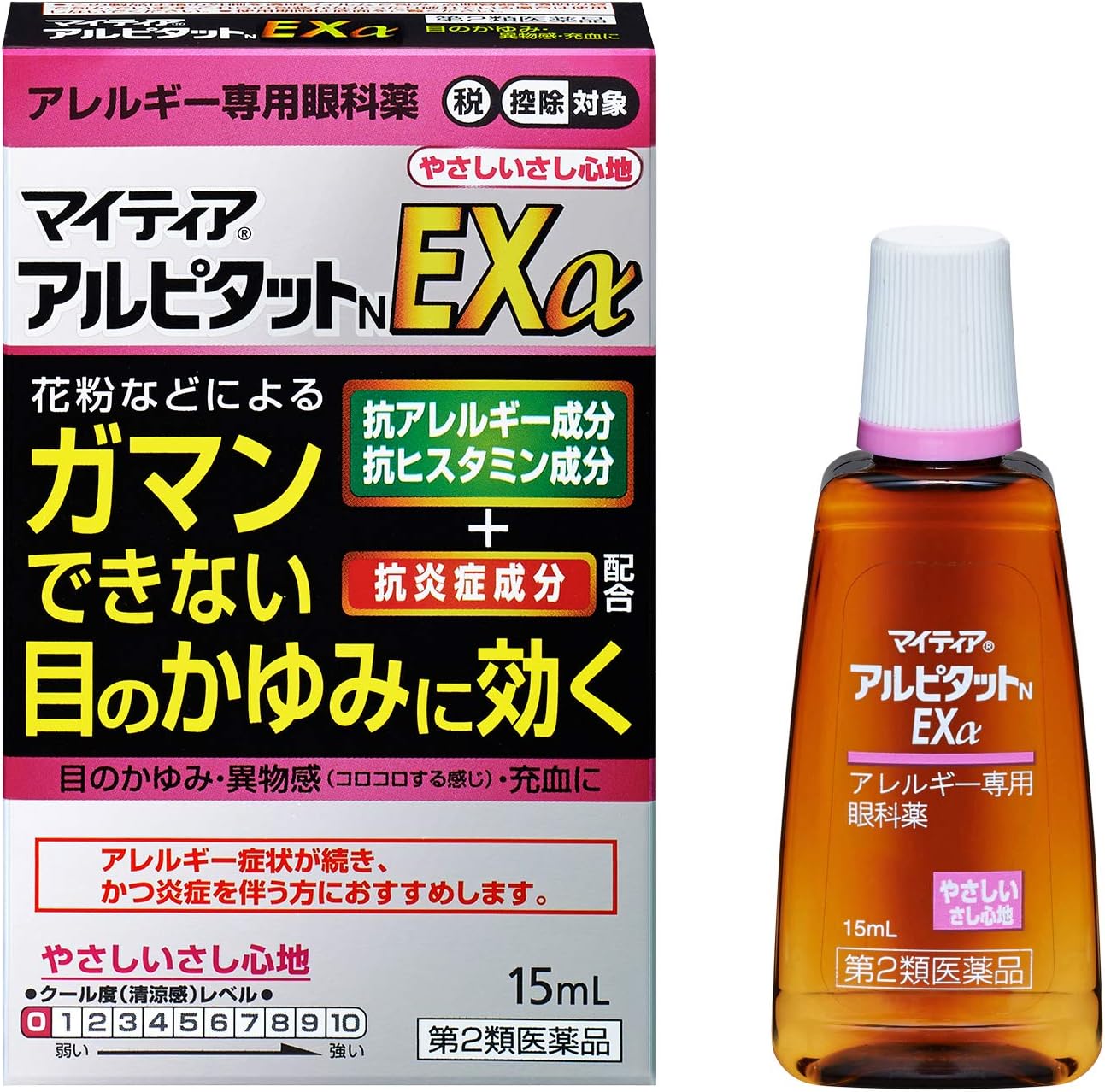
My Tear Alpitatto NEXα
マイティアアルピタットNEXα
Uses:
Relief of these eye allergy symptoms caused by pollen, house dust, and similar: red eyes, itchy eyes, blurred vision (when there is a lot of discharge, for example), watery eyes, and a feeling of a foreign object in the eye (異物感; the insert adds コロコロする感じ, a word for something small rolling around). The insert says it is for people whose allergy symptoms continue and come with inflammation. It has three active ingredients: sodium cromoglicate and pranoprofen (both marked as switch OTC ingredients, ones that were once prescription-only), plus chlorpheniramine maleate. It also contains chondroitin sulfate ester sodium, which the insert describes as protecting the cornea. It is described as having no cooling (清涼感) feel.
Active ingredients:
- Sodium cromoglicate (クロモグリク酸ナトリウム), an anti-allergy ingredient: 10 mg per mL
- Chlorpheniramine maleate (クロルフェニラミンマレイン酸塩), an antihistamine: 0.3 mg per mL
- Pranoprofen (プラノプロフェン), an anti-inflammatory: 0.5 mg per mL
- Chondroitin sulfate ester sodium (コンドロイチン硫酸エステルナトリウム): 5 mg per mL
Ages 7 and over. Under 7: Do not use this medicine.
- Children under 7, women who are or may be pregnant, and women who are breastfeeding should not use it.
- Do not use it with contact lenses in.
- Do not drive or operate machinery if you are also using a nasal medicine.
- Consult a doctor, pharmacist, or registered salesperson before use if you have severe eye pain or glaucoma, or if you are not sure the symptoms are an allergy.
- If symptoms have not improved after 2 days, stop using it and consult a doctor, pharmacist, or registered salesperson.
View on Amazon Japan
Directions & precautions
Classification:
Class 2 medicine (第2類医薬品). Sold with a pharmacist or registered salesperson on duty; you can take it off the shelf yourself. 15 mL.
Do not take:
- Children under 7.
- If you are pregnant or may be pregnant.
- If you are breastfeeding.
Do not:
- Drive or operate machinery if you are also using a nasal medicine. Drowsiness may occur.
Instructions for use:
Put 1 to 2 drops in the eye, 4 times a day.
- If a child is using it, a parent or guardian should supervise.
- Do not let the tip of the container touch the eye, eyelid, or eyelashes. This can contaminate the drops with discharge, dust, or other foreign matter. Do not use the drops if they have turned cloudy.
- Do not use the drops with contact lenses in. Take the lenses out first.
- For use in the eyes only.
- Follow the dosage directions strictly.
Inactive ingredients:
Boric acid, edetate sodium hydrate, dibutylhydroxytoluene, benzalkonium chloride, polysorbate 80, borax, a pH adjuster. No l-menthol, so no cooling feel.
Consult a doctor, pharmacist, or registered salesperson before use if you:
- Are receiving treatment from a doctor.
- Have had an allergic reaction to a medicine or other substance.
- Are receiving treatment for allergy, such as desensitization therapy (減感作療法).
- Have severe eye pain.
- Have been diagnosed with glaucoma.
- Are not sure whether your symptoms come from an allergy or another cause. If only one eye is affected, if you have eye symptoms but no nose symptoms, or if your vision is affected, an allergy cannot be assumed. See a doctor before using these drops.
When to stop and seek advice:
If any of the following appear after using this medicine, they may be side effects. Stop using it at once and consult a doctor, pharmacist, or registered salesperson, taking the package insert with you:
- Skin: Rash, redness, or itching.
- Eyes: Redness, itching, swelling (including around the eyes), stinging, a feeling of something in the eye, watery eyes, discharge, or pain.
- Other: Difficulty breathing.
Rare but serious reactions may occur. Seek medical attention immediately if you develop the following symptoms:
- Anaphylaxis: Difficulty breathing, swelling (of the throat, eyelids, lining of the nose, lips, and so on), or hives soon after using the drops.
Even if your symptoms improve, consult a doctor, pharmacist, or registered salesperson if you will use the drops for more than 2 weeks.
Stop using it and consult a doctor, pharmacist, or registered salesperson, taking the package insert with you, if your symptoms get worse, if blurred vision does not improve (it could be glaucoma, among other causes), or if your symptoms do not improve after 2 days of use.
Storage:
Store in a cool place out of direct sunlight, with the cap tightly closed. Do not leave it in a car, near a heater, or anywhere else that may get hot. To protect it from light-related changes in quality, keep it in its box until you start using it. Keep out of reach of children. Do not transfer it to another container, which can cause misuse or change the quality. Do not put anything else in the container. Do not share it with another person. Do not use it after the expiry date. Even before the expiry date, use it promptly once the inner bag has been opened. Depending on how it is stored, crystals of an ingredient may form around the tip of the container or inside the cap. If so, wipe them off gently with clean gauze before use.
Source: Japanese package insert (PDF) · Manufacturer product page
Translated from the Japanese insert (no revision date is printed on it) and the product page. My Tear Alpitatto NEXα information checked October 2, 2026.
My Tear Alpitatto EXα
マイティアアルピタットEXα

Uses:
Relief of these eye allergy symptoms caused by pollen, house dust, and similar: red eyes, itchy eyes, blurred vision (when there is a lot of discharge, for example), watery eyes, and a feeling of a foreign object in the eye (異物感; the insert adds コロコロする感じ, a word for something small rolling around). The insert says it is for people whose allergy symptoms continue and come with inflammation. It has three active ingredients: sodium cromoglicate and pranoprofen (both marked as switch OTC ingredients, ones that were once prescription-only), plus chlorpheniramine maleate. It also contains chondroitin sulfate ester sodium, which the insert describes as protecting the cornea. It is described as having a cooling (清涼感) feel.
Active ingredients:
- Sodium cromoglicate (クロモグリク酸ナトリウム), an anti-allergy ingredient: 10 mg per mL
- Chlorpheniramine maleate (クロルフェニラミンマレイン酸塩), an antihistamine: 0.3 mg per mL
- Pranoprofen (プラノプロフェン), an anti-inflammatory: 0.5 mg per mL
- Chondroitin sulfate ester sodium (コンドロイチン硫酸エステルナトリウム): 5 mg per mL
Ages 7 and over. Under 7: Do not use this medicine.
- Children under 7, women who are or may be pregnant, and women who are breastfeeding should not use it.
- Do not use it with contact lenses in.
- Do not drive or operate machinery if you are also using a nasal medicine.
- Consult a doctor, pharmacist, or registered salesperson before use if you have severe eye pain or glaucoma, or if you are not sure the symptoms are an allergy.
- If symptoms have not improved after 2 days, stop using it and consult a doctor, pharmacist, or registered salesperson.
View on Amazon Japan
Directions & precautions
Classification:
Class 2 medicine (第2類医薬品). Sold with a pharmacist or registered salesperson on duty; you can take it off the shelf yourself. 15 mL.
Do not take:
- Children under 7.
- If you are pregnant or may be pregnant.
- If you are breastfeeding.
Do not:
- Drive or operate machinery if you are also using a nasal medicine. Drowsiness may occur.
Instructions for use:
Put 1 to 2 drops in the eye, 4 times a day.
- If a child is using it, a parent or guardian should supervise.
- Do not let the tip of the container touch the eye, eyelid, or eyelashes. This can contaminate the drops with discharge, dust, or other foreign matter. Do not use the drops if they have turned cloudy.
- Do not use the drops with contact lenses in. Take the lenses out first.
- For use in the eyes only.
- Follow the dosage directions strictly.
Inactive ingredients:
Boric acid, edetate sodium hydrate, dibutylhydroxytoluene, benzalkonium chloride, polysorbate 80, borax, a pH adjuster, l-menthol.
Consult a doctor, pharmacist, or registered salesperson before use if you:
- Are receiving treatment from a doctor.
- Have had an allergic reaction to a medicine or other substance.
- Are receiving treatment for allergy, such as desensitization therapy (減感作療法).
- Have severe eye pain.
- Have been diagnosed with glaucoma.
- Are not sure whether your symptoms come from an allergy or another cause. If only one eye is affected, if you have eye symptoms but no nose symptoms, or if your vision is affected, an allergy cannot be assumed. See a doctor before using these drops.
When to stop and seek advice:
If any of the following appear after using this medicine, they may be side effects. Stop using it at once and consult a doctor, pharmacist, or registered salesperson, taking the package insert with you:
- Skin: Rash, redness, or itching.
- Eyes: Redness, itching, swelling (including around the eyes), stinging, a feeling of something in the eye, watery eyes, discharge, or pain.
- Other: Difficulty breathing.
Rare but serious reactions may occur. Seek medical attention immediately if you develop the following symptoms:
- Anaphylaxis: Difficulty breathing, swelling (of the throat, eyelids, lining of the nose, lips, and so on), or hives soon after using the drops.
Even if your symptoms improve, consult a doctor, pharmacist, or registered salesperson if you will use the drops for more than 2 weeks.
Stop using it and consult a doctor, pharmacist, or registered salesperson, taking the package insert with you, if your symptoms get worse, if blurred vision does not improve (it could be glaucoma, among other causes), or if your symptoms do not improve after 2 days of use.
Storage:
Store in a cool place out of direct sunlight, with the cap tightly closed. Do not leave it in a car, near a heater, or anywhere else that may get hot. To protect it from light-related changes in quality, keep it in its box until you start using it. Keep out of reach of children. Do not transfer it to another container, which can cause misuse or change the quality. Do not put anything else in the container. Do not share it with another person. Do not use it after the expiry date. Even before the expiry date, use it promptly once the inner bag has been opened. Depending on how it is stored, crystals of an ingredient may form around the tip of the container or inside the cap. If so, wipe them off gently with clean gauze before use.
Source: Japanese package insert (PDF) · Manufacturer product page
Translated from the Japanese insert (no revision date is printed on it) and the product page. My Tear Alpitatto EXα information checked October 2, 2026.
My Tear EyeTect Alpitatto N
マイティアアイテクトアルピタットN

Uses:
Relief of these eye allergy symptoms caused by pollen, house dust, and similar: red eyes, itchy eyes, blurred vision (when there is a lot of discharge, for example), watery eyes, and a feeling of a foreign object in the eye (異物感; the insert adds コロコロする感じ, a word for something small rolling around). The insert says it is for people whose allergy symptoms continue and come with inflammation. It has three active ingredients: sodium cromoglicate and pranoprofen (both marked as switch OTC ingredients, ones that were once prescription-only), plus chlorpheniramine maleate. It is described as having no cooling feel.
Active ingredients:
- Sodium cromoglicate (クロモグリク酸ナトリウム), an anti-allergy ingredient: 10 mg per mL
- Chlorpheniramine maleate (クロルフェニラミンマレイン酸塩), an antihistamine: 0.15 mg per mL
- Pranoprofen (プラノプロフェン), an anti-inflammatory: 0.5 mg per mL
Ages 7 and over. Under 7: Do not use this medicine.
- Children under 7, women who are or may be pregnant, and women who are breastfeeding should not use it.
- Do not use it with contact lenses in.
- Do not drive or operate machinery if you are also using a nasal medicine.
- Consult a doctor, pharmacist, or registered salesperson before use if you have severe eye pain or glaucoma, or if you are not sure the symptoms are an allergy.
- If symptoms have not improved after 2 days, stop using it and consult a doctor, pharmacist, or registered salesperson.
View on Amazon Japan
Directions & precautions
Classification:
Class 2 medicine (第2類医薬品). Sold with a pharmacist or registered salesperson on duty; you can take it off the shelf yourself. 15 mL.
Do not take:
- Children under 7.
- If you are pregnant or may be pregnant.
- If you are breastfeeding.
Do not:
- Drive or operate machinery if you are also using a nasal medicine. Drowsiness may occur.
Instructions for use:
Put 1 to 2 drops in the eye, 4 times a day.
- If a child is using it, a parent or guardian should supervise.
- Do not let the tip of the container touch the eye, eyelid, or eyelashes. This can contaminate the drops with discharge, dust, or other foreign matter. Do not use the drops if they have turned cloudy.
- Do not use the drops with contact lenses in. Take the lenses out first.
- For use in the eyes only.
- Follow the dosage directions strictly.
Inactive ingredients:
Boric acid, edetate sodium hydrate, dibutylhydroxytoluene, benzalkonium chloride, polysorbate 80, borax, a pH adjuster. No l-menthol, so no cooling feel.
Consult a doctor, pharmacist, or registered salesperson before use if you:
- Are receiving treatment from a doctor.
- Have had an allergic reaction to a medicine or other substance.
- Are receiving treatment for allergy, such as desensitization therapy (減感作療法).
- Have severe eye pain.
- Have been diagnosed with glaucoma.
- Are not sure whether your symptoms come from an allergy or another cause. If only one eye is affected, if you have eye symptoms but no nose symptoms, or if your vision is affected, an allergy cannot be assumed. See a doctor before using these drops.
When to stop and seek advice:
If any of the following appear after using this medicine, they may be side effects. Stop using it at once and consult a doctor, pharmacist, or registered salesperson, taking the package insert with you:
- Skin: Rash, redness, or itching.
- Eyes: Redness, itching, swelling (including around the eyes), stinging, a feeling of something in the eye, watery eyes, discharge, or pain.
- Other: Difficulty breathing.
Rare but serious reactions may occur. Seek medical attention immediately if you develop the following symptoms:
- Anaphylaxis: Difficulty breathing, swelling (of the throat, eyelids, lining of the nose, lips, and so on), or hives soon after using the drops.
Even if your symptoms improve, consult a doctor, pharmacist, or registered salesperson if you will use the drops for more than 2 weeks.
Stop using it and consult a doctor, pharmacist, or registered salesperson, taking the package insert with you, if your symptoms get worse, if blurred vision does not improve (it could be glaucoma, among other causes), or if your symptoms do not improve after 2 days of use.
Storage:
Store in a cool place out of direct sunlight, with the cap tightly closed. Do not leave it in a car, near a heater, or anywhere else that may get hot. To protect it from light-related changes in quality, keep it in its box until you start using it. Keep out of reach of children. Do not transfer it to another container, which can cause misuse or change the quality. Do not put anything else in the container. Do not share it with another person. Do not use it after the expiry date. Even before the expiry date, use it promptly once the inner bag has been opened. Depending on how it is stored, crystals of an ingredient may form around the tip of the container or inside the cap. If so, wipe them off gently with clean gauze before use.
Source: Japanese package insert (PDF) · Manufacturer product page
Translated from the Japanese insert (no revision date is printed on it) and the product page. My Tear EyeTect Alpitatto N information checked October 2, 2026.
My Tear EyeTect Alpitatto
マイティアアイテクトアルピタット

Uses:
Relief of these eye allergy symptoms caused by pollen, house dust, and similar: red eyes, itchy eyes, blurred vision (when there is a lot of discharge, for example), watery eyes, and a feeling of a foreign object in the eye (異物感; the insert adds コロコロする感じ, a word for something small rolling around). The insert says it is for people whose allergy symptoms continue and come with inflammation. It has three active ingredients: sodium cromoglicate and pranoprofen (both marked as switch OTC ingredients, ones that were once prescription-only), plus chlorpheniramine maleate. It is described as having a cooling (清涼感) feel.
Active ingredients:
- Sodium cromoglicate (クロモグリク酸ナトリウム), an anti-allergy ingredient: 10 mg per mL
- Chlorpheniramine maleate (クロルフェニラミンマレイン酸塩), an antihistamine: 0.15 mg per mL
- Pranoprofen (プラノプロフェン), an anti-inflammatory: 0.5 mg per mL
Ages 7 and over. Under 7: Do not use this medicine.
- Children under 7, women who are or may be pregnant, and women who are breastfeeding should not use it.
- Do not use it with contact lenses in.
- Do not drive or operate machinery if you are also using a nasal medicine.
- Consult a doctor, pharmacist, or registered salesperson before use if you have severe eye pain or glaucoma, or if you are not sure the symptoms are an allergy.
- If symptoms have not improved after 2 days, stop using it and consult a doctor, pharmacist, or registered salesperson.
View on Amazon Japan
Directions & precautions
Classification:
Class 2 medicine (第2類医薬品). Sold with a pharmacist or registered salesperson on duty; you can take it off the shelf yourself. 15 mL.
Do not take:
- Children under 7.
- If you are pregnant or may be pregnant.
- If you are breastfeeding.
Do not:
- Drive or operate machinery if you are also using a nasal medicine. Drowsiness may occur.
Instructions for use:
Put 1 to 2 drops in the eye, 4 times a day.
- If a child is using it, a parent or guardian should supervise.
- Do not let the tip of the container touch the eye, eyelid, or eyelashes. This can contaminate the drops with discharge, dust, or other foreign matter. Do not use the drops if they have turned cloudy.
- Do not use the drops with contact lenses in. Take the lenses out first.
- For use in the eyes only.
- Follow the dosage directions strictly.
Inactive ingredients:
Boric acid, edetate sodium hydrate, dibutylhydroxytoluene, benzalkonium chloride, polysorbate 80, borax, a pH adjuster, l-menthol.
Consult a doctor, pharmacist, or registered salesperson before use if you:
- Are receiving treatment from a doctor.
- Have had an allergic reaction to a medicine or other substance.
- Are receiving treatment for allergy, such as desensitization therapy (減感作療法).
- Have severe eye pain.
- Have been diagnosed with glaucoma.
- Are not sure whether your symptoms come from an allergy or another cause. If only one eye is affected, if you have eye symptoms but no nose symptoms, or if your vision is affected, an allergy cannot be assumed. See a doctor before using these drops.
When to stop and seek advice:
If any of the following appear after using this medicine, they may be side effects. Stop using it at once and consult a doctor, pharmacist, or registered salesperson, taking the package insert with you:
- Skin: Rash, redness, or itching.
- Eyes: Redness, itching, swelling (including around the eyes), stinging, a feeling of something in the eye, watery eyes, discharge, or pain.
- Other: Difficulty breathing.
Rare but serious reactions may occur. Seek medical attention immediately if you develop the following symptoms:
- Anaphylaxis: Difficulty breathing, swelling (of the throat, eyelids, lining of the nose, lips, and so on), or hives soon after using the drops.
Even if your symptoms improve, consult a doctor, pharmacist, or registered salesperson if you will use the drops for more than 2 weeks.
Stop using it and consult a doctor, pharmacist, or registered salesperson, taking the package insert with you, if your symptoms get worse, if blurred vision does not improve (it could be glaucoma, among other causes), or if your symptoms do not improve after 2 days of use.
Storage:
Store in a cool place out of direct sunlight, with the cap tightly closed. Do not leave it in a car, near a heater, or anywhere else that may get hot. To protect it from light-related changes in quality, keep it in its box until you start using it. Keep out of reach of children. Do not transfer it to another container, which can cause misuse or change the quality. Do not put anything else in the container. Do not share it with another person. Do not use it after the expiry date. Even before the expiry date, use it promptly once the inner bag has been opened. Depending on how it is stored, crystals of an ingredient may form around the tip of the container or inside the cap. If so, wipe them off gently with clean gauze before use.
Source: Japanese package insert (PDF) · Manufacturer product page
Translated from the Japanese insert (no revision date is printed on it) and the product page. My Tear EyeTect Alpitatto information checked October 2, 2026.
Eye Wash
Eyebon d
アイボンd 洗眼薬

Uses:
Washing the eyes and preventing eye disease (for example, after swimming, or when dust or sweat gets in the eyes). The pack says it is for use after you take your contact lenses out (コンタクトを外した後に). The pack lists allantoin as a cornea-repair ingredient and chondroitin sulfate ester sodium as a cornea-protection ingredient.
Active ingredients (per 100 mL):
- Epsilon-aminocaproic acid (イプシロン-アミノカプロン酸), anti-inflammatory: 200 mg
- Allantoin (アラントイン), cornea repair: 30 mg
- Dipotassium glycyrrhizinate (グリチルリチン酸二カリウム), anti-inflammatory: 10 mg
- Chlorpheniramine maleate (クロルフェニラミンマレイン酸塩), antihistamine: 3 mg
- Pyridoxine hydrochloride, vitamin B6 (ピリドキシン塩酸塩), metabolism promotion: 10 mg
- Tocopherol acetate, vitamin E (トコフェロール酢酸エステル), circulation promotion: 5 mg
- Chondroitin sulfate ester sodium (コンドロイチン硫酸エステルナトリウム), cornea protection: 50 mg
No age limit is printed on the insert. If a child uses it, a parent or guardian should supervise.
- Do not use it with contact lenses in. Take them out first, and wait 10 to 15 minutes after washing before putting them back in.
- Do not wash the other eye with the liquid you used for one eye. Do not wash for more than 30 seconds.
- Consult a doctor, pharmacist, or registered salesperson before use if you have severe eye pain or have been diagnosed with dry eye (ドライアイ).
- Wash the cup with tap water before and after use.
View on Amazon Japan
Directions & precautions
Classification:
Class 3 medicine (第3類医薬品). The manufacturer lists it in 100 mL and 500 mL sizes.
Instructions for use:
Wash the eye with 5 mL of the liquid, 3 to 6 times a day.
- Pour the liquid into the eye wash cup, up to the 5 mL line on the inside.
- Press the cup against your eye.
- Keep the cup pressed on, tilt your head back, and look up so the liquid does not spill.
- Blink several times to wash the eye. Do the other eye the same way, with fresh liquid.
- If a child is using it, a parent or guardian should supervise.
- Do not wear contact lenses while using it. Wait 10 to 15 minutes after washing before putting them back in.
- Wash the cup thoroughly with tap water before and after use. Letting the water left in the cup air-dry is recommended.
- Do not use the liquid if it has turned cloudy.
- For eye washing only.
- Do not wash the other eye with the liquid you used for one eye.
- Do not wash for more than 30 seconds.
- Wipe makeup and dirt from around the eyes before use.
- Depending on how it is stored, white crystals may form around the mouth of the container. If so, wipe them off gently with clean gauze.
- The pack says people who do not wear contact lenses can use it too.
Inactive ingredients:
Boric acid, borax, polysorbate 80, edetate sodium, l-menthol, d-borneol, a pH adjuster.
Consult a doctor, pharmacist, or registered salesperson before use if you:
- Are receiving treatment from a doctor.
- Have had an allergic reaction to a medicine or other substance.
- Have severe eye pain.
- Have been diagnosed with dry eye (眼球乾燥症候群, ドライアイ). The pack adds that this means people diagnosed by a doctor as having the disease.
When to stop and seek advice:
If any of the following appear after using this medicine, they may be side effects. Stop using it at once and consult a doctor, pharmacist, or registered salesperson, taking the box with you:
- Skin: Rash, redness, or itching.
- Eyes: Redness, itching, or swelling.
Storage:
Store in a cool place out of direct sunlight, with the cap tightly closed, and keep it in its box. Keep out of reach of children. Do not transfer it to another container, which can cause misuse or change the quality. Do not share the eye wash cup with another person. Do not use it after the expiry date.
Source: Japanese package insert (PDF) · Manufacturer product page
Translated from the Japanese insert (no revision date is printed on it) and the product page. Eyebon d information checked October 2, 2026.
Eyebon AL
アイボンAL 洗眼薬

Uses:
Washing the eyes and preventing eye disease (for example, after swimming, or when dust or sweat gets in the eyes). The pack says it is for use after you take your contact lenses out (コンタクトを外した後に). The pack says it contains an antihistamine and washes pollen and dust out of the eye. Its cooling scale (0 to 5) is 4.
Active ingredients (per 100 mL):
- Epsilon-aminocaproic acid (イプシロン-アミノカプロン酸), anti-inflammatory: 300 mg
- Dipotassium glycyrrhizinate (グリチルリチン酸二カリウム), anti-inflammatory: 25 mg
- Chlorpheniramine maleate (クロルフェニラミンマレイン酸塩), antihistamine: 3 mg
- Chondroitin sulfate ester sodium (コンドロイチン硫酸エステルナトリウム), cornea protection: 10 mg
No age limit is printed on the insert. If a child uses it, a parent or guardian should supervise.
- Do not use it with contact lenses in. Take them out first, and wait 10 to 15 minutes after washing before putting them back in.
- Do not wash the other eye with the liquid you used for one eye. Do not wash for more than 30 seconds.
- Consult a doctor, pharmacist, or registered salesperson before use if you have severe eye pain or have been diagnosed with dry eye (ドライアイ).
- Wash the cup with tap water before and after use.
View on Amazon Japan
Directions & precautions
Classification:
Class 3 medicine (第3類医薬品). The manufacturer lists it in 100 mL and 500 mL sizes.
Instructions for use:
Wash the eye with 5 mL of the liquid, 3 to 6 times a day.
- Pour the liquid into the eye wash cup, up to the 5 mL line on the inside.
- Press the cup against your eye.
- Keep the cup pressed on, tilt your head back, and look up so the liquid does not spill.
- Blink several times to wash the eye. Do the other eye the same way, with fresh liquid.
- If a child is using it, a parent or guardian should supervise.
- Do not wear contact lenses while using it. Wait 10 to 15 minutes after washing before putting them back in.
- Wash the cup thoroughly with tap water before and after use. Letting the water left in the cup air-dry is recommended.
- Do not use the liquid if it has turned cloudy.
- For eye washing only.
- Do not wash the other eye with the liquid you used for one eye.
- Do not wash for more than 30 seconds.
- Wipe makeup and dirt from around the eyes before use.
- Depending on how it is stored, white crystals may form around the mouth of the container. If so, wipe them off gently with clean gauze.
- The pack says people who do not wear contact lenses can use it too.
Inactive ingredients:
Boric acid, borax, polysorbate 80, edetate sodium, l-menthol, d-borneol, a pH adjuster.
Consult a doctor, pharmacist, or registered salesperson before use if you:
- Are receiving treatment from a doctor.
- Have had an allergic reaction to a medicine or other substance.
- Have severe eye pain.
- Have been diagnosed with dry eye (眼球乾燥症候群, ドライアイ). The pack adds that this means people diagnosed by a doctor as having the disease.
When to stop and seek advice:
If any of the following appear after using this medicine, they may be side effects. Stop using it at once and consult a doctor, pharmacist, or registered salesperson, taking the box with you:
- Skin: Rash, redness, or itching.
- Eyes: Redness, itching, or swelling.
Storage:
Store in a cool place out of direct sunlight, with the cap tightly closed, and keep it in its box. Keep out of reach of children. Do not transfer it to another container, which can cause misuse or change the quality. Do not share the eye wash cup with another person. Do not use it after the expiry date.
Source: Japanese package insert (PDF) · Manufacturer product page
Translated from the Japanese insert (no revision date is printed on it) and the product page. Eyebon AL information checked October 2, 2026.
Eyebon Mild
アイボンマイルド 洗眼薬

Uses:
Washing the eyes and preventing eye disease (for example, after swimming, or when dust or sweat gets in the eyes). The pack says it is for use after you take your contact lenses out (コンタクトを外した後に). The pack says it has no cooling ingredient (清涼成分を含まない) and is the non-stinging type. Its cooling scale (0 to 5) is 0.
Active ingredients (per 100 mL):
- Epsilon-aminocaproic acid (イプシロン-アミノカプロン酸), anti-inflammatory: 100 mg
- Chlorpheniramine maleate (クロルフェニラミンマレイン酸塩), antihistamine: 2 mg
- Pyridoxine hydrochloride, vitamin B6 (ピリドキシン塩酸塩), metabolism promotion: 10 mg
- Chondroitin sulfate ester sodium (コンドロイチン硫酸エステルナトリウム), cornea protection: 40 mg
No age limit is printed on the insert. If a child uses it, a parent or guardian should supervise.
- Do not use it with contact lenses in. Take them out first, and wait 10 to 15 minutes after washing before putting them back in.
- Do not wash the other eye with the liquid you used for one eye. Do not wash for more than 30 seconds.
- Consult a doctor, pharmacist, or registered salesperson before use if you have severe eye pain or have been diagnosed with dry eye (ドライアイ).
- Wash the cup with tap water before and after use.
View on Amazon Japan
Directions & precautions
Classification:
Class 3 medicine (第3類医薬品). The manufacturer lists it in 100 mL and 500 mL sizes.
Instructions for use:
Wash the eye with 5 mL of the liquid, 3 to 6 times a day.
- Pour the liquid into the eye wash cup, up to the 5 mL line on the inside.
- Press the cup against your eye.
- Keep the cup pressed on, tilt your head back, and look up so the liquid does not spill.
- Blink several times to wash the eye. Do the other eye the same way, with fresh liquid.
- If a child is using it, a parent or guardian should supervise.
- Do not wear contact lenses while using it. Wait 10 to 15 minutes after washing before putting them back in.
- Wash the cup thoroughly with tap water before and after use. Letting the water left in the cup air-dry is recommended.
- Do not use the liquid if it has turned cloudy.
- For eye washing only.
- Do not wash the other eye with the liquid you used for one eye.
- Do not wash for more than 30 seconds.
- Wipe makeup and dirt from around the eyes before use.
- Depending on how it is stored, white crystals may form around the mouth of the container. If so, wipe them off gently with clean gauze.
- The pack says people who do not wear contact lenses can use it too.
Inactive ingredients:
Boric acid, borax, edetate sodium, polysorbate 80, a pH adjuster. No l-menthol or camphor.
Consult a doctor, pharmacist, or registered salesperson before use if you:
- Are receiving treatment from a doctor.
- Have had an allergic reaction to a medicine or other substance.
- Have severe eye pain.
- Have been diagnosed with dry eye (眼球乾燥症候群, ドライアイ). The pack adds that this means people diagnosed by a doctor as having the disease.
When to stop and seek advice:
If any of the following appear after using this medicine, they may be side effects. Stop using it at once and consult a doctor, pharmacist, or registered salesperson, taking the box with you:
- Skin: Rash, redness, or itching.
- Eyes: Redness, itching, or swelling.
Storage:
Store in a cool place out of direct sunlight, with the cap tightly closed, and keep it in its box. Keep out of reach of children. Do not transfer it to another container, which can cause misuse or change the quality. Do not share the eye wash cup with another person. Do not use it after the expiry date.
Source: Japanese package insert (PDF) · Manufacturer product page
Translated from the Japanese insert (no revision date is printed on it) and the product page. Eyebon Mild information checked October 2, 2026.
Eyebon Cool
アイボンクール 洗眼薬

Uses:
Washing the eyes and preventing eye disease (for example, after swimming, or when dust or sweat gets in the eyes). The pack says it is for use after you take your contact lenses out (コンタクトを外した後に). The pack describes a cool, refreshing feel. Its cooling scale (0 to 5) is 5.
Active ingredients (per 100 mL):
- Epsilon-aminocaproic acid (イプシロン-アミノカプロン酸), anti-inflammatory: 200 mg
- Dipotassium glycyrrhizinate (グリチルリチン酸二カリウム), anti-inflammatory: 10 mg
- Chlorpheniramine maleate (クロルフェニラミンマレイン酸塩), antihistamine: 3 mg
- Pyridoxine hydrochloride, vitamin B6 (ピリドキシン塩酸塩), metabolism promotion: 10 mg
- Tocopherol acetate, vitamin E (トコフェロール酢酸エステル), circulation promotion: 5 mg
- Chondroitin sulfate ester sodium (コンドロイチン硫酸エステルナトリウム), cornea protection: 40 mg
No age limit is printed on the insert. If a child uses it, a parent or guardian should supervise.
- Do not use it with contact lenses in. Take them out first, and wait 10 to 15 minutes after washing before putting them back in.
- Do not wash the other eye with the liquid you used for one eye. Do not wash for more than 30 seconds.
- Consult a doctor, pharmacist, or registered salesperson before use if you have severe eye pain or have been diagnosed with dry eye (ドライアイ).
- Wash the cup with tap water before and after use.
View on Amazon Japan
Directions & precautions
Classification:
Class 3 medicine (第3類医薬品). The manufacturer lists it in 100 mL and 500 mL sizes.
Instructions for use:
Wash the eye with 5 mL of the liquid, 3 to 6 times a day.
- Pour the liquid into the eye wash cup, up to the 5 mL line on the inside.
- Press the cup against your eye.
- Keep the cup pressed on, tilt your head back, and look up so the liquid does not spill.
- Blink several times to wash the eye. Do the other eye the same way, with fresh liquid.
- If a child is using it, a parent or guardian should supervise.
- Do not wear contact lenses while using it. Wait 10 to 15 minutes after washing before putting them back in.
- Wash the cup thoroughly with tap water before and after use. Letting the water left in the cup air-dry is recommended.
- Do not use the liquid if it has turned cloudy.
- For eye washing only.
- Do not wash the other eye with the liquid you used for one eye.
- Do not wash for more than 30 seconds.
- Wipe makeup and dirt from around the eyes before use.
- Depending on how it is stored, white crystals may form around the mouth of the container. If so, wipe them off gently with clean gauze.
- The pack says people who do not wear contact lenses can use it too.
Inactive ingredients:
Boric acid, borax, polysorbate 80, edetate sodium, propylene glycol, l-menthol, dl-camphor, a pH adjuster.
Consult a doctor, pharmacist, or registered salesperson before use if you:
- Are receiving treatment from a doctor.
- Have had an allergic reaction to a medicine or other substance.
- Have severe eye pain.
- Have been diagnosed with dry eye (眼球乾燥症候群, ドライアイ). The pack adds that this means people diagnosed by a doctor as having the disease.
When to stop and seek advice:
If any of the following appear after using this medicine, they may be side effects. Stop using it at once and consult a doctor, pharmacist, or registered salesperson, taking the box with you:
- Skin: Rash, redness, or itching.
- Eyes: Redness, itching, or swelling.
Storage:
Store in a cool place out of direct sunlight, with the cap tightly closed, and keep it in its box. Keep out of reach of children. Do not transfer it to another container, which can cause misuse or change the quality. Do not share the eye wash cup with another person. Do not use it after the expiry date.
Source: Japanese package insert (PDF) · Manufacturer product page
Translated from the Japanese insert (no revision date is printed on it) and the product page. Eyebon Cool information checked October 2, 2026.
Eyebon W Vitamin PREMIUM
アイボンWビタミン PREMIUM 洗眼薬

Uses:
Washing the eyes and preventing eye disease (for example, after swimming, or when dust or sweat gets in the eyes). The pack says it is for use after you take your contact lenses out (コンタクトを外した後に). The pack says it is a pink eye wash that contains vitamin B6 and vitamin B12. Its cooling scale (0 to 5) is 3.
Active ingredients (per 100 mL):
- Dipotassium glycyrrhizinate (グリチルリチン酸二カリウム), anti-inflammatory: 25 mg
- Chlorpheniramine maleate (クロルフェニラミンマレイン酸塩), antihistamine: 3 mg
- Pyridoxine hydrochloride, vitamin B6 (ピリドキシン塩酸塩), metabolism promotion: 10 mg
- Taurine (タウリン), metabolism promotion: 100 mg
- Cyanocobalamin, vitamin B12 (シアノコバラミン), focusing-function improvement: 1 mg
- Tocopherol acetate, vitamin E (トコフェロール酢酸エステル), circulation promotion: 2.5 mg
- Chondroitin sulfate ester sodium (コンドロイチン硫酸エステルナトリウム), cornea protection: 10 mg
No age limit is printed on the insert. If a child uses it, a parent or guardian should supervise.
- Do not use it with contact lenses in. Take them out first, and wait 10 to 15 minutes after washing before putting them back in.
- Do not wash the other eye with the liquid you used for one eye. Do not wash for more than 30 seconds.
- Consult a doctor, pharmacist, or registered salesperson before use if you have severe eye pain or have been diagnosed with dry eye (ドライアイ).
- Wash the cup with tap water before and after use.