Cold medicine sold at Japanese drugstores, for sore throat, fever, cough and a runny nose. None of it treats the influenza virus itself, so if you think you may have influenza, see a doctor.
Each product shows its Japanese name, so you can match it to the box on the shelf. Use the tabs to see one brand, or scroll to see them all.
For a blocked nose, the nasal congestion pills are on the Allergy page. For a fever or aches on their own, see Pain Relief.
Looking for more detailed info? OTC Guide Japan — Cold Medicine has more products, full ingredient breakdowns, and dosage guides.
Relief of these symptoms from acute rhinitis, allergic rhinitis, or sinusitis (副鼻腔炎): sneezing, runny nose, stuffy nose, watery eyes, sore throat, and a heavy head (頭重). The insert calls it a rhinitis medicine (鼻炎用薬), for hay fever and dust allergies and for acute rhinitis from a cold.
Active ingredients (per 3 capsules, the adult daily dose):
Asiasarum root dry extract (サイシン乾燥エキス) 30 mg, from 300 mg of the crude drug
Ages 15 and over. Under 15: Do not take this medicine.
Do not take it if you have difficulty urinating from an enlarged prostate, or have been diagnosed with high blood pressure, heart disease, a thyroid disorder, or diabetes.
Do not take it with other oral nasal medicines, oral medicines that contain an antihistamine (cold, cough and phlegm, motion sickness, and allergy medicines), or stomach antispasmodics.
Do not drive or operate machinery after taking it. Drowsiness, blurred vision, or unusual glare may occur.
Do not take more than the dose, or take it for a long time.
If symptoms have not improved after 5 to 6 days, stop taking it and consult a doctor, pharmacist, or registered salesperson.
Designated Class 2 medicine (指定第2類医薬品). The package insert prints it as 第②類医薬品 with the 2 in a circle, and the Amazon listing says 指定第2類医薬品. The manufacturer's product page prints 第②類医薬品.
Do not take:
If you have had an allergic reaction to this medicine or any of its ingredients.
If you have difficulty urinating from an enlarged prostate (前立腺肥大).
If you have been diagnosed with high blood pressure, heart disease, a thyroid disorder (甲状腺機能障害), or diabetes.
Do not take with:
Other oral nasal medicines.
Oral medicines that contain an antihistamine (抗ヒスタミン剤): cold medicines, cough and phlegm medicines, motion sickness medicines, allergy medicines, and so on.
Stomach antispasmodic medicines (胃腸鎮痛鎮痙薬).
Do not:
Drive or operate machinery after taking it. Drowsiness, blurred vision, unusual glare, and similar symptoms may occur.
Take more than the dose, or take it for a long time.
Instructions for use:
Take after meals, with water or lukewarm water.
Ages 15 and over: Take 1 capsule per dose, 3 times a day.
Under 15: Do not take this medicine.
Follow the dosage directions strictly.
Press the raised part of the capsule on the blister sheet firmly with your fingertip to break the foil on the back, then take the capsule out. Swallowing the sheet by mistake can pierce the esophagus and cause an accident.
Inactive ingredients:
Potato starch, lactose, cellulose, magnesium stearate, Blue No. 1, Red No. 3, sodium lauryl sulfate, sodium bisulfite, gelatin.
Consult a doctor, pharmacist, or registered salesperson before use if you:
Are receiving treatment from a doctor.
Are pregnant or may be pregnant.
Are breastfeeding.
Are elderly.
Have had an allergic reaction to a medicine or other substance.
Have had insomnia, dizziness, weakness, shaking, or palpitations from a cold, cough, or oral rhinitis medicine.
Have a high fever or difficulty urinating.
Have been diagnosed with glaucoma or kidney disease.
Are being treated with a monoamine oxidase inhibitor (MAOI), such as selegiline hydrochloride.
When to stop and seek advice:
If any of the following appear after taking this medicine, they may be side effects. Stop taking it at once and consult a doctor, pharmacist, or registered salesperson, taking the package insert with you:
Skin: Rash, redness, or itching.
Digestive: Nausea, vomiting, or loss of appetite.
Nervous system: Dizziness, insomnia, nervousness, headache, or convulsions.
Urinary: Difficulty urinating.
Other: Flushed face or unusual glare.
Rare but serious reactions may occur. Seek medical attention immediately if you develop the following symptoms:
Shock (anaphylaxis): Itchy skin, hives, a hoarse voice, sneezing, an itchy throat, difficulty breathing, palpitations, or clouded consciousness soon after taking the medicine.
Aplastic anemia: Bruising, nosebleeds, bleeding gums, fever, skin and mucous membranes that look pale, fatigue, palpitations, shortness of breath, feeling faint, or blood in the urine.
Agranulocytosis: Sudden high fever, chills, or sore throat.
Acute generalized exanthematous pustulosis: High fever, a widespread rash and redness, small pustules on the red skin, fatigue, or loss of appetite that persist or quickly get worse.
If dry mouth, drowsiness, constipation, or blurred vision appears and keeps up or gets worse, stop taking this medicine and consult a doctor, pharmacist, or registered salesperson, taking the package insert with you.
If symptoms have not improved after taking it for 5 to 6 days, stop taking it and consult a doctor, pharmacist, or registered salesperson, taking the package insert with you.
Storage:
Store in a cool place with low humidity, away from direct sunlight. Keep out of reach of children. Do not transfer to another container, as this may cause misuse or affect the quality. Do not use it after the expiry date printed on the carton.
Relief of cold symptoms: sore throat, fever, runny nose, stuffy nose, sneezing, cough, phlegm, chills, headache, joint pain, and muscle pain. It is a cold medicine with ibuprofen, taken in the morning and the evening.
Active ingredients (per 4 capsules, the daily dose):
Designated Class 2 medicine (指定第2類医薬品). The package insert prints it as 第②類医薬品 with the 2 in a circle, and the Amazon listing says 指定第2類医薬品. The manufacturer's product page prints 第②類医薬品.
Do not take:
If you have had an allergic reaction to this medicine or any of its ingredients.
If you have had asthma from another cold medicine or fever reducer and pain reliever.
If you are under 15.
If you are pregnant and due to give birth within 12 weeks.
Do not take with:
Other cold medicines, fever reducers and pain relievers, sedatives, cough and phlegm medicines, and oral medicines that contain an antihistamine (oral nasal medicines, motion sickness medicines, allergy medicines, and so on).
Stomach antispasmodic medicines (胃腸鎮痛鎮痙薬).
Do not:
Drive or operate machinery after taking it. Drowsiness, blurred vision, unusual glare, and similar symptoms may occur.
Drink alcohol before or after taking it.
Take it for more than 5 days.
Take more than the dose.
Instructions for use:
Take the dose below in the morning and the evening after meals, preferably within 30 minutes of the meal, with water or hot water.
Ages 15 and over: Take 2 capsules per dose, 2 times a day (morning and evening).
Under 15: Do not take this medicine.
Follow the dosage directions strictly.
Press the raised part of the capsule on the blister sheet firmly with your fingertip to break the foil on the back, then take the capsule out. Swallowing the sheet by mistake can pierce the esophagus and cause an accident.
Consult a doctor, pharmacist, or registered salesperson before use if you:
Are receiving treatment from a doctor or dentist.
Are pregnant or may be pregnant.
Are breastfeeding.
Are elderly.
Have had an allergic reaction to a medicine or other substance.
Have a high fever or difficulty urinating.
Have been diagnosed with a thyroid disorder, diabetes, heart disease, high blood pressure, liver disease, kidney disease, glaucoma, systemic lupus erythematosus, or mixed connective tissue disease.
Have had a gastric or duodenal ulcer, ulcerative colitis, or Crohn's disease.
When to stop and seek advice:
If any of the following appear after taking this medicine, they may be side effects. Stop taking it at once and consult a doctor, pharmacist, or registered salesperson, taking the package insert with you:
Skin: Rash, redness, itching, or bruising.
Digestive: Nausea, vomiting, loss of appetite, stomach pain, stomach discomfort, mouth sores, heartburn, an upset stomach, bleeding from the digestive tract, abdominal pain, diarrhea, or bloody stools.
Nervous system: Dizziness or headache.
Circulatory: Palpitations.
Respiratory: Shortness of breath or difficulty breathing.
Urinary: Difficulty urinating.
Other: Ringing in the ears, blurred vision, swelling, flushed face, unusual glare, nosebleeds, bleeding gums, bleeding that is slow to stop, back pain, an excessive drop in body temperature, or fatigue.
Rare but serious reactions may occur. Seek medical attention immediately if you develop the following symptoms:
Shock (anaphylaxis): Itchy skin, hives, a hoarse voice, sneezing, an itchy throat, difficulty breathing, palpitations, or clouded consciousness soon after taking the medicine.
Severe skin reactions (Stevens-Johnson syndrome, toxic epidermal necrolysis): High fever, red eyes, eye discharge, sore lips, sore throat, or a widespread rash or redness that persists or suddenly worsens.
Liver damage: Fever, itching, rash, jaundice (yellow skin and whites of the eyes), brown urine, fatigue, or loss of appetite.
Kidney damage: Fever, rash, passing less urine, swelling of the whole body, fatigue, joint pain, or diarrhea.
Aseptic meningitis: Severe headache with a stiff neck, fever, nausea, or vomiting. This has been reported most often in people being treated for systemic lupus erythematosus or mixed connective tissue disease.
Heart attack: A tight squeezing pain in the chest, shortness of breath, or a cold sweat.
Stroke: Loss of consciousness, weakness on one side of the body, headache, vomiting, dizziness, or difficulty speaking, appearing suddenly.
Interstitial pneumonia: Shortness of breath on stairs or light exertion, dry cough, or fever that appears suddenly or keeps up.
Asthma: Wheezing when you breathe, or difficulty breathing.
Aplastic anemia: Bruising, nosebleeds, bleeding gums, fever, skin and mucous membranes that look pale, fatigue, palpitations, shortness of breath, feeling faint, or blood in the urine.
Agranulocytosis: Sudden high fever, chills, or sore throat.
If constipation, dry mouth, or drowsiness appears and keeps up or gets worse, stop taking this medicine and consult a doctor, pharmacist, or registered salesperson, taking the package insert with you.
If symptoms have not improved after 3 to 4 doses, stop taking it and consult a doctor, pharmacist, or registered salesperson, taking the package insert with you. This applies especially if a fever lasts 3 days or more, or comes back.
Storage:
Store in a cool place with low humidity, away from direct sunlight. Keep out of reach of children. Do not transfer to another container, as this may cause misuse or affect the quality. Do not use it after the expiry date printed on the carton. The expiry date applies to an unopened inner aluminum bag.
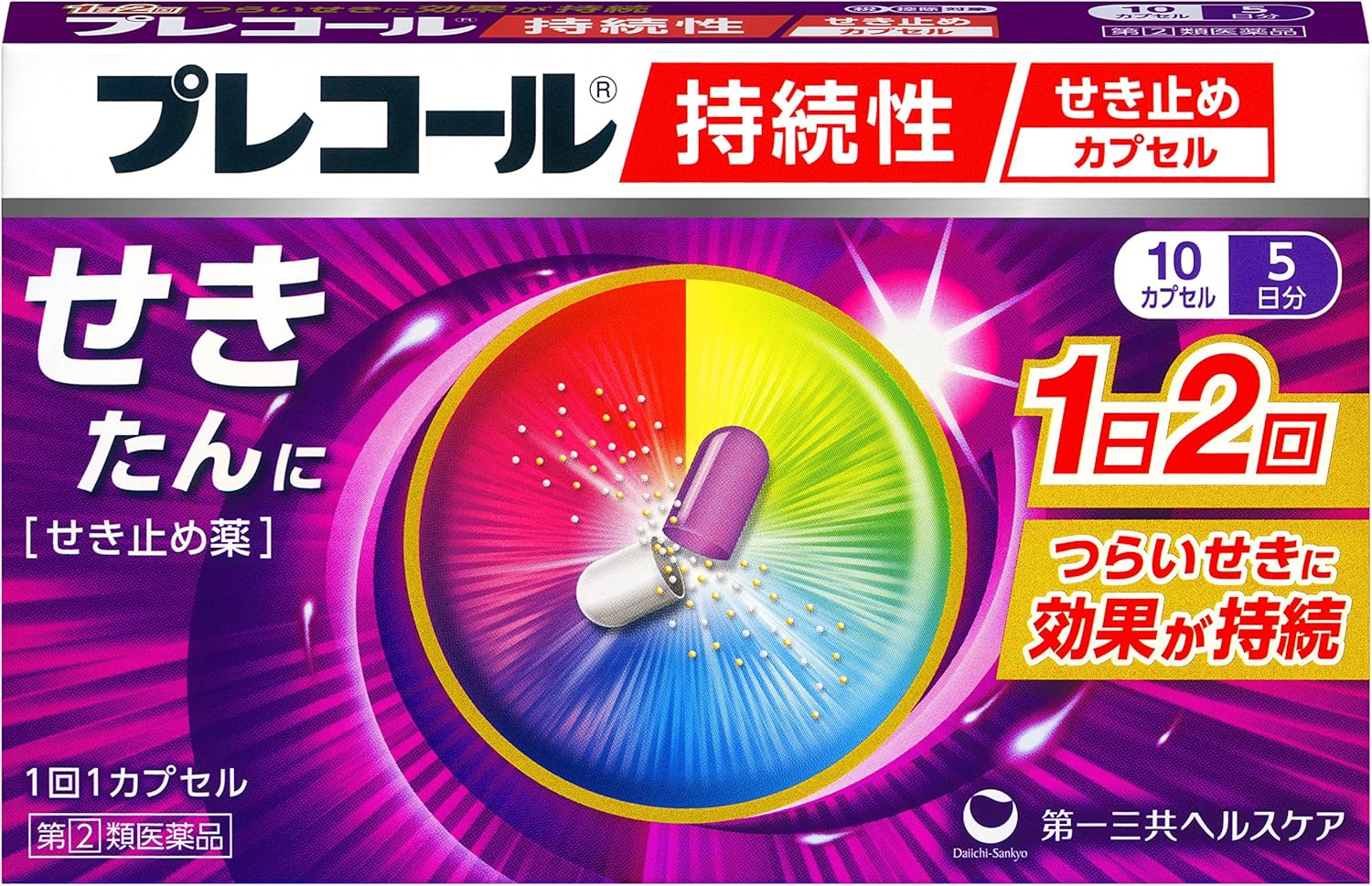
Relief of cough and phlegm (せき、たん). One capsule is described as working for about 12 hours.
Active ingredients (per 2 capsules, the daily dose):
Dextromethorphan hydrobromide hydrate (デキストロメトルファン臭化水素酸塩水和物), a non-narcotic cough suppressant, 60 mg
Diprophylline (ジプロフィリン), a bronchodilator, 200 mg
Ages 15 and over. Under 15: Do not take this medicine.
Do not take it with other cough and phlegm medicines, cold medicines, sedatives, or oral medicines that contain an antihistamine.
Do not drive or operate machinery after taking it. Drowsiness may occur.
Do not take more than the dose.
Consult a doctor, pharmacist, or registered salesperson before use if you have a high fever, or have been diagnosed with a thyroid disorder or epilepsy.
If symptoms have not improved after 5 to 6 doses, stop taking it and consult a doctor, pharmacist, or registered salesperson.
Class 2 medicine (第2類医薬品). It is not the designated Class 2 (指定第2類) that Contac 600 Plus S and Contac EX carry.
Do not take:
If you have had an allergic reaction to this medicine or any of its ingredients.
Do not take with:
Other cough and phlegm medicines, cold medicines, sedatives, and oral medicines that contain an antihistamine (oral nasal medicines, motion sickness medicines, allergy medicines, and so on).
Do not:
Drive or operate machinery after taking it. Drowsiness may occur.
Take more than the dose. (This item was added in the manufacturer's revision of April 2026.)
Instructions for use:
Take the dose below with water or hot water. Swallow the capsule without chewing it.
Ages 15 and over: Take 1 capsule per dose, 2 times a day (morning and evening).
Under 15: Do not take this medicine.
Press the raised part of the capsule on the blister sheet firmly with your fingertip to break the foil on the back, then take the capsule out. Swallowing the sheet by mistake can pierce the esophagus and cause an accident.
Consult a doctor, pharmacist, or registered salesperson before use if you:
Are receiving treatment from a doctor.
Are pregnant or may be pregnant.
Have had an allergic reaction to a medicine or other substance.
Have a high fever.
Have been diagnosed with a thyroid disorder or epilepsy.
When to stop and seek advice:
If any of the following appear after taking this medicine, they may be side effects. Stop taking it at once and consult a doctor, pharmacist, or registered salesperson, taking the package insert with you:
Skin: Rash, redness, or itching.
Digestive: Nausea, vomiting, or loss of appetite.
Nervous system: Dizziness.
Circulatory: Palpitations.
Respiratory: Difficulty breathing or shortness of breath.
Rare but serious reactions may occur. Seek medical attention immediately if you develop the following symptoms:
Shock (anaphylaxis): Itchy skin, hives, a hoarse voice, sneezing, an itchy throat, difficulty breathing, palpitations, or clouded consciousness soon after taking the medicine.
If drowsiness appears and keeps up or gets worse, stop taking this medicine and consult a doctor, pharmacist, or registered salesperson, taking the package insert with you.
If symptoms have not improved after taking it 5 to 6 times, stop taking it and consult a doctor, pharmacist, or registered salesperson, taking the package insert with you.
Storage:
Store in a cool place with low humidity, away from direct sunlight. Keep out of reach of children. Do not transfer to another container, as this may cause misuse or affect the quality. Do not use it after the expiry date printed on the carton.
Relief of cold symptoms: cough, phlegm, sore throat, sneezing, runny nose, stuffy nose, chills, fever, headache, joint pain, and muscle pain. The insert describes it as a cold medicine (かぜ薬) with seven active ingredients, starting with guaifenesin, for use as a household medicine.
Ages 12 and over. Ages 12 to 14 take 2 tablets per dose. Under 12: Do not take this medicine.
Do not take it with other cold medicines, fever reducers and pain relievers, sedatives, cough and phlegm medicines, or oral medicines that contain an antihistamine.
Do not drive or operate machinery after taking it. Drowsiness may occur.
If you are breastfeeding, do not take it, or avoid breastfeeding while you take it.
Do not drink alcohol before or after taking it.
Do not take more than the dose, or take it for a long time.
If symptoms have not improved after 5 to 6 doses, stop taking it and consult a doctor, pharmacist, or registered salesperson.
Designated Class 2 medicine (指定第二類医薬品), as printed in the Taisho catalog and marked on the Amazon listing.
Do not take:
If you have had an allergic reaction to this medicine or any of its ingredients.
If you have had asthma from this medicine or from another cold medicine or fever reducer and pain reliever.
If you are under 12.
Do not take with:
Other cold medicines, fever reducers and pain relievers, sedatives, cough and phlegm medicines, and oral medicines that contain an antihistamine (oral nasal medicines, motion sickness medicines, allergy medicines, and so on).
Do not:
Drive or operate machinery after taking it. Drowsiness may occur.
Take it while breastfeeding, or avoid breastfeeding if you do take it.
Drink alcohol before or after taking it.
Take it for a long time.
Take more than the dose.
Instructions for use:
Take after meals, preferably within 30 minutes of the meal, with water or lukewarm water.
Ages 15 and over: Take 3 tablets per dose, 3 times a day.
Ages 12 to 14: Take 2 tablets per dose, 3 times a day.
Under 12: Do not take this medicine.
Follow the dosage directions strictly.
If a child takes it, an adult must supervise and guide.
Do not put a tablet back in the bottle if you have touched it with wet hands. This can discolor it or change its quality.
When you first open the bottle, peel off the seal on the mouth of the bottle and throw it away, then take out the padding and throw it away. The padding stops the tablets breaking in transit, and moving it in and out of the bottle can bring in foreign matter.
This medicine can turn your urine yellow. It is from the vitamin B2 and is nothing to worry about.
Consult a doctor, pharmacist, or registered salesperson before use if you:
Are receiving treatment from a doctor or dentist.
Are pregnant or may be pregnant.
Are elderly.
Have had an allergic reaction to a medicine or other substance.
Have a high fever or difficulty urinating.
Have been diagnosed with a thyroid disorder, diabetes, heart disease, high blood pressure, liver disease, kidney disease, a gastric or duodenal ulcer, glaucoma, a respiratory disorder, obstructive sleep apnea, or obesity.
When to stop and seek advice:
If any of the following appear after taking this medicine, they may be side effects. Stop taking it at once and consult a doctor, pharmacist, or registered salesperson, taking the package insert with you:
Skin: Rash, redness, or itching.
Digestive: Nausea, vomiting, or loss of appetite.
Nervous system: Dizziness.
Urinary: Difficulty urinating.
Other: An excessive drop in body temperature.
Rare but serious reactions may occur. Seek medical attention immediately if you develop the following symptoms:
Shock (anaphylaxis): Itchy skin, hives, a hoarse voice, sneezing, an itchy throat, difficulty breathing, palpitations, or clouded consciousness soon after taking the medicine.
Severe skin reactions (Stevens-Johnson syndrome, toxic epidermal necrolysis, acute generalized exanthematous pustulosis): High fever, red eyes, eye discharge, sore lips, sore throat, a widespread rash or redness, small pustules on the red skin, fatigue, or loss of appetite that persist or suddenly get worse.
Drug-induced hypersensitivity syndrome: Widespread redness of the skin, a rash over the body, fever, fatigue, or swollen lymph nodes in the neck, armpits, or groin.
Liver damage: Fever, itching, rash, jaundice (yellow skin and whites of the eyes), brown urine, fatigue, or loss of appetite.
Kidney damage: Fever, rash, passing less urine, swelling of the whole body, fatigue, joint pain, or diarrhea.
Interstitial pneumonia: Shortness of breath on stairs or light exertion, dry cough, or fever that appears suddenly or keeps up.
Asthma: Wheezing when you breathe, or difficulty breathing.
Aplastic anemia: Bruising, nosebleeds, bleeding gums, fever, skin and mucous membranes that look pale, fatigue, palpitations, shortness of breath, feeling faint, or blood in the urine.
Agranulocytosis: Sudden high fever, chills, or sore throat.
Respiratory depression: Shortness of breath or difficulty breathing.
If constipation, dry mouth, or drowsiness appears and keeps up or gets worse, stop taking this medicine and consult a doctor, pharmacist, or registered salesperson, taking the package insert with you.
If symptoms have not improved after 5 to 6 doses, stop taking it and consult a doctor, pharmacist, or registered salesperson, taking the package insert with you.
Storage:
Store in a cool place with low humidity, away from direct sunlight, with the cap shut tight. Keep out of reach of children. Do not transfer to another container, as this may cause misuse or affect the quality. Do not use it after the expiry date. Even within the expiry date, take it within 6 months of opening, to keep the quality.
Relief of cold symptoms: sore throat, cough, runny nose, stuffy nose, sneezing, phlegm, headache, fever, chills, joint pain, and muscle pain. It is a cold medicine (かぜ薬) with ambroxol and L-carbocisteine for the airways.
Active ingredients (per 2 tablets):
Ambroxol hydrochloride (アンブロキソール塩酸塩) 15 mg
L-Carbocisteine (L-カルボシステイン) 250 mg
Dihydrocodeine phosphate (ジヒドロコデインリン酸塩) 8 mg
Acetaminophen (アセトアミノフェン) 300 mg
Chlorpheniramine maleate (クロルフェニラミンマレイン酸塩) 2.5 mg
Riboflavin, vitamin B2 (リボフラビン) 4 mg
Ages 12 and over. Ages 12 to 14 take 1 tablet per dose. Under 12: Do not take this medicine.
Do not take it with other cold medicines, fever reducers and pain relievers, sedatives, cough and phlegm medicines, or oral medicines that contain an antihistamine.
Do not drive or operate machinery after taking it. Drowsiness may occur.
If you are breastfeeding, do not take it, or avoid breastfeeding while you take it.
Do not drink alcohol before or after taking it.
Do not take more than the dose, or take it for a long time.
If symptoms have not improved after 5 to 6 doses, stop taking it and consult a doctor, pharmacist, or registered salesperson.
Designated Class 2 medicine (指定第2類医薬品), as marked on the Amazon listing. The manufacturer's product page prints 第2類医薬品.
Do not take:
If you have had an allergic reaction to this medicine or any of its ingredients.
If you have had asthma from this medicine or from another cold medicine or fever reducer and pain reliever.
If you are under 12.
Do not take with:
Other cold medicines, fever reducers and pain relievers, sedatives, cough and phlegm medicines, and oral medicines that contain an antihistamine (oral nasal medicines, motion sickness medicines, allergy medicines, and so on).
Do not:
Drive or operate machinery after taking it. Drowsiness may occur.
Take it while breastfeeding, or avoid breastfeeding if you do take it.
Drink alcohol before or after taking it.
Take it for a long time.
Take more than the dose. (This item was added in the manufacturer's revision of April 2026.)
Instructions for use:
Take after meals, preferably within 30 minutes of the meal, with water or lukewarm water.
Ages 15 and over: Take 2 tablets per dose, 3 times a day.
Ages 12 to 14: Take 1 tablet per dose, 3 times a day.
Under 12: Do not take this medicine.
Follow the dosage directions strictly.
If a child takes it, an adult must supervise and guide.
Do not put a tablet back in the bottle if you have touched it with wet hands. This can discolor it or change its quality.
When you first open the bottle, peel off the seal on the mouth of the bottle and throw it away, then take out the padding and throw it away. The padding stops the tablets breaking in transit, and moving it in and out of the bottle can bring in foreign matter.
This medicine can turn your urine yellow. It is from the vitamin B2 and is nothing to worry about.
Consult a doctor, pharmacist, or registered salesperson before use if you:
Are receiving treatment from a doctor or dentist.
Are pregnant or may be pregnant.
Have had an allergic reaction to a medicine or other substance.
Have a high fever or difficulty urinating.
Have been diagnosed with heart disease, liver disease, kidney disease, a gastric or duodenal ulcer, glaucoma, a respiratory disorder, obstructive sleep apnea, or obesity.
When to stop and seek advice:
If any of the following appear after taking this medicine, they may be side effects. Stop taking it at once and consult a doctor, pharmacist, or registered salesperson, taking the package insert with you:
Skin: Rash, redness, or itching.
Digestive: Nausea, vomiting, loss of appetite, stomach discomfort, stomach pain, abdominal pain, a bloated stomach or abdomen, heartburn, or diarrhea.
Nervous system: Dizziness or numbness.
Urinary: Difficulty urinating.
Other: An excessive drop in body temperature, or swelling.
Rare but serious reactions may occur. Seek medical attention immediately if you develop the following symptoms:
Shock (anaphylaxis): Itchy skin, hives, a hoarse voice, sneezing, an itchy throat, difficulty breathing, palpitations, or clouded consciousness soon after taking the medicine.
Severe skin reactions (Stevens-Johnson syndrome, toxic epidermal necrolysis, acute generalized exanthematous pustulosis): High fever, red eyes, eye discharge, sore lips, sore throat, a widespread rash or redness, small pustules on the red skin, fatigue, or loss of appetite that persist or suddenly get worse.
Drug-induced hypersensitivity syndrome: Widespread redness of the skin, a rash over the body, fever, fatigue, or swollen lymph nodes in the neck, armpits, or groin.
Liver damage: Fever, itching, rash, jaundice (yellow skin and whites of the eyes), brown urine, fatigue, or loss of appetite.
Kidney damage: Fever, rash, passing less urine, swelling of the whole body, fatigue, joint pain, or diarrhea.
Interstitial pneumonia: Shortness of breath on stairs or light exertion, dry cough, or fever that appears suddenly or keeps up.
Asthma: Wheezing when you breathe, or difficulty breathing.
Aplastic anemia: Bruising, nosebleeds, bleeding gums, fever, skin and mucous membranes that look pale, fatigue, palpitations, shortness of breath, feeling faint, or blood in the urine.
Agranulocytosis: Sudden high fever, chills, or sore throat.
Respiratory depression: Shortness of breath or difficulty breathing.
If constipation, dry mouth, or drowsiness appears and keeps up or gets worse, stop taking this medicine and consult a doctor, pharmacist, or registered salesperson, taking the package insert with you.
If symptoms have not improved after 5 to 6 doses, stop taking it and consult a doctor, pharmacist, or registered salesperson, taking the package insert with you.
Storage:
Store in a cool place with low humidity, away from direct sunlight. Keep out of reach of children. Do not transfer to another container, as this may cause misuse or affect the quality. Do not use it after the expiry date. Even within the expiry date, take it within 6 months of opening, to keep the quality. Keep the cap shut tight.
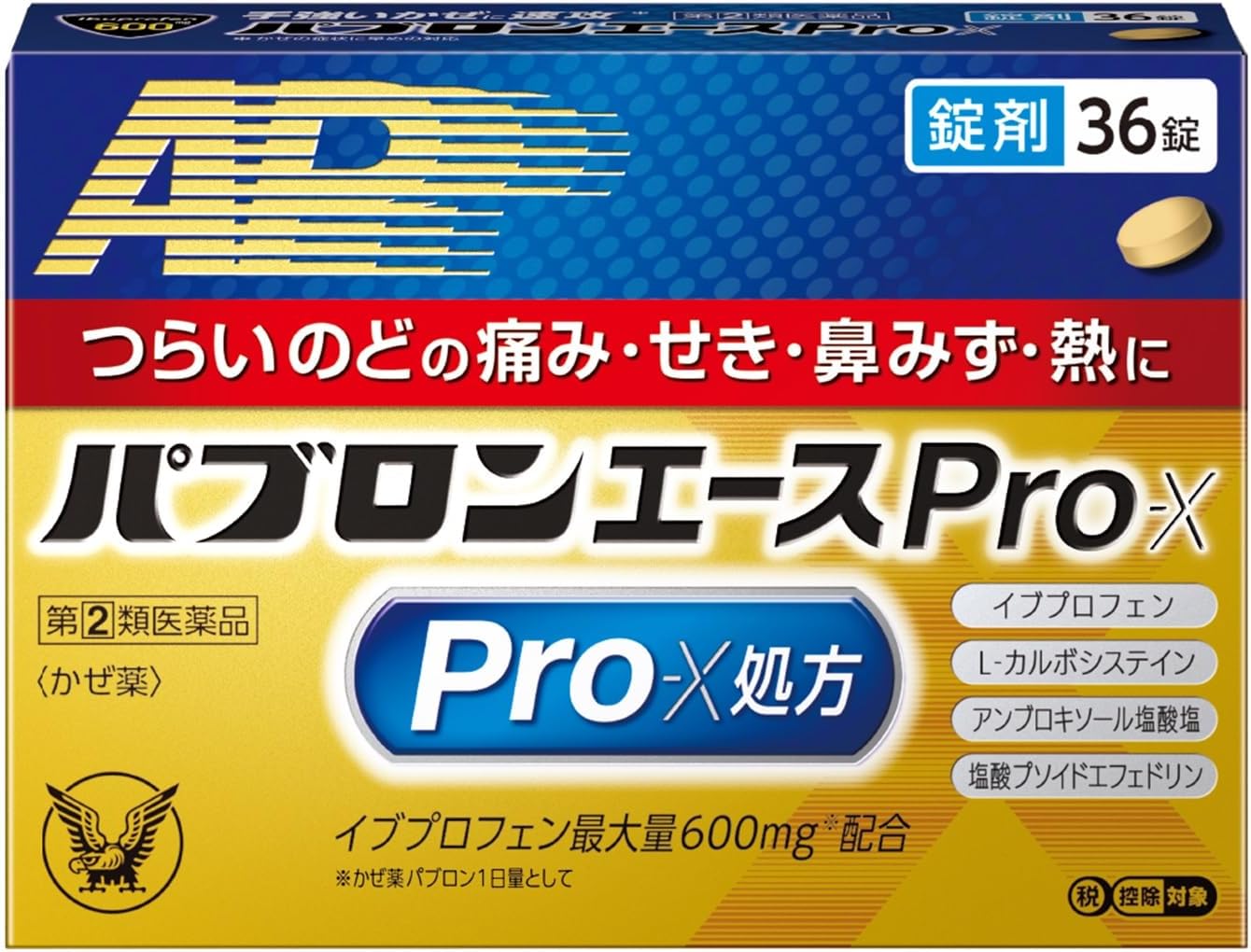
Relief of cold symptoms: sore throat, cough, phlegm, runny nose, stuffy nose, sneezing, fever, chills, headache, joint pain, and muscle pain. It is a cold medicine (かぜ薬) with ibuprofen. It replaces the earlier Pabron Ace Pro.
Ages 15 and over. Under 15: Do not take this medicine.
Do not take it if you are pregnant and due within 12 weeks, or if another cold medicine or fever reducer has ever set off asthma for you.
Do not take it with other cold medicines, fever reducers and pain relievers, sedatives, cough and phlegm medicines, or oral medicines that contain an antihistamine.
Do not drive or operate machinery after taking it. Drowsiness may occur.
If you are breastfeeding, do not take it, or avoid breastfeeding while you take it.
Do not drink alcohol before or after taking it.
Do not take it for more than 5 days, or take more than the dose.
Designated Class 2 medicine (指定第2類医薬品), as marked on the Amazon listing. The manufacturer's product page prints 第2類医薬品.
Do not take:
If you have had an allergic reaction to this medicine or any of its ingredients.
If you have had asthma from this medicine or from another cold medicine or fever reducer and pain reliever.
If you are under 15.
If you are pregnant and due to give birth within 12 weeks.
If you are being treated at a medical institution for a gastric or duodenal ulcer, a blood disease, liver disease, kidney disease, heart disease, or high blood pressure, or are being given zidovudine (Retrovir and others).
If you have difficulty urinating from an enlarged prostate.
If you have been diagnosed with high blood pressure, heart disease, a thyroid disorder, or diabetes.
Do not take with:
Other cold medicines, fever reducers and pain relievers, sedatives, cough and phlegm medicines, and oral medicines that contain an antihistamine (oral nasal medicines, motion sickness medicines, allergy medicines, and so on).
Do not:
Drive or operate machinery after taking it. Drowsiness may occur.
Take it while breastfeeding, or avoid breastfeeding if you do take it. Transfer into breast milk was seen in animal studies.
Drink alcohol before or after taking it.
Take it for more than 5 days.
Take more than the dose. (This item was added in the manufacturer's revision of April 2026.)
Instructions for use:
Take after meals, preferably within 30 minutes of the meal, with water or lukewarm water.
Ages 15 and over: Take 3 tablets per dose, 3 times a day.
Under 15: Do not take this medicine.
Follow the dosage directions strictly.
Press the raised part of the tablet on the blister sheet firmly with your fingertip to break the foil on the back, then take the tablet out. Swallowing the sheet by mistake can pierce the esophagus and cause an accident.
This medicine can turn your urine yellow. It is from the vitamin B2 and is nothing to worry about.
Consult a doctor, pharmacist, or registered salesperson before use if you:
Are receiving treatment from a doctor or dentist.
Are pregnant or may be pregnant.
Are elderly.
Have had an allergic reaction to a medicine or other substance.
Have had insomnia, dizziness, weakness, shaking, or palpitations from a cold, cough, or oral rhinitis medicine.
Have a high fever or difficulty urinating.
Have been diagnosed with, or have had, a gastric or duodenal ulcer, a blood disease, liver disease, kidney disease, bronchial asthma, systemic lupus erythematosus, mixed connective tissue disease, ulcerative colitis, Crohn's disease, glaucoma, a respiratory disorder, obstructive sleep apnea, or obesity.
Are being treated with a monoamine oxidase inhibitor (MAOI), such as selegiline hydrochloride, which is used for Parkinson's disease.
When to stop and seek advice:
If any of the following appear after taking this medicine, they may be side effects. Stop taking it at once and consult a doctor, pharmacist, or registered salesperson, taking the package insert with you:
Skin: Rash, redness, itching, swelling, or bruising.
Digestive: Nausea, vomiting, loss of appetite, stomach discomfort, stomach pain, mouth sores, heartburn, an upset stomach, bleeding from the digestive tract, abdominal pain, diarrhea, bloody stools, or a bloated stomach or abdomen.
Nervous system: Dizziness, numbness, insomnia, a low mood, nervousness, or convulsions.
Circulatory: Palpitations.
Respiratory: Shortness of breath.
Urinary: Difficulty urinating.
Other: Blurred vision, ringing in the ears, swelling, nosebleeds, bleeding gums, bleeding that is slow to stop, back pain, an excessive drop in body temperature, or fatigue.
Rare but serious reactions may occur. Seek medical attention immediately if you develop the following symptoms:
Shock (anaphylaxis): Itchy skin, hives, a hoarse voice, sneezing, an itchy throat, difficulty breathing, palpitations, or clouded consciousness soon after taking the medicine.
Blood disorders: Easy bruising, sudden high fever, chills, sore throat, easy bleeding (gums, nose), or bleeding that is slow to stop.
Digestive disorders: Black stools, vomiting blood, bloody stools, or loose stools with blood and mucus.
Severe skin reactions (Stevens-Johnson syndrome, toxic epidermal necrolysis, acute generalized exanthematous pustulosis): High fever, red eyes, eye discharge, sore lips, sore throat, a widespread rash or redness, small pustules on the red skin, fatigue, or loss of appetite that persist or suddenly get worse.
Liver damage: Fever, itching, rash, jaundice (yellow skin and whites of the eyes), brown urine, fatigue, or loss of appetite.
Kidney damage: Fever, rash, passing less urine, swelling of the whole body, fatigue, joint pain, or diarrhea.
Aseptic meningitis: Severe headache with a stiff neck, fever, nausea, or vomiting. This has been reported most often in people being treated for systemic lupus erythematosus or mixed connective tissue disease.
Heart attack: A tight squeezing pain in the chest, shortness of breath, or a cold sweat.
Stroke: Loss of consciousness, weakness on one side of the body, headache, vomiting, dizziness, or difficulty speaking, appearing suddenly.
Interstitial pneumonia: Shortness of breath on stairs or light exertion, dry cough, or fever that appears suddenly or keeps up.
Asthma: Wheezing when you breathe, or difficulty breathing.
Aplastic anemia: Bruising, nosebleeds, bleeding gums, fever, skin and mucous membranes that look pale, fatigue, palpitations, shortness of breath, feeling faint, or blood in the urine.
Agranulocytosis: Sudden high fever, chills, or sore throat.
Respiratory depression: Shortness of breath or difficulty breathing.
If constipation, dry mouth, or drowsiness appears and keeps up or gets worse, stop taking this medicine and consult a doctor, pharmacist, or registered salesperson, taking the package insert with you.
If symptoms have not improved after 5 to 6 doses, stop taking it and consult a doctor, pharmacist, or registered salesperson, taking the package insert with you. This applies especially if a fever lasts 3 days or more, or comes back.
Storage:
Store in a cool place with low humidity, away from direct sunlight. Keep out of reach of children. Do not transfer to another container, as this may cause misuse or affect the quality. Do not use it after the expiry date. Even within the expiry date, take it within 6 months of opening, to keep the quality.
Relief of cold symptoms: sore throat, chills, fever, headache, joint pain, muscle pain, and phlegm. The insert says it has no ingredient that causes sleepiness, dry mouth, or difficulty urinating (an antihistamine), none that tends to cause constipation (dihydrocodeine), and none that affects diabetes or high blood pressure (dl-methylephedrine, ephedra).
Bakumondoto dry extract (麦門冬湯乾燥エキス) 600 mg, made from the crude drugs below, listed by their Japanese names as on the box (amounts shown are crude drug per 12 tablets): バクモンドウ 1,600 mg, カンゾウ 400 mg, コウベイ 2,000 mg, タイソウ 600 mg, ニンジン 400 mg, ハンゲ 1,000 mg
Ages 15 and over. Under 15: Do not take this medicine.
Do not take it with other cold medicines, fever reducers and pain relievers, sedatives, or cough and phlegm medicines.
Do not drink alcohol before or after taking it.
Do not take it for a long time.
If symptoms have not improved after 5 to 6 doses, stop taking it and consult a doctor, pharmacist, or registered salesperson.
Class 2 medicine (第2類医薬品). The insert prints the sales name as パブロン50錠; the Amazon listing is the 48-tablet pack.
Do not take:
If you have had an allergic reaction to this medicine or any of its ingredients.
If you have had asthma from this medicine or from another cold medicine or fever reducer and pain reliever.
If you are under 15.
Do not take with:
Other cold medicines, fever reducers and pain relievers, sedatives, and cough and phlegm medicines.
Do not:
Drink alcohol before or after taking it.
Take it for a long time.
Instructions for use:
Take after meals, preferably within 30 minutes of the meal, with water or lukewarm water.
Ages 15 and over: Take 4 tablets per dose, 3 times a day.
Under 15: Do not take this medicine.
Follow the dosage directions strictly.
The first time you open the bottle, take out the filling and throw it away. It is there to keep the tablets from breaking in transit. Taking it in and out of the bottle can let foreign matter in.
Do not put tablets that you have touched with wet hands back into the bottle, as this can discolor them and change the quality.
Inactive ingredients:
Silicic anhydride, aluminum silicate, calcium carboxymethylcellulose, magnesium stearate, corn starch. The insert notes that the tablets are made from crude drugs, so the color may vary a little, with no effect on how well they work.
Consult a doctor, pharmacist, or registered salesperson before use if you:
Are receiving treatment from a doctor or dentist.
Are pregnant or may be pregnant.
Have had an allergic reaction to a medicine or other substance.
Have a high fever.
Have been diagnosed with heart disease, liver disease, kidney disease, or a gastric or duodenal ulcer.
When to stop and seek advice:
If any of the following appear after taking this medicine, they may be side effects. Stop taking it at once and consult a doctor, pharmacist, or registered salesperson, taking the package insert with you:
Skin: Rash, redness, or itching.
Digestive: Nausea, vomiting, or loss of appetite.
Nervous system: Dizziness.
Other: An excessive drop in body temperature.
Rare but serious reactions may occur. Seek medical attention immediately if you develop the following symptoms:
Shock (anaphylaxis): Itchy skin, hives, a hoarse voice, sneezing, an itchy throat, difficulty breathing, palpitations, or clouded consciousness soon after taking the medicine.
Severe skin reactions (Stevens-Johnson syndrome, toxic epidermal necrolysis, acute generalized exanthematous pustulosis): High fever, red eyes, eye discharge, sore lips, sore throat, a widespread rash or redness, small pustules on the red skin, fatigue, or loss of appetite that persist or suddenly get worse.
Drug-induced hypersensitivity syndrome: Widespread redness of the skin, a rash over the body, fever, fatigue, or swollen lymph nodes in the neck, armpits, or groin.
Liver damage: Fever, itching, rash, jaundice (yellow skin and whites of the eyes), brown urine, fatigue, or loss of appetite.
Kidney damage: Fever, rash, passing less urine, swelling of the whole body, fatigue, joint pain, or diarrhea.
Interstitial pneumonia: Shortness of breath on stairs or light exertion, dry cough, or fever that appears suddenly or keeps up.
Asthma: Wheezing when you breathe, or difficulty breathing.
If symptoms have not improved after 5 to 6 doses, stop taking it and consult a doctor, pharmacist, or registered salesperson, taking the package insert with you.
Storage:
Store in a cool place with low humidity, away from direct sunlight. Keep out of reach of children. Do not transfer to another container, as this may cause misuse or affect the quality. Do not use it after the expiry date. Even within the expiry date, take it as soon as you can after opening, to keep the quality.
Relief of cold symptoms: runny nose, stuffy nose, sore throat, sneezing, cough, phlegm, chills, fever, headache, joint pain, and muscle pain. The insert describes it as a cold medicine for a runny nose and a stuffy nose. It replaces the earlier Benza Block S Plus.
Active ingredients (per 6 tablets, the daily dose):
Ages 15 and over. Under 15: Do not take this medicine.
Do not take it if you have difficulty urinating from an enlarged prostate, or have been diagnosed with high blood pressure, heart disease, a thyroid disorder, or diabetes.
Do not take it with other cold medicines, fever reducers and pain relievers, cough and phlegm medicines, oral medicines that contain an antihistamine, stomach antispasmodics, or oral medicines that contain tranexamic acid.
Do not drive or operate machinery after taking it. Drowsiness, blurred vision, or unusual glare may occur.
Do not drink alcohol before or after taking it.
Do not take more than the dose, or take it for a long time.
Designated Class 2 medicine (指定第2類医薬品), as marked on the Amazon listing. The package insert prints it as a Class 2 medicine (第2類医薬品) with the designation mark.
Do not take:
If you have had an allergic reaction to this medicine or any of its ingredients.
If you have had asthma from this medicine or from another cold medicine or fever reducer and pain reliever.
If you have difficulty urinating from an enlarged prostate (前立腺肥大).
If you have been diagnosed with high blood pressure, heart disease, a thyroid disorder (甲状腺機能障害), or diabetes.
Do not take with:
Other cold medicines, fever reducers and pain relievers, sedatives, cough and phlegm medicines, and oral medicines that contain an antihistamine (oral nasal medicines, motion sickness medicines, allergy medicines, sleeping and calming medicines, and so on).
Stomach antispasmodic medicines (胃腸鎮痛鎮痙薬).
Oral medicines that contain tranexamic acid.
Do not:
Drive or operate machinery after taking it. Drowsiness, blurred vision, unusual glare, and similar symptoms may occur.
Drink alcohol before or after taking it.
Take more than the dose, or take it for a long time.
Instructions for use:
Take after meals, preferably within 30 minutes of the meal, with water or hot water. Swallow the tablets without chewing them.
Ages 15 and over: Take 2 tablets per dose, 3 times a day.
Under 15: Do not take this medicine.
Follow the dosage directions strictly.
Press the raised part of the caplet on the blister sheet firmly with your fingertip to break the foil on the back, then take the caplet out. Swallowing the sheet by mistake can pierce the esophagus and cause an accident.
This medicine can turn your urine yellow. It is from the riboflavin (vitamin B2) and is nothing to worry about.
Consult a doctor, pharmacist, or registered salesperson before use if you:
Are receiving treatment from a doctor or dentist.
Are pregnant or may be pregnant.
Are breastfeeding.
Are elderly.
Have had an allergic reaction to a medicine or other substance.
Have a high fever or difficulty urinating.
Have been diagnosed with liver disease, kidney disease, a gastric or duodenal ulcer, or glaucoma, have a blood clot (cerebral thrombosis, heart attack, thrombophlebitis), or may be at risk of a blood clot.
Are being treated with a monoamine oxidase inhibitor (MAOI), such as selegiline hydrochloride.
Have had insomnia, dizziness, weakness, shaking, or palpitations from a cold, cough, or oral rhinitis medicine.
Are taking an oral medicine that contains a parasympathetic blocker (副交感神経遮断剤), such as belladonna total alkaloids, isopropamide iodide, or scopolia extract.
When to stop and seek advice:
If any of the following appear after taking this medicine, they may be side effects. Stop taking it at once and consult a doctor, pharmacist, or registered salesperson, taking the package insert with you:
Skin: Rash, redness, or itching.
Digestive: Nausea, vomiting, or loss of appetite.
Nervous system: Dizziness, convulsions, headache, insomnia, or nervousness.
Respiratory: Shortness of breath or difficulty breathing.
Urinary: Difficulty urinating.
Other: An excessive drop in body temperature, flushed face, or unusual glare.
Rare but serious reactions may occur. Seek medical attention immediately if you develop the following symptoms:
Shock (anaphylaxis): Itchy skin, hives, a hoarse voice, sneezing, an itchy throat, difficulty breathing, palpitations, or clouded consciousness soon after taking the medicine.
Severe skin reactions (Stevens-Johnson syndrome, toxic epidermal necrolysis, acute generalized exanthematous pustulosis): High fever, red eyes, eye discharge, sore lips, sore throat, a widespread rash or redness, small pustules on the red skin, fatigue, or loss of appetite that persist or suddenly get worse.
Drug-induced hypersensitivity syndrome: Widespread redness of the skin, a rash over the body, fever, fatigue, or swollen lymph nodes in the neck, armpits, or groin.
Liver damage: Fever, itching, rash, jaundice (yellow skin and whites of the eyes), brown urine, fatigue, or loss of appetite.
Kidney damage: Fever, rash, passing less urine, swelling of the whole body, fatigue, joint pain, or diarrhea.
Interstitial pneumonia: Shortness of breath on stairs or light exertion, dry cough, or fever that appears suddenly or keeps up.
Asthma: Wheezing when you breathe, or difficulty breathing.
Aplastic anemia: Bruising, nosebleeds, bleeding gums, fever, skin and mucous membranes that look pale, fatigue, palpitations, shortness of breath, feeling faint, or blood in the urine.
Agranulocytosis: Sudden high fever, chills, or sore throat.
If constipation, dry mouth, drowsiness, or blurred vision appears and keeps up or gets worse, stop taking this medicine and consult a doctor, pharmacist, or registered salesperson, taking the package insert with you.
If symptoms have not improved after 5 to 6 doses, stop taking it and consult a doctor, pharmacist, or registered salesperson, taking the package insert with you.
Storage:
Store in a cool place with low humidity, away from direct sunlight, inside the box. Keep out of reach of children. Do not transfer to another container, as this may cause misuse or affect the quality. Do not use it after the expiry date. When you open the inner aluminum bag, write the date in the “opened on” (開封年月日) box on the carton. Once the bag is open, take it within 6 months of that date, to keep the quality.
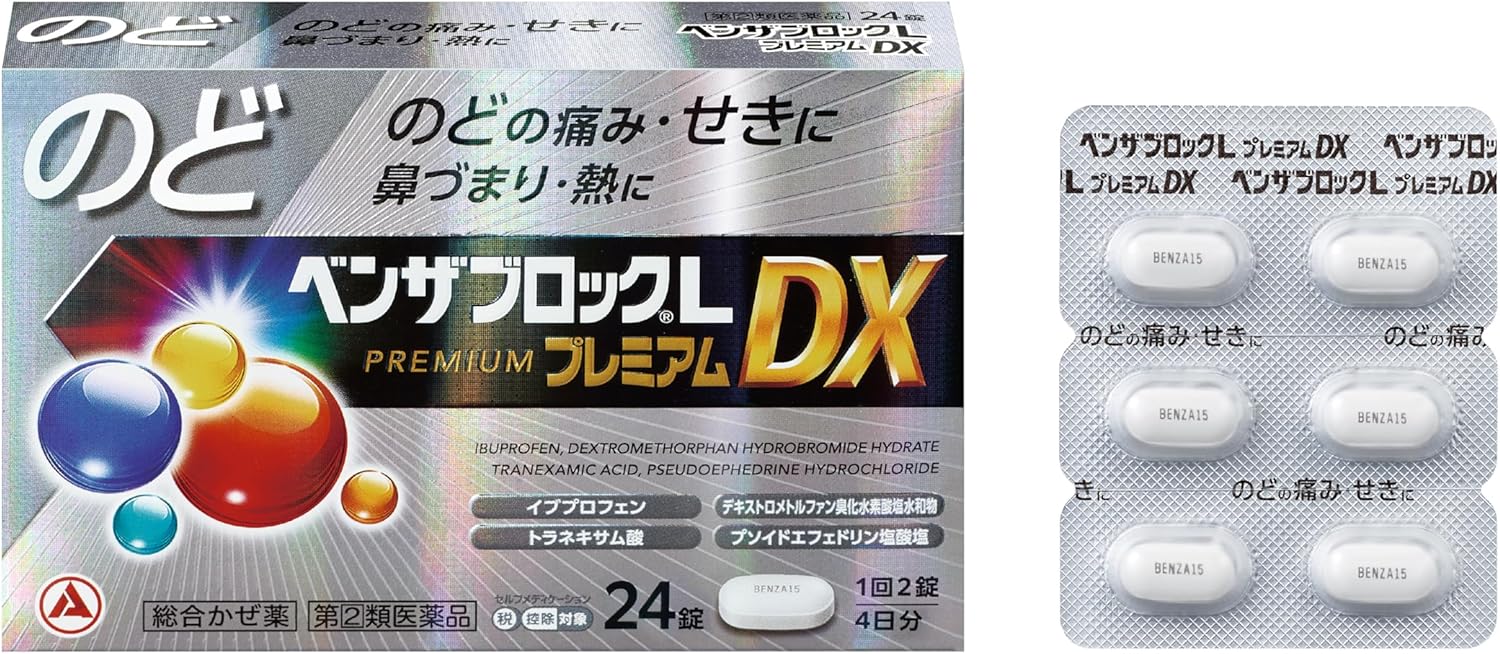
Relief of cold symptoms: sore throat, cough, fever, stuffy nose, runny nose, sneezing, phlegm, chills, headache, joint pain, and muscle pain. The insert describes it as a cold medicine for a sore throat and cough. It replaces the earlier Benza Block L Plus.
Active ingredients (per 6 tablets, the daily dose):
Ages 15 and over. Under 15: Do not take this medicine.
Do not take it if you are pregnant and due within 12 weeks, or if another cold medicine or fever reducer has ever set off asthma for you.
Do not take it if you have difficulty urinating from an enlarged prostate, or have been diagnosed with high blood pressure, heart disease, a thyroid disorder, or diabetes.
Do not take it with other cold medicines, fever reducers and pain relievers, cough and phlegm medicines, oral medicines that contain an antihistamine, or oral medicines that contain tranexamic acid.
Do not drive or operate machinery after taking it. Drowsiness may occur.
Do not drink alcohol before or after taking it.
Do not take it for more than 5 days, or take more than the dose.
Designated Class 2 medicine (指定第2類医薬品), as marked on the Amazon listing. The package insert prints it as a Class 2 medicine (第2類医薬品) with the designation mark.
Do not take:
If you have had an allergic reaction to this medicine or any of its ingredients.
If you have had asthma from this medicine or from another cold medicine or fever reducer and pain reliever.
If you are under 15.
If you are pregnant and due to give birth within 12 weeks.
If you have difficulty urinating from an enlarged prostate.
If you have been diagnosed with high blood pressure, heart disease, a thyroid disorder, or diabetes.
If you are being treated at a medical institution for a gastric or duodenal ulcer, a blood disease, liver disease, or kidney disease, or are being given zidovudine (Retrovir and others).
Do not take with:
Other cold medicines, fever reducers and pain relievers, sedatives, cough and phlegm medicines, and oral medicines that contain an antihistamine (oral nasal medicines, motion sickness medicines, allergy medicines, sleeping and calming medicines, and so on).
Oral medicines that contain tranexamic acid.
Do not:
Drive or operate machinery after taking it. Drowsiness may occur.
Drink alcohol before or after taking it.
Take it for more than 5 days.
Take more than the dose.
Instructions for use:
Take after meals, preferably within 30 minutes of the meal, with water or hot water. Swallow the tablets without chewing them.
Ages 15 and over: Take 2 tablets per dose, 3 times a day.
Under 15: Do not take this medicine.
Follow the dosage directions strictly.
Press the raised part of the caplet on the blister sheet firmly with your fingertip to break the foil on the back, then take the caplet out. Swallowing the sheet by mistake can pierce the esophagus and cause an accident.
Consult a doctor, pharmacist, or registered salesperson before use if you:
Are receiving treatment from a doctor or dentist.
Are pregnant or may be pregnant.
Are breastfeeding.
Are elderly.
Have had an allergic reaction to a medicine or other substance.
Have a high fever or difficulty urinating.
Have been diagnosed with glaucoma, systemic lupus erythematosus, mixed connective tissue disease, or bronchial asthma, have a blood clot (cerebral thrombosis, heart attack, thrombophlebitis), or may be at risk of a blood clot.
Have had a gastric or duodenal ulcer, ulcerative colitis, Crohn's disease, a blood disease, liver disease, or kidney disease.
Are being treated with a monoamine oxidase inhibitor (MAOI), such as selegiline hydrochloride.
Have had insomnia, dizziness, weakness, shaking, or palpitations from a cold, cough, or oral rhinitis medicine.
When to stop and seek advice:
If any of the following appear after taking this medicine, they may be side effects. Stop taking it at once and consult a doctor, pharmacist, or registered salesperson, taking the package insert with you:
Skin: Rash, redness, itching, or bruising.
Digestive: Nausea, vomiting, loss of appetite, stomach discomfort, stomach pain, mouth sores, heartburn, an upset stomach, bleeding from the digestive tract, abdominal pain, diarrhea, or bloody stools.
Nervous system: Dizziness, convulsions, insomnia, nervousness, or a low mood.
Circulatory: Palpitations.
Respiratory: Shortness of breath or difficulty breathing.
Urinary: Difficulty urinating.
Other: Blurred vision, ringing in the ears, swelling, nosebleeds, bleeding gums, bleeding that is slow to stop, back pain, an excessive drop in body temperature, fatigue, weakness, cold hands and feet, flushed face, or hot flashes.
Rare but serious reactions may occur. Seek medical attention immediately if you develop the following symptoms:
Shock (anaphylaxis): Itchy skin, hives, a hoarse voice, sneezing, an itchy throat, difficulty breathing, palpitations, or clouded consciousness soon after taking the medicine.
Severe skin reactions (Stevens-Johnson syndrome, toxic epidermal necrolysis, acute generalized exanthematous pustulosis): High fever, red eyes, eye discharge, sore lips, sore throat, a widespread rash or redness, small pustules on the red skin, fatigue, or loss of appetite that persist or suddenly get worse.
Liver damage: Fever, itching, rash, jaundice (yellow skin and whites of the eyes), brown urine, fatigue, or loss of appetite.
Kidney damage: Fever, rash, passing less urine, swelling of the whole body, fatigue, joint pain, or diarrhea.
Aseptic meningitis: Severe headache with a stiff neck, fever, nausea, or vomiting. This has been reported most often in people being treated for systemic lupus erythematosus or mixed connective tissue disease.
Heart attack: A tight squeezing pain in the chest, shortness of breath, or a cold sweat.
Stroke: Loss of consciousness, weakness on one side of the body, headache, vomiting, dizziness, or difficulty speaking, appearing suddenly.
Interstitial pneumonia: Shortness of breath on stairs or light exertion, dry cough, or fever that appears suddenly or keeps up.
Asthma: Wheezing when you breathe, or difficulty breathing.
Aplastic anemia: Bruising, nosebleeds, bleeding gums, fever, skin and mucous membranes that look pale, fatigue, palpitations, shortness of breath, feeling faint, or blood in the urine.
Agranulocytosis: Sudden high fever, chills, or sore throat.
Blood disorders: Easy bruising, sudden high fever, chills, sore throat, easy bleeding (gums, nose), or bleeding that is slow to stop.
Digestive disorders: Black stools, vomiting blood, bloody stools, or loose stools with blood and mucus.
If constipation, dry mouth, or drowsiness appears and keeps up or gets worse, stop taking this medicine and consult a doctor, pharmacist, or registered salesperson, taking the package insert with you.
If symptoms have not improved after 5 to 6 doses, stop taking it and consult a doctor, pharmacist, or registered salesperson, taking the package insert with you. This applies especially if a fever lasts 3 days or more, or comes back.
Storage:
Store in a cool place with low humidity, away from direct sunlight, inside the box. Keep out of reach of children. Do not transfer to another container, as this may cause misuse or affect the quality. Do not use it after the expiry date. When you open the inner aluminum bag, write the date in the “opened on” (開封年月日) box on the carton. Once the bag is open, take it within 6 months of that date, to keep the quality.
Relief of cold symptoms: fever, chills, headache, sore throat, joint pain, runny nose, stuffy nose, muscle pain, cough, phlegm, and sneezing. The insert describes it as a cold medicine for fever, chills, and headache. It replaces the earlier Benza Block IP Plus.
Active ingredients (per 6 tablets, the daily dose):
Calcium ascorbate, vitamin C (アスコルビン酸カルシウム) 500 mg
Ages 15 and over. Under 15: Do not take this medicine.
Do not take it if you are pregnant and due within 12 weeks, or if another cold medicine or fever reducer has ever set off asthma for you.
Do not take it with other cold medicines, fever reducers and pain relievers, cough and phlegm medicines, or oral medicines that contain an antihistamine.
Do not drive or operate machinery after taking it. Drowsiness may occur.
Do not drink alcohol before or after taking it.
Do not take it for more than 5 days, or take more than the dose.
Designated Class 2 medicine (指定第2類医薬品), as marked on the Amazon listing. The package insert prints it as a Class 2 medicine (第2類医薬品) with the designation mark.
Do not take:
If you have had an allergic reaction to this medicine or any of its ingredients.
If you have had asthma from this medicine or from another cold medicine or fever reducer and pain reliever.
If you are under 15.
If you are pregnant and due to give birth within 12 weeks.
Do not take with:
Other cold medicines, fever reducers and pain relievers, sedatives, cough and phlegm medicines, and oral medicines that contain an antihistamine (oral nasal medicines, motion sickness medicines, allergy medicines, sleeping and calming medicines, and so on).
Do not:
Drive or operate machinery after taking it. Drowsiness may occur.
Drink alcohol before or after taking it.
Take it for more than 5 days.
Take more than the dose.
Instructions for use:
Take after meals, preferably within 30 minutes of the meal, with water or hot water. Swallow the tablets without chewing them.
Ages 15 and over: Take 2 tablets per dose, 3 times a day.
Under 15: Do not take this medicine.
Follow the dosage directions strictly.
Press the raised part of the caplet on the blister sheet firmly with your fingertip to break the foil on the back, then take the caplet out. Swallowing the sheet by mistake can pierce the esophagus and cause an accident.
Consult a doctor, pharmacist, or registered salesperson before use if you:
Are receiving treatment from a doctor or dentist.
Are pregnant or may be pregnant.
Are breastfeeding.
Are elderly.
Have had an allergic reaction to a medicine or other substance.
Have a high fever or difficulty urinating.
Have been diagnosed with a thyroid disorder, diabetes, heart disease, high blood pressure, liver disease, kidney disease, glaucoma, systemic lupus erythematosus, or mixed connective tissue disease.
Have had a gastric or duodenal ulcer, ulcerative colitis, or Crohn's disease.
When to stop and seek advice:
If any of the following appear after taking this medicine, they may be side effects. Stop taking it at once and consult a doctor, pharmacist, or registered salesperson, taking the package insert with you:
Skin: Rash, redness, itching, or bruising.
Digestive: Nausea, vomiting, loss of appetite, stomach discomfort, stomach pain, mouth sores, heartburn, an upset stomach, bleeding from the digestive tract, abdominal pain, diarrhea, or bloody stools.
Nervous system: Dizziness.
Circulatory: Palpitations.
Respiratory: Shortness of breath or difficulty breathing.
Urinary: Difficulty urinating.
Other: Blurred vision, ringing in the ears, swelling, nosebleeds, bleeding gums, bleeding that is slow to stop, back pain, an excessive drop in body temperature, or fatigue.
Rare but serious reactions may occur. Seek medical attention immediately if you develop the following symptoms:
Shock (anaphylaxis): Itchy skin, hives, a hoarse voice, sneezing, an itchy throat, difficulty breathing, palpitations, or clouded consciousness soon after taking the medicine.
Severe skin reactions (Stevens-Johnson syndrome, toxic epidermal necrolysis, acute generalized exanthematous pustulosis): High fever, red eyes, eye discharge, sore lips, sore throat, a widespread rash or redness, small pustules on the red skin, fatigue, or loss of appetite that persist or suddenly get worse.
Drug-induced hypersensitivity syndrome: Widespread redness of the skin, a rash over the body, fever, fatigue, or swollen lymph nodes in the neck, armpits, or groin.
Liver damage: Fever, itching, rash, jaundice (yellow skin and whites of the eyes), brown urine, fatigue, or loss of appetite.
Kidney damage: Fever, rash, passing less urine, swelling of the whole body, fatigue, joint pain, or diarrhea.
Aseptic meningitis: Severe headache with a stiff neck, fever, nausea, or vomiting. This has been reported most often in people being treated for systemic lupus erythematosus or mixed connective tissue disease.
Heart attack: A tight squeezing pain in the chest, shortness of breath, or a cold sweat.
Stroke: Loss of consciousness, weakness on one side of the body, headache, vomiting, dizziness, or difficulty speaking, appearing suddenly.
Interstitial pneumonia: Shortness of breath on stairs or light exertion, dry cough, or fever that appears suddenly or keeps up.
Asthma: Wheezing when you breathe, or difficulty breathing.
Aplastic anemia: Bruising, nosebleeds, bleeding gums, fever, skin and mucous membranes that look pale, fatigue, palpitations, shortness of breath, feeling faint, or blood in the urine.
Agranulocytosis: Sudden high fever, chills, or sore throat.
Low platelets: Bleeding from a drop in blood platelets, such as nosebleeds, bleeding gums, or bruising.
If constipation, dry mouth, or drowsiness appears and keeps up or gets worse, stop taking this medicine and consult a doctor, pharmacist, or registered salesperson, taking the package insert with you.
If symptoms have not improved after 5 to 6 doses, stop taking it and consult a doctor, pharmacist, or registered salesperson, taking the package insert with you. This applies especially if a fever lasts 3 days or more, or comes back.
Storage:
Store in a cool place with low humidity, away from direct sunlight, inside the box. Keep out of reach of children. Do not transfer to another container, as this may cause misuse or affect the quality. Do not use it after the expiry date. When you open the inner aluminum bag, write the date in the “opened on” (開封年月日) box on the carton. Once the bag is open, take it within 6 months of that date, to keep the quality.
Relief of cold symptoms: sore throat, fever, chills, headache, runny nose, stuffy nose, sneezing, cough, phlegm, joint pain, and muscle pain. The insert describes it as a cold medicine for a painful sore throat and fever.
Active ingredients (per 6 tablets):
Tranexamic acid (トラネキサム酸) 750 mg
Ibuprofen (イブプロフェン) 450 mg
Clemastine fumarate (クレマスチンフマル酸塩) 1.34 mg, as 1 mg of clemastine
Ages 15 and over. Under 15: Do not take this medicine.
Do not take it if you are pregnant and due within 12 weeks, or if another cold medicine or fever reducer has ever set off asthma for you.
Do not take it with other cold medicines, fever reducers and pain relievers, cough and phlegm medicines, oral medicines that contain an antihistamine, or oral medicines that contain tranexamic acid.
Do not drive or operate machinery after taking it. Drowsiness may occur.
If you are breastfeeding, do not take it, or avoid breastfeeding while you take it.
Do not drink alcohol before or after taking it.
Do not take it for more than 5 days, or take more than the dose.
Designated Class 2 medicine (指定第2類医薬品). The package insert prints it as 第2類医薬品 with the 2 in a box, and the Amazon listing says 指定第2類医薬品.
Do not take:
If you have had an allergic reaction to this medicine or any of its ingredients.
If you have had asthma from this medicine or from another cold medicine or fever reducer and pain reliever.
If you are under 15.
If you are pregnant and due to give birth within 12 weeks.
Do not take with:
Other cold medicines, fever reducers and pain relievers, sedatives, cough and phlegm medicines, and oral medicines that contain an antihistamine (oral nasal medicines, motion sickness medicines, allergy medicines, and so on).
Stomach antispasmodic medicines (胃腸鎮痛鎮痙薬).
Oral medicines that contain tranexamic acid.
Do not:
Drive or operate machinery after taking it. Drowsiness may occur.
Take it while breastfeeding, or avoid breastfeeding if you do take it.
Drink alcohol before or after taking it.
Take it for more than 5 days.
Take more than the dose.
Instructions for use:
Take after meals, preferably within 30 minutes of the meal, with water or hot water.
Ages 15 and over: Take 2 tablets per dose, 3 times a day.
Under 15: Do not take this medicine.
Follow the dosage directions strictly.
Press the raised part of the tablet on the blister sheet firmly with your fingertip to break the foil on the back, then take the tablet out. Swallowing the sheet by mistake can pierce the esophagus and cause an accident.
This medicine can turn your urine yellow. It is from the riboflavin (vitamin B2) and is nothing to worry about.
Consult a doctor, pharmacist, or registered salesperson before use if you:
Are receiving treatment from a doctor or dentist.
Are pregnant or may be pregnant.
Are elderly.
Have had an allergic reaction to a medicine or other substance.
Have a high fever or difficulty urinating.
Have been diagnosed with a thyroid disorder, diabetes, heart disease, high blood pressure, liver disease, kidney disease, glaucoma, systemic lupus erythematosus, mixed connective tissue disease, a respiratory disorder, obstructive sleep apnea, or obesity, have a blood clot (cerebral thrombosis, heart attack, thrombophlebitis), or may be at risk of a blood clot.
Have had a gastric or duodenal ulcer, ulcerative colitis, or Crohn's disease.
When to stop and seek advice:
If any of the following appear after taking this medicine, they may be side effects. Stop taking it at once and consult a doctor, pharmacist, or registered salesperson, taking the package insert with you:
Skin: Rash, redness, itching, or bruising.
Digestive: Nausea, vomiting, loss of appetite, stomach discomfort, stomach pain, mouth sores, heartburn, an upset stomach, bleeding from the digestive tract, abdominal pain, diarrhea, or bloody stools.
Nervous system: Dizziness, excitement, or convulsions.
Circulatory: Palpitations.
Respiratory: Shortness of breath.
Urinary: Difficulty urinating.
Other: Blurred vision, ringing in the ears, swelling, nosebleeds, bleeding gums, bleeding that is slow to stop, back pain, an excessive drop in body temperature, or fatigue.
Rare but serious reactions may occur. Seek medical attention immediately if you develop the following symptoms:
Shock (anaphylaxis): Itchy skin, hives, a hoarse voice, sneezing, an itchy throat, difficulty breathing, palpitations, or clouded consciousness soon after taking the medicine.
Severe skin reactions (Stevens-Johnson syndrome, toxic epidermal necrolysis, acute generalized exanthematous pustulosis): High fever, red eyes, eye discharge, sore lips, sore throat, a widespread rash or redness, small pustules on the red skin, fatigue, or loss of appetite that persist or suddenly get worse.
Liver damage: Fever, itching, rash, jaundice (yellow skin and whites of the eyes), brown urine, fatigue, or loss of appetite.
Kidney damage: Fever, rash, passing less urine, swelling of the whole body, fatigue, joint pain, or diarrhea.
Aseptic meningitis: Severe headache with a stiff neck, fever, nausea, or vomiting. This has been reported most often in people being treated for systemic lupus erythematosus or mixed connective tissue disease.
Heart attack: A tight squeezing pain in the chest, shortness of breath, or a cold sweat.
Stroke: Loss of consciousness, weakness on one side of the body, headache, vomiting, dizziness, or difficulty speaking, appearing suddenly.
Interstitial pneumonia: Shortness of breath on stairs or light exertion, dry cough, or fever that appears suddenly or keeps up.
Asthma: Wheezing when you breathe, or difficulty breathing.
Aplastic anemia: Bruising, nosebleeds, bleeding gums, fever, skin and mucous membranes that look pale, fatigue, palpitations, shortness of breath, feeling faint, or blood in the urine.
Agranulocytosis: Sudden high fever, chills, or sore throat.
Respiratory depression: Shortness of breath or difficulty breathing.
If constipation, dry mouth, or drowsiness appears and keeps up or gets worse, stop taking this medicine and consult a doctor, pharmacist, or registered salesperson, taking the package insert with you.
If symptoms have not improved after 5 to 6 doses, stop taking it and consult a doctor, pharmacist, or registered salesperson, taking the package insert with you. This applies especially if a fever lasts 3 days or more, or comes back.
Storage:
Store in a cool place with low humidity, away from direct sunlight. Keep out of reach of children. Do not transfer to another container, as this may cause misuse or affect the quality. Do not use it after the expiry date printed on the package.
Relief of cold symptoms: fever, chills, headache, sore throat, runny nose, stuffy nose, cough, phlegm, joint pain, muscle pain, and sneezing. The insert describes it as a pyrine-type (ピリン系) cold medicine with isopropylantipyrine, for colds with a hard fever and chills.
Active ingredients (per 6 tablets):
Isopropylantipyrine, a pyrine-type fever reducer (イソプロピルアンチピリン) 300 mg
Ages 7 and over. Ages 7 to 14 take 1 tablet per dose. Under 7: Do not take this medicine.
Do not take it with other cold medicines, fever reducers and pain relievers, sedatives, cough and phlegm medicines, or oral medicines that contain an antihistamine.
Do not drive or operate machinery after taking it. Drowsiness may occur.
Do not drink alcohol before or after taking it.
Do not take more than the dose, or take it for a long time.
If symptoms have not improved after 5 to 6 doses, stop taking it and consult a doctor, pharmacist, or registered salesperson.
Designated Class 2 medicine (指定第2類医薬品). The package insert prints it as 第2類医薬品 with the 2 in a box, and the Amazon listing says 指定第2類医薬品.
Do not take:
If you have had an allergic reaction to this medicine or any of its ingredients.
If you have had asthma from this medicine or from another cold medicine or fever reducer and pain reliever.
Do not take with:
Other cold medicines, fever reducers and pain relievers, sedatives, cough and phlegm medicines, and oral medicines that contain an antihistamine (oral nasal medicines, motion sickness medicines, allergy medicines, and so on).
Do not:
Drive or operate machinery after taking it. Drowsiness may occur.
Drink alcohol before or after taking it.
Take it for a long time.
Take more than the dose.
Instructions for use:
Take after meals, preferably within 30 minutes of the meal, with water or hot water.
Ages 15 and over: Take 2 tablets per dose, 3 times a day.
Ages 7 to 14: Take 1 tablet per dose, 3 times a day.
Under 7: Do not take this medicine.
Follow the dosage directions strictly.
If a child aged 7 or over takes it, an adult must supervise and guide.
Press the raised part of the tablet on the blister sheet firmly with your fingertip to break the foil on the back, then take the tablet out. Swallowing the sheet by mistake can pierce the esophagus and cause an accident.
Consult a doctor, pharmacist, or registered salesperson before use if you:
Are receiving treatment from a doctor or dentist.
Are pregnant or may be pregnant.
Are breastfeeding.
Are elderly.
Have had an allergic reaction to a medicine or other substance.
Have a high fever or difficulty urinating.
Have been diagnosed with a thyroid disorder, diabetes, heart disease, high blood pressure, liver disease, kidney disease, a gastric or duodenal ulcer, or glaucoma.
When to stop and seek advice:
If any of the following appear after taking this medicine, they may be side effects. Stop taking it at once and consult a doctor, pharmacist, or registered salesperson, taking the package insert with you:
Skin: Rash, redness, or itching.
Digestive: Nausea, vomiting, or loss of appetite.
Nervous system: Dizziness, excitement, or convulsions.
Urinary: Difficulty urinating.
Other: An excessive drop in body temperature.
Rare but serious reactions may occur. Seek medical attention immediately if you develop the following symptoms:
Shock (anaphylaxis): Itchy skin, hives, a hoarse voice, sneezing, an itchy throat, difficulty breathing, palpitations, or clouded consciousness soon after taking the medicine.
Severe skin reactions (Stevens-Johnson syndrome, toxic epidermal necrolysis, acute generalized exanthematous pustulosis): High fever, red eyes, eye discharge, sore lips, sore throat, a widespread rash or redness, small pustules on the red skin, fatigue, or loss of appetite that persist or suddenly get worse.
Drug-induced hypersensitivity syndrome: Widespread redness of the skin, a rash over the body, fever, fatigue, or swollen lymph nodes in the neck, armpits, or groin.
Liver damage: Fever, itching, rash, jaundice (yellow skin and whites of the eyes), brown urine, fatigue, or loss of appetite.
Kidney damage: Fever, rash, passing less urine, swelling of the whole body, fatigue, joint pain, or diarrhea.
Interstitial pneumonia: Shortness of breath on stairs or light exertion, dry cough, or fever that appears suddenly or keeps up.
Asthma: Wheezing when you breathe, or difficulty breathing.
Aplastic anemia: Bruising, nosebleeds, bleeding gums, fever, skin and mucous membranes that look pale, fatigue, palpitations, shortness of breath, feeling faint, or blood in the urine.
Agranulocytosis: Sudden high fever, chills, or sore throat.
If dry mouth or drowsiness appears and keeps up or gets worse, stop taking this medicine and consult a doctor, pharmacist, or registered salesperson, taking the package insert with you.
If symptoms have not improved after 5 to 6 doses, stop taking it and consult a doctor, pharmacist, or registered salesperson, taking the package insert with you.
Storage:
Store in a cool place with low humidity, away from direct sunlight. Keep out of reach of children. Do not transfer to another container, as this may cause misuse or affect the quality. Do not use it after the expiry date printed on the package. Once you have opened the aluminum bag, use it within 12 months. Write the date you opened it in the “opened on” (開封年月日) box on the carton.
Relief of cold symptoms: runny nose, stuffy nose, sore throat, cough, phlegm, fever, chills, sneezing, headache, joint pain, and muscle pain. The insert describes it as a cold medicine for a bad runny nose and stuffy nose.
Benfotiamine, a vitamin B1 derivative (ベンフォチアミン) 25 mg
Riboflavin, vitamin B2 (リボフラビン) 12 mg
Ages 15 and over. Under 15: Do not take this medicine.
Do not take it if you are pregnant and due within 12 weeks, or if another cold medicine or fever reducer has ever set off asthma for you.
Do not take it with other cold medicines, fever reducers and pain relievers, cough and phlegm medicines, oral medicines that contain an antihistamine, or stomach antispasmodics.
Do not drive or operate machinery after taking it. Drowsiness, blurred vision, or unusual glare may occur.
If you are breastfeeding, do not take it, or avoid breastfeeding while you take it.
Do not drink alcohol before or after taking it.
Do not take it for more than 5 days, or take more than the dose.
Designated Class 2 medicine (指定第2類医薬品). The package insert prints it as 第2類医薬品 with the 2 in a box, and the Amazon listing says 指定第2類医薬品.
Do not take:
If you have had an allergic reaction to this medicine or any of its ingredients.
If you have had asthma from this medicine or from another cold medicine or fever reducer and pain reliever.
If you are under 15.
If you are pregnant and due to give birth within 12 weeks.
Do not take with:
Other cold medicines, fever reducers and pain relievers, sedatives, cough and phlegm medicines, and oral medicines that contain an antihistamine (oral nasal medicines, motion sickness medicines, allergy medicines, and so on).
Stomach antispasmodic medicines (胃腸鎮痛鎮痙薬).
Do not:
Drive or operate machinery after taking it. Drowsiness, blurred vision, unusual glare, and similar symptoms may occur.
Take it while breastfeeding, or avoid breastfeeding if you do take it.
Drink alcohol before or after taking it.
Take it for more than 5 days.
Take more than the dose.
Instructions for use:
Take after meals, preferably within 30 minutes of the meal, with water or hot water.
Ages 15 and over: Take 2 tablets per dose, 3 times a day.
Under 15: Do not take this medicine.
Follow the dosage directions strictly.
Press the raised part of the tablet on the blister sheet firmly with your fingertip to break the foil on the back, then take the tablet out. Swallowing the sheet by mistake can pierce the esophagus and cause an accident.
This medicine can turn your urine yellow. It is from the riboflavin (vitamin B2) and is nothing to worry about.
Consult a doctor, pharmacist, or registered salesperson before use if you:
Are receiving treatment from a doctor or dentist.
Are pregnant or may be pregnant.
Are elderly.
Have had an allergic reaction to a medicine or other substance.
Have a high fever or difficulty urinating.
Have been diagnosed with a thyroid disorder, diabetes, heart disease, high blood pressure, liver disease, kidney disease, glaucoma, systemic lupus erythematosus, mixed connective tissue disease, a respiratory disorder, obstructive sleep apnea, or obesity.
Have had a gastric or duodenal ulcer, ulcerative colitis, or Crohn's disease.
When to stop and seek advice:
If any of the following appear after taking this medicine, they may be side effects. Stop taking it at once and consult a doctor, pharmacist, or registered salesperson, taking the package insert with you:
Skin: Rash, redness, itching, or bruising.
Digestive: Nausea, vomiting, loss of appetite, stomach discomfort, stomach pain, mouth sores, heartburn, an upset stomach, bleeding from the digestive tract, abdominal pain, diarrhea, or bloody stools.
Nervous system: Dizziness, headache, excitement, or convulsions.
Circulatory: Palpitations.
Respiratory: Shortness of breath.
Urinary: Difficulty urinating.
Other: Blurred vision, ringing in the ears, swelling, nosebleeds, bleeding gums, bleeding that is slow to stop, back pain, an excessive drop in body temperature, fatigue, flushed face, or unusual glare.
Rare but serious reactions may occur. Seek medical attention immediately if you develop the following symptoms:
Shock (anaphylaxis): Itchy skin, hives, a hoarse voice, sneezing, an itchy throat, difficulty breathing, palpitations, or clouded consciousness soon after taking the medicine.
Severe skin reactions (Stevens-Johnson syndrome, toxic epidermal necrolysis, acute generalized exanthematous pustulosis): High fever, red eyes, eye discharge, sore lips, sore throat, a widespread rash or redness, small pustules on the red skin, fatigue, or loss of appetite that persist or suddenly get worse.
Liver damage: Fever, itching, rash, jaundice (yellow skin and whites of the eyes), brown urine, fatigue, or loss of appetite.
Kidney damage: Fever, rash, passing less urine, swelling of the whole body, fatigue, joint pain, or diarrhea.
Aseptic meningitis: Severe headache with a stiff neck, fever, nausea, or vomiting. This has been reported most often in people being treated for systemic lupus erythematosus or mixed connective tissue disease.
Heart attack: A tight squeezing pain in the chest, shortness of breath, or a cold sweat.
Stroke: Loss of consciousness, weakness on one side of the body, headache, vomiting, dizziness, or difficulty speaking, appearing suddenly.
Interstitial pneumonia: Shortness of breath on stairs or light exertion, dry cough, or fever that appears suddenly or keeps up.
Asthma: Wheezing when you breathe, or difficulty breathing.
Aplastic anemia: Bruising, nosebleeds, bleeding gums, fever, skin and mucous membranes that look pale, fatigue, palpitations, shortness of breath, feeling faint, or blood in the urine.
Agranulocytosis: Sudden high fever, chills, or sore throat.
Respiratory depression: Shortness of breath or difficulty breathing.
If constipation, dry mouth, or drowsiness appears and keeps up or gets worse, stop taking this medicine and consult a doctor, pharmacist, or registered salesperson, taking the package insert with you.
If symptoms have not improved after 5 to 6 doses, stop taking it and consult a doctor, pharmacist, or registered salesperson, taking the package insert with you. This applies especially if a fever lasts 3 days or more, or comes back.
Storage:
Store in a cool place with low humidity, away from direct sunlight. Keep out of reach of children. Do not transfer to another container, as this may cause misuse or affect the quality. Do not use it after the expiry date printed on the package. Once you have opened the aluminum bag, use it within 9 months. Write the date you opened it in the “opened on” (開封年月日) box on the carton.
Relief of cold symptoms: sore throat, fever, runny nose, stuffy nose, cough, phlegm, chills, headache, sneezing, joint pain, and muscle pain. It is a cold medicine that adults and children aged 7 and over can take. The manufacturer describes the tablets as small, sugar-coated, and without a bitter taste. It replaces the earlier New Lulu A Gold DX.
Ages 7 and over. Ages 11 to 14 take 2 tablets per dose; ages 7 to 10 take 1 tablet. Under 7: Do not take this medicine.
Do not take it with other cold medicines, fever reducers and pain relievers, sedatives, cough and phlegm medicines, oral medicines that contain an antihistamine, stomach antispasmodics, or oral medicines that contain tranexamic acid.
Do not drive or operate machinery after taking it. Drowsiness, blurred vision, or unusual glare may occur.
Do not drink alcohol before or after taking it.
Do not take it for a long time, or take more than the dose.
If symptoms have not improved after 5 to 6 doses, stop taking it and consult a doctor, pharmacist, or registered salesperson.
Designated Class 2 medicine (指定第2類医薬品). The package insert prints it as 第2類医薬品 with the 2 in a box, and the Amazon listing says 指定第2類医薬品.
Do not take:
If you have had an allergic reaction to this medicine or any of its ingredients.
If you have had asthma from this medicine or from another cold medicine or fever reducer and pain reliever.
Do not take with:
Other cold medicines, fever reducers and pain relievers, sedatives, cough and phlegm medicines, and oral medicines that contain an antihistamine (oral nasal medicines, motion sickness medicines, allergy medicines, and so on).
Stomach antispasmodic medicines (胃腸鎮痛鎮痙薬).
Oral medicines that contain tranexamic acid.
Do not:
Drive or operate machinery after taking it. Drowsiness, blurred vision, unusual glare, and similar symptoms may occur.
Drink alcohol before or after taking it.
Take it for a long time.
Take more than the dose.
Instructions for use:
Take after meals, preferably within 30 minutes of the meal, with water or hot water.
Ages 15 and over: Take 3 tablets per dose, 3 times a day.
Ages 11 to 14: Take 2 tablets per dose, 3 times a day.
Ages 7 to 10: Take 1 tablet per dose, 3 times a day.
Under 7: Do not take this medicine.
Follow the dosage directions strictly.
If a child aged 7 or over takes it, an adult must supervise and guide.
Do not handle the tablets with wet hands, and do not put a wet tablet back in the bottle. Moisture can partly dissolve the surface and cause discoloration or mottling, and a wet tablet can affect the others.
The padding in the bottle is there to stop the tablets breaking in transit. Throw it away after you open the bottle.
Consult a doctor, pharmacist, or registered salesperson before use if you:
Are receiving treatment from a doctor or dentist.
Are pregnant or may be pregnant.
Are breastfeeding.
Are elderly.
Have had an allergic reaction to a medicine or other substance.
Have a high fever or difficulty urinating.
Have been diagnosed with a thyroid disorder, diabetes, heart disease, high blood pressure, liver disease, kidney disease, a gastric or duodenal ulcer, or glaucoma, have a blood clot (cerebral thrombosis, heart attack, thrombophlebitis), or may be at risk of a blood clot.
When to stop and seek advice:
If any of the following appear after taking this medicine, they may be side effects. Stop taking it at once and consult a doctor, pharmacist, or registered salesperson, taking the package insert with you:
Skin: Rash, redness, or itching.
Digestive: Nausea, vomiting, or loss of appetite.
Nervous system: Dizziness, excitement, convulsions, or headache.
Respiratory: Shortness of breath or difficulty breathing.
Urinary: Difficulty urinating.
Other: An excessive drop in body temperature, flushed face, or unusual glare.
Rare but serious reactions may occur. Seek medical attention immediately if you develop the following symptoms:
Shock (anaphylaxis): Itchy skin, hives, a hoarse voice, sneezing, an itchy throat, difficulty breathing, palpitations, or clouded consciousness soon after taking the medicine.
Severe skin reactions (Stevens-Johnson syndrome, toxic epidermal necrolysis, acute generalized exanthematous pustulosis): High fever, red eyes, eye discharge, sore lips, sore throat, a widespread rash or redness, small pustules on the red skin, fatigue, or loss of appetite that persist or suddenly get worse.
Drug-induced hypersensitivity syndrome: Widespread redness of the skin, a rash over the body, fever, fatigue, or swollen lymph nodes in the neck, armpits, or groin.
Liver damage: Fever, itching, rash, jaundice (yellow skin and whites of the eyes), brown urine, fatigue, or loss of appetite.
Kidney damage: Fever, rash, passing less urine, swelling of the whole body, fatigue, joint pain, or diarrhea.
Interstitial pneumonia: Shortness of breath on stairs or light exertion, dry cough, or fever that appears suddenly or keeps up.
Asthma: Wheezing when you breathe, or difficulty breathing.
If constipation, dry mouth, drowsiness, or blurred vision appears and keeps up or gets worse, stop taking this medicine and consult a doctor, pharmacist, or registered salesperson, taking the package insert with you.
If symptoms have not improved after 5 to 6 doses, stop taking it and consult a doctor, pharmacist, or registered salesperson, taking the package insert with you.
Storage:
Store in a cool place with low humidity, away from direct sunlight, with the cap shut tight. Keep out of reach of children. Do not transfer to another container, as this may cause misuse or affect the quality. Do not use it after the expiry date. Once you have opened the bottle, use it within 12 months. Write the date you opened it in the “opened on” (開封年月日) box on the carton.
Relief of cold symptoms: sore throat, fever, runny nose, stuffy nose, cough, phlegm, chills, headache, joint pain, muscle pain, and sneezing. The insert describes it as a pyrine-type (ピリン系) cold medicine with isopropylantipyrine, taken twice a day. Fast-dissolving and slow-dissolving granules are meant to keep it working from morning to night, or night to morning.
Active ingredients (per 4 capsules):
Isopropylantipyrine, a pyrine-type fever reducer (イソプロピルアンチピリン) 300 mg
Licorice extract powder (カンゾウエキス末) 118 mg, from 983 mg of the crude drug
Anhydrous caffeine (無水カフェイン) 75 mg
Ages 15 and over. Under 15: Do not take this medicine.
Do not take it with other cold medicines, fever reducers and pain relievers, sedatives, cough and phlegm medicines, or oral medicines that contain an antihistamine.
Do not drive or operate machinery after taking it. Drowsiness may occur.
If you are breastfeeding, do not take it, or avoid breastfeeding while you take it.
Do not drink alcohol before or after taking it.
Do not take it for a long time, or take more than the dose.
If symptoms have not improved after 5 to 6 doses, stop taking it and consult a doctor, pharmacist, or registered salesperson.
Designated Class 2 medicine (指定第2類医薬品). The package insert prints it as 第2類医薬品 with the 2 in a box, and the Amazon listing says 指定第2類医薬品.
Do not take:
If you have had an allergic reaction to this medicine or any of its ingredients.
If you have had asthma from this medicine or from another cold medicine or fever reducer and pain reliever.
If you are under 15.
Do not take with:
Other cold medicines, fever reducers and pain relievers, sedatives, cough and phlegm medicines, and oral medicines that contain an antihistamine (oral nasal medicines, motion sickness medicines, allergy medicines, and so on).
Do not:
Drive or operate machinery after taking it. Drowsiness may occur.
Take it while breastfeeding, or avoid breastfeeding if you do take it.
Drink alcohol before or after taking it.
Take it for a long time.
Take more than the dose. (This item was added in the manufacturer's revision of May 2026.)
Instructions for use:
Take the dose below with water or hot water, after the morning meal and after the evening meal, preferably within 30 minutes of the meal.
Ages 15 and over: Take 2 capsules per dose, 2 times a day (morning and evening).
Under 15: Do not take this medicine.
Follow the dosage directions strictly.
Press the raised part of the capsule on the blister sheet firmly with your fingertip to break the foil on the back, then take the capsule out. Swallowing the sheet by mistake can pierce the esophagus and cause an accident.
Inactive ingredients:
Lactose, hydroxypropylcellulose, corn starch, silicic anhydride, methacrylic acid copolymer L, stearic acid, talc, cellulose, carmellose calcium, gelatin, sodium lauryl sulfate. The capsules are yellow and white.
Consult a doctor, pharmacist, or registered salesperson before use if you:
Are receiving treatment from a doctor or dentist.
Are pregnant or may be pregnant.
Are elderly.
Have had an allergic reaction to a medicine or other substance.
Have a high fever or difficulty urinating.
Have been diagnosed with a thyroid disorder, diabetes, heart disease, high blood pressure, liver disease, kidney disease, a gastric or duodenal ulcer, glaucoma, a respiratory disorder, obstructive sleep apnea, or obesity.
When to stop and seek advice:
If any of the following appear after taking this medicine, they may be side effects. Stop taking it at once and consult a doctor, pharmacist, or registered salesperson, taking the package insert with you:
Skin: Rash, redness, itching, or swelling.
Digestive: Nausea, vomiting, loss of appetite, upper abdominal pain, or heartburn.
Nervous system: Dizziness.
Urinary: Difficulty urinating.
Other: An excessive drop in body temperature.
Rare but serious reactions may occur. Seek medical attention immediately if you develop the following symptoms:
Shock (anaphylaxis): Itchy skin, hives, a hoarse voice, sneezing, an itchy throat, difficulty breathing, palpitations, or clouded consciousness soon after taking the medicine.
Severe skin reactions (Stevens-Johnson syndrome, toxic epidermal necrolysis, acute generalized exanthematous pustulosis): High fever, red eyes, eye discharge, sore lips, sore throat, a widespread rash or redness, small pustules on the red skin, fatigue, or loss of appetite that persist or suddenly get worse.
Drug-induced hypersensitivity syndrome: Widespread redness of the skin, a rash over the body, fever, fatigue, or swollen lymph nodes in the neck, armpits, or groin.
Liver damage: Fever, itching, rash, jaundice (yellow skin and whites of the eyes), brown urine, fatigue, or loss of appetite.
Kidney damage: Fever, rash, passing less urine, swelling of the whole body, fatigue, joint pain, or diarrhea.
Interstitial pneumonia: Shortness of breath on stairs or light exertion, dry cough, or fever that appears suddenly or keeps up.
Asthma: Wheezing when you breathe, or difficulty breathing.
Aplastic anemia: Bruising, nosebleeds, bleeding gums, fever, skin and mucous membranes that look pale, fatigue, palpitations, shortness of breath, feeling faint, or blood in the urine.
Agranulocytosis: Sudden high fever, chills, or sore throat.
Respiratory depression: Shortness of breath or difficulty breathing.
If constipation, dry mouth, or drowsiness appears and keeps up or gets worse, stop taking this medicine and consult a doctor, pharmacist, or registered salesperson, taking the package insert with you.
If symptoms have not improved after 5 to 6 doses, stop taking it and consult a doctor, pharmacist, or registered salesperson, taking the package insert with you.
Storage:
Store in a cool place with low humidity, away from direct sunlight. Keep out of reach of children. Do not transfer to another container, as this may cause misuse or affect the quality. Do not use it after the expiry date printed on the package.
Relief of cough and phlegm (せき、たん). It is a cough medicine taken twice a day. Fast-dissolving and slow-dissolving granules are meant to keep it working from morning to night, or night to morning.
Active ingredients (per 2 capsules, the daily dose):
Ages 15 and over. Under 15: Do not take this medicine.
Do not take it with other cough and phlegm medicines, cold medicines, sedatives, or oral medicines that contain an antihistamine.
Do not drive or operate machinery after taking it. Drowsiness may occur.
Do not take more than the dose.
Consult a doctor, pharmacist, or registered salesperson before use if you have a high fever or difficulty urinating, or have been diagnosed with heart disease, high blood pressure, diabetes, glaucoma, or a thyroid disorder.
If symptoms have not improved after 5 to 6 doses, stop taking it and consult a doctor, pharmacist, or registered salesperson.
Designated Class 2 medicine (指定第2類医薬品). The package insert prints it as 第2類医薬品 with the 2 in a box, and the Amazon listing says 指定第2類医薬品.
Do not take:
If you have had an allergic reaction to this medicine or any of its ingredients.
Do not take with:
Other cough and phlegm medicines, cold medicines, sedatives, and oral medicines that contain an antihistamine (oral nasal medicines, motion sickness medicines, allergy medicines, and so on).
Do not:
Drive or operate machinery after taking it. Drowsiness may occur.
Take more than the dose. (This item was added in the manufacturer's revision of May 2026.)
Instructions for use:
Take the dose below with water or hot water.
Ages 15 and over: Take 1 capsule per dose, 2 times a day (morning and evening).
Under 15: Do not take this medicine.
Follow the dosage directions strictly.
Press the raised part of the capsule on the blister sheet firmly with your fingertip to break the foil on the back, then take the capsule out. Swallowing the sheet by mistake can pierce the esophagus and cause an accident.
Inactive ingredients:
Lactose, cellulose, carmellose calcium, hydroxypropylcellulose, ethylcellulose, glycerin fatty acid ester, talc, gelatin, Red No. 3, Blue No. 1, sodium lauryl sulfate. The capsules are pale purple and white.
Consult a doctor, pharmacist, or registered salesperson before use if you:
Are receiving treatment from a doctor or dentist.
Are pregnant or may be pregnant.
Are breastfeeding.
Are elderly.
Have had an allergic reaction to a medicine or other substance.
Have a high fever or difficulty urinating.
Have been diagnosed with heart disease, high blood pressure, diabetes, glaucoma, or a thyroid disorder.
When to stop and seek advice:
If any of the following appear after taking this medicine, they may be side effects. Stop taking it at once and consult a doctor, pharmacist, or registered salesperson, taking the package insert with you:
Skin: Rash, redness, or itching.
Digestive: Nausea, vomiting, or loss of appetite.
Nervous system: Dizziness.
Respiratory: Difficulty breathing or shortness of breath.
Urinary: Difficulty urinating.
Rare but serious reactions may occur. Seek medical attention immediately if you develop the following symptoms:
Shock (anaphylaxis): Itchy skin, hives, a hoarse voice, sneezing, an itchy throat, difficulty breathing, palpitations, or clouded consciousness soon after taking the medicine.
Aplastic anemia: Bruising, nosebleeds, bleeding gums, fever, skin and mucous membranes that look pale, fatigue, palpitations, shortness of breath, feeling faint, or blood in the urine.
Agranulocytosis: Sudden high fever, chills, or sore throat.
If dry mouth or drowsiness appears and keeps up or gets worse, stop taking this medicine and consult a doctor, pharmacist, or registered salesperson, taking the package insert with you.
If symptoms have not improved after 5 to 6 doses, stop taking it and consult a doctor, pharmacist, or registered salesperson, taking the package insert with you.
Storage:
Store in a cool place with low humidity, away from direct sunlight. Keep out of reach of children. Do not transfer to another container, as this may cause misuse or affect the quality. Do not use it after the expiry date printed on the package.
Source: Japanese package insert (PDF) · Manufacturer product page Translated from the Japanese insert (revised May 2026) and the product page. Precol Sustained Release Cough Capsules information checked October 1, 2026.
Stona
Stona Gel Sinus EX
ストナジェルサイナスEX
Uses:
Relief of cold symptoms: runny nose, stuffy nose, sneezing, sore throat, cough, phlegm, chills, fever, headache, joint pain, and muscle pain. The insert describes it as a cold medicine for a runny nose and stuffy nose, in liquid-filled soft capsules. It replaces the earlier Stona Gel Sinus.
Ages 15 and over. Under 15: Do not take this medicine.
Do not take it with other cold medicines, fever reducers and pain relievers, sedatives, cough and phlegm medicines, oral medicines that contain an antihistamine, or stomach antispasmodics.
Do not drive or operate machinery after taking it. Drowsiness, blurred vision, or unusual glare may occur.
If you are breastfeeding, do not take it, or avoid breastfeeding while you take it.
Do not drink alcohol before or after taking it.
Do not take more than the dose, or take it for a long time.
If symptoms have not improved after 5 to 6 doses, stop taking it and consult a doctor, pharmacist, or registered salesperson.
Designated Class 2 medicine (指定第2類医薬品). The package insert prints it as 第2類医薬品 with the 2 in a box, and the Amazon listing says 指定第2類医薬品.
Do not take:
If you have had an allergic reaction to this medicine or any of its ingredients.
If you have had asthma from this medicine or from another cold medicine or fever reducer and pain reliever.
If you are under 15.
Do not take with:
Other cold medicines, fever reducers and pain relievers, sedatives, cough and phlegm medicines, and oral medicines that contain an antihistamine (oral nasal medicines, motion sickness medicines, allergy medicines, and so on).
Stomach antispasmodic medicines (胃腸鎮痛鎮痙薬).
Do not:
Drive or operate machinery after taking it. Drowsiness, blurred vision, unusual glare, and similar symptoms may occur.
Take it while breastfeeding, or avoid breastfeeding if you do take it.
Drink alcohol before or after taking it.
Take more than the dose, or take it for a long time.
Instructions for use:
Take after meals, preferably within 30 minutes of the meal.
Ages 15 and over: Take 2 capsules per dose, 3 times a day.
Under 15: Do not take this medicine.
Follow the dosage directions strictly.
Press the raised part of the capsule on the blister sheet firmly with your fingertip to break the foil on the back, then take the capsule out. Swallowing the sheet by mistake can pierce the esophagus and cause an accident.
This medicine can turn your urine yellow. It is from the riboflavin (vitamin B2) and is nothing to worry about.
Consult a doctor, pharmacist, or registered salesperson before use if you:
Are receiving treatment from a doctor or dentist.
Are pregnant or may be pregnant.
Are elderly.
Have had an allergic reaction to a medicine or other substance.
Have a high fever or difficulty urinating.
Have been diagnosed with a thyroid disorder, diabetes, heart disease, high blood pressure, liver disease, kidney disease, a gastric or duodenal ulcer, glaucoma, a respiratory disorder, obstructive sleep apnea, or obesity.
When to stop and seek advice:
If any of the following appear after taking this medicine, they may be side effects. Stop taking it at once and consult a doctor, pharmacist, or registered salesperson, taking the package insert with you:
Skin: Rash, redness, or itching.
Digestive: Nausea, vomiting, loss of appetite, stomach discomfort, stomach pain, abdominal pain, a bloated stomach or abdomen, heartburn, or diarrhea.
Nervous system: Dizziness, headache, or numbness.
Urinary: Difficulty urinating.
Other: An excessive drop in body temperature, flushed face, unusual glare, or swelling.
Rare but serious reactions may occur. Seek medical attention immediately if you develop the following symptoms:
Shock (anaphylaxis): Itchy skin, hives, a hoarse voice, sneezing, an itchy throat, difficulty breathing, palpitations, or clouded consciousness soon after taking the medicine.
Severe skin reactions (Stevens-Johnson syndrome, toxic epidermal necrolysis, acute generalized exanthematous pustulosis): High fever, red eyes, eye discharge, sore lips, sore throat, a widespread rash or redness, small pustules on the red skin, fatigue, or loss of appetite that persist or suddenly get worse.
Drug-induced hypersensitivity syndrome: Widespread redness of the skin, a rash over the body, fever, fatigue, or swollen lymph nodes in the neck, armpits, or groin.
Liver damage: Fever, itching, rash, jaundice (yellow skin and whites of the eyes), brown urine, fatigue, or loss of appetite.
Kidney damage: Fever, rash, passing less urine, swelling of the whole body, fatigue, joint pain, or diarrhea.
Interstitial pneumonia: Shortness of breath on stairs or light exertion, dry cough, or fever that appears suddenly or keeps up.
Asthma: Wheezing when you breathe, or difficulty breathing.
Respiratory depression: Shortness of breath or difficulty breathing.
If constipation, dry mouth, drowsiness, or blurred vision appears and keeps up or gets worse, stop taking this medicine and consult a doctor, pharmacist, or registered salesperson, taking the package insert with you.
If symptoms have not improved after 5 to 6 doses, stop taking it and consult a doctor, pharmacist, or registered salesperson, taking the package insert with you.
Storage:
Store in a cool place with low humidity, away from direct sunlight. Keep out of reach of children. Do not transfer to another container, as this may cause misuse or affect the quality. Do not use it after the expiry date.
Relief of cold symptoms: runny nose, stuffy nose, sneezing, sore throat, cough, phlegm, chills, fever, headache, joint pain, and muscle pain. The insert describes it as a cold medicine for a sore throat and fever, with ibuprofen and tranexamic acid, in liquid-filled soft capsules. It replaces the earlier Stona IB Gel S.
Ages 15 and over. Under 15: Do not take this medicine.
Do not take it if you are pregnant and due within 12 weeks, or if another cold medicine or fever reducer has ever set off asthma for you.
Do not take it with other cold medicines, fever reducers and pain relievers, sedatives, cough and phlegm medicines, or oral medicines that contain an antihistamine.
Do not drive or operate machinery after taking it. Drowsiness may occur.
If you are breastfeeding, do not take it, or avoid breastfeeding while you take it.
Do not drink alcohol before or after taking it.
Do not take it for more than 5 days, or take more than the dose.
Designated Class 2 medicine (指定第2類医薬品). The package insert prints it as 第2類医薬品 with the 2 in a box, and the Amazon listing says 指定第2類医薬品.
Do not take:
If you have had an allergic reaction to this medicine or any of its ingredients.
If you have had asthma from this medicine or from another cold medicine or fever reducer and pain reliever.
If you are under 15.
If you are pregnant and due to give birth within 12 weeks.
If you are being treated at a medical institution for a gastric or duodenal ulcer, a blood disease, liver disease, kidney disease, heart disease, or high blood pressure, or are being given zidovudine (Retrovir and others).
Do not take with:
Other cold medicines, fever reducers and pain relievers, sedatives, cough and phlegm medicines, and oral medicines that contain an antihistamine (oral nasal medicines, motion sickness medicines, allergy medicines, and so on).
Do not:
Drive or operate machinery after taking it. Drowsiness may occur.
Take it while breastfeeding, or avoid breastfeeding if you do take it.
Drink alcohol before or after taking it.
Take it for more than 5 days.
Take more than the dose.
Instructions for use:
Take after meals, preferably within 30 minutes of the meal.
Ages 15 and over: Take 2 capsules per dose, 3 times a day.
Under 15: Do not take this medicine.
Follow the dosage directions strictly.
Press the raised part of the capsule on the blister sheet firmly with your fingertip to break the foil on the back, then take the capsule out. Swallowing the sheet by mistake can pierce the esophagus and cause an accident.
Consult a doctor, pharmacist, or registered salesperson before use if you:
Are receiving treatment from a doctor or dentist.
Are pregnant or may be pregnant.
Are elderly.
Have had an allergic reaction to a medicine or other substance.
Have a high fever or difficulty urinating.
Have been diagnosed with, or have had, a gastric or duodenal ulcer, a blood disease, liver disease, kidney disease, heart disease, high blood pressure, bronchial asthma, systemic lupus erythematosus, mixed connective tissue disease, ulcerative colitis, Crohn's disease, a thyroid disorder, diabetes, glaucoma, a respiratory disorder, obstructive sleep apnea, or obesity, or have a blood clot (cerebral thrombosis, heart attack, thrombophlebitis) or may be at risk of one.
When to stop and seek advice:
If any of the following appear after taking this medicine, they may be side effects. Stop taking it at once and consult a doctor, pharmacist, or registered salesperson, taking the package insert with you:
Skin: Rash, redness, itching, or bruising.
Digestive: Nausea, vomiting, loss of appetite, stomach discomfort, stomach pain, mouth sores, heartburn, an upset stomach, bleeding from the digestive tract, abdominal pain, diarrhea, or bloody stools.
Nervous system: Dizziness, insomnia, or a low mood.
Circulatory: Palpitations.
Respiratory: Shortness of breath.
Urinary: Difficulty urinating.
Other: Blurred vision, ringing in the ears, swelling, nosebleeds, bleeding gums, bleeding that is slow to stop, back pain, an excessive drop in body temperature, or fatigue.
Rare but serious reactions may occur. Seek medical attention immediately if you develop the following symptoms:
Shock (anaphylaxis): Itchy skin, hives, a hoarse voice, sneezing, an itchy throat, difficulty breathing, palpitations, or clouded consciousness soon after taking the medicine.
Severe skin reactions (Stevens-Johnson syndrome, toxic epidermal necrolysis): High fever, red eyes, eye discharge, sore lips, sore throat, or a widespread rash or redness that persists or suddenly worsens.
Digestive disorders: Black stools, vomiting blood, bloody stools, or loose stools with blood and mucus.
Liver damage: Fever, itching, rash, jaundice (yellow skin and whites of the eyes), brown urine, fatigue, or loss of appetite.
Kidney damage: Fever, rash, passing less urine, swelling of the whole body, fatigue, joint pain, or diarrhea.
Aseptic meningitis: Severe headache with a stiff neck, fever, nausea, or vomiting. This has been reported most often in people being treated for systemic lupus erythematosus or mixed connective tissue disease.
Heart attack: A tight squeezing pain in the chest, shortness of breath, or a cold sweat.
Stroke: Loss of consciousness, weakness on one side of the body, headache, vomiting, dizziness, or difficulty speaking, appearing suddenly.
Interstitial pneumonia: Shortness of breath on stairs or light exertion, dry cough, or fever that appears suddenly or keeps up.
Asthma: Wheezing when you breathe, or difficulty breathing.
Aplastic anemia: Bruising, nosebleeds, bleeding gums, fever, skin and mucous membranes that look pale, fatigue, palpitations, shortness of breath, feeling faint, or blood in the urine.
Agranulocytosis: Sudden high fever, chills, or sore throat.
Respiratory depression: Shortness of breath or difficulty breathing.
If constipation, dry mouth, or drowsiness appears and keeps up or gets worse, stop taking this medicine and consult a doctor, pharmacist, or registered salesperson, taking the package insert with you.
If symptoms have not improved after 5 to 6 doses, stop taking it and consult a doctor, pharmacist, or registered salesperson, taking the package insert with you. This applies especially if a fever lasts 3 days or more, or comes back.
Storage:
Store in a cool place with low humidity, away from direct sunlight. Keep out of reach of children. Do not transfer to another container, as this may cause misuse or affect the quality. Do not use it after the expiry date.
Relief of cold symptoms: runny nose, stuffy nose, sneezing, sore throat, cough, phlegm, chills, fever, headache, joint pain, and muscle pain. The insert describes it as a cold medicine for a hard cough and phlegm, with L-carbocisteine and bromhexine, in cream-colored liquid-filled soft capsules. It replaces the earlier Stona Plus Gel S.
Ages 12 and over. Ages 12 to 14 take 1 capsule per dose. Under 12: Do not take this medicine.
Do not take it with other cold medicines, fever reducers and pain relievers, sedatives, cough and phlegm medicines, or oral medicines that contain an antihistamine.
Do not drive or operate machinery after taking it. Drowsiness may occur.
If you are breastfeeding, do not take it, or avoid breastfeeding while you take it.
Do not drink alcohol before or after taking it.
Do not take more than the dose, or take it for a long time.
If symptoms have not improved after 5 to 6 doses, stop taking it and consult a doctor, pharmacist, or registered salesperson.
Designated Class 2 medicine (指定第2類医薬品). The package insert prints it as 第2類医薬品 with the 2 in a box, and the Amazon listing says 指定第2類医薬品.
Do not take:
If you have had an allergic reaction to this medicine or any of its ingredients.
If you have had asthma from this medicine or from another cold medicine or fever reducer and pain reliever.
If you are under 12.
Do not take with:
Other cold medicines, fever reducers and pain relievers, sedatives, cough and phlegm medicines, and oral medicines that contain an antihistamine (oral nasal medicines, motion sickness medicines, allergy medicines, and so on).
Do not:
Drive or operate machinery after taking it. Drowsiness may occur.
Take it while breastfeeding, or avoid breastfeeding if you do take it.
Drink alcohol before or after taking it.
Take more than the dose, or take it for a long time.
Instructions for use:
Take after meals, preferably within 30 minutes of the meal.
Ages 15 and over: Take 2 capsules per dose, 3 times a day.
Ages 12 to 14: Take 1 capsule per dose, 3 times a day.
Under 12: Do not take this medicine.
Follow the dosage directions strictly.
If a child takes it, an adult must supervise and guide.
Press the raised part of the capsule on the blister sheet firmly with your fingertip to break the foil on the back, then take the capsule out. Swallowing the sheet by mistake can pierce the esophagus and cause an accident.
This medicine can turn your urine yellow. It is from the riboflavin (vitamin B2) and is nothing to worry about.
Consult a doctor, pharmacist, or registered salesperson before use if you:
Are receiving treatment from a doctor or dentist.
Are pregnant or may be pregnant.
Are elderly.
Have had an allergic reaction to a medicine or other substance.
Have a high fever or difficulty urinating.
Have been diagnosed with a thyroid disorder, diabetes, heart disease, high blood pressure, liver disease, kidney disease, a gastric or duodenal ulcer, glaucoma, a respiratory disorder, obstructive sleep apnea, or obesity.
When to stop and seek advice:
If any of the following appear after taking this medicine, they may be side effects. Stop taking it at once and consult a doctor, pharmacist, or registered salesperson, taking the package insert with you:
Skin: Rash, redness, or itching.
Digestive: Nausea, vomiting, or loss of appetite.
Nervous system: Dizziness.
Urinary: Difficulty urinating.
Other: An excessive drop in body temperature.
Rare but serious reactions may occur. Seek medical attention immediately if you develop the following symptoms:
Shock (anaphylaxis): Itchy skin, hives, a hoarse voice, sneezing, an itchy throat, difficulty breathing, palpitations, or clouded consciousness soon after taking the medicine.
Severe skin reactions (Stevens-Johnson syndrome, toxic epidermal necrolysis, acute generalized exanthematous pustulosis): High fever, red eyes, eye discharge, sore lips, sore throat, a widespread rash or redness, small pustules on the red skin, fatigue, or loss of appetite that persist or suddenly get worse.
Drug-induced hypersensitivity syndrome: Widespread redness of the skin, a rash over the body, fever, fatigue, or swollen lymph nodes in the neck, armpits, or groin.
Liver damage: Fever, itching, rash, jaundice (yellow skin and whites of the eyes), brown urine, fatigue, or loss of appetite.
Kidney damage: Fever, rash, passing less urine, swelling of the whole body, fatigue, joint pain, or diarrhea.
Interstitial pneumonia: Shortness of breath on stairs or light exertion, dry cough, or fever that appears suddenly or keeps up.
Asthma: Wheezing when you breathe, or difficulty breathing.
Respiratory depression: Shortness of breath or difficulty breathing.
If constipation, dry mouth, or drowsiness appears and keeps up or gets worse, stop taking this medicine and consult a doctor, pharmacist, or registered salesperson, taking the package insert with you.
If symptoms have not improved after 5 to 6 doses, stop taking it and consult a doctor, pharmacist, or registered salesperson, taking the package insert with you.
Storage:
Store in a cool place with low humidity, away from direct sunlight. Keep out of reach of children. Do not transfer to another container, as this may cause misuse or affect the quality. Do not use it after the expiry date.
Relief of cold symptoms: sore throat, fever, chills, headache, cough, phlegm, runny nose, stuffy nose, sneezing, joint pain, and muscle pain. The insert describes it as a combination cold medicine (総合かぜ薬) with ibuprofen, for a sore throat and a hard fever, with seven active ingredients that include tranexamic acid and ambroxol.
Ages 15 and over. Under 15: Do not take this medicine.
Do not take it if you are pregnant and due within 12 weeks, or if another cold medicine or fever reducer has ever set off asthma for you.
Do not take it with other cold medicines, fever reducers and pain relievers, sedatives, cough and phlegm medicines, oral medicines that contain an antihistamine, or oral medicines that contain tranexamic acid.
Do not drive or operate machinery after taking it. Drowsiness may occur.
If you are breastfeeding, do not take it, or avoid breastfeeding while you take it.
Do not drink alcohol before or after taking it.
Do not take it for more than 5 days, or take more than the dose.
Designated Class 2 medicine (指定第2類医薬品). The package insert prints 第②類医薬品 with the 2 in a circle, and the Amazon listing says 指定第2類医薬品.
Do not take:
If you have had an allergic reaction to this medicine or any of its ingredients.
If you have had asthma from this medicine or from another cold medicine or fever reducer and pain reliever.
If you are under 15.
If you are being treated at a medical institution for a gastric or duodenal ulcer, a blood disease, liver disease, kidney disease, heart disease, or high blood pressure, or are being given zidovudine (Retrovir).
If you are pregnant and due to give birth within 12 weeks.
Do not take with:
Other cold medicines, fever reducers and pain relievers, sedatives, cough and phlegm medicines, and oral medicines that contain an antihistamine (oral nasal medicines, motion sickness medicines, allergy medicines, and so on), and oral medicines that contain tranexamic acid.
Do not:
Drive or operate machinery after taking it. Drowsiness may occur.
Take it while breastfeeding, or avoid breastfeeding if you do take it.
Drink alcohol before or after taking it.
Take it for more than 5 days.
Take more than the dose.
Instructions for use:
Take after meals, preferably within 30 minutes of the meal, with water or lukewarm water.
Ages 15 and over: Take 3 tablets per dose, 3 times a day.
Under 15: Do not take this medicine.
Follow the dosage directions strictly.
Press the raised part of the tablet on the blister sheet firmly with your fingertip to break the foil on the back, then take the tablet out. Swallowing the sheet by mistake can pierce the esophagus and cause an accident.
Consult a doctor, pharmacist, or registered salesperson before use if you:
Are receiving treatment from a doctor or dentist.
Are pregnant or may be pregnant.
Are elderly.
Have had an allergic reaction to a medicine or other substance.
Have a high fever or difficulty urinating.
Have been diagnosed with a thyroid disorder, diabetes, glaucoma, systemic lupus erythematosus, mixed connective tissue disease, a blood clot (cerebral thrombosis, heart attack, thrombophlebitis), bronchial asthma, a respiratory disorder, obstructive sleep apnea, or obesity, or may be at risk of a blood clot.
Have had a gastric or duodenal ulcer, ulcerative colitis, Crohn's disease, a blood disease, liver disease, or kidney disease.
When to stop and seek advice:
If any of the following appear after taking this medicine, they may be side effects. Stop taking it at once and consult a doctor, pharmacist, or registered salesperson, taking the package insert with you:
Skin: Rash, redness, or itching.
Digestive: Nausea, vomiting, loss of appetite, stomach discomfort, stomach pain, mouth sores, heartburn, an upset stomach, bleeding from the digestive tract, abdominal pain, diarrhea, or a bloated stomach or abdomen.
Nervous system: Dizziness, insomnia, or a low mood.
Circulatory: Palpitations.
Respiratory: Shortness of breath.
Urinary: Difficulty urinating.
Other: Blurred vision, ringing in the ears, swelling, back pain, or numbness.
Rare but serious reactions may occur. Seek medical attention immediately if you develop the following symptoms:
Shock (anaphylaxis): Itchy skin, hives, a hoarse voice, sneezing, an itchy throat, difficulty breathing, palpitations, or clouded consciousness soon after taking the medicine.
Severe skin reactions (Stevens-Johnson syndrome, toxic epidermal necrolysis): High fever, red eyes, eye discharge, sore lips, sore throat, or a widespread rash or redness that persists or suddenly worsens.
Liver damage: Fever, itching, rash, jaundice (yellow skin and whites of the eyes), brown urine, fatigue, or loss of appetite.
Kidney damage: Fever, rash, passing less urine, swelling of the whole body, fatigue, joint pain, or diarrhea.
Aseptic meningitis: Severe headache with a stiff neck, fever, nausea, or vomiting. This has been reported most often in people being treated for systemic lupus erythematosus or mixed connective tissue disease.
Heart attack: A tight squeezing pain in the chest, shortness of breath, or a cold sweat.
Stroke: Loss of consciousness, weakness on one side of the body, headache, vomiting, dizziness, or difficulty speaking, appearing suddenly.
Interstitial pneumonia: Shortness of breath on stairs or light exertion, dry cough, or fever that appears suddenly or keeps up.
Asthma: Wheezing when you breathe, or difficulty breathing.
Blood disorders: Sore throat, fever, fatigue, a pale face or pale inside of the eyelids, easy bleeding (bleeding gums, nosebleeds), or bruises that do not fade when pressed.
Digestive disorders: Black stools, vomiting blood, bloody stools, or loose stools mixed with blood, mucus, or pus.
Respiratory depression: Shortness of breath or difficulty breathing.
If an excessive drop in body temperature, collapse (no strength), or cold hands and feet appears after taking it, stop taking it at once and consult a doctor, pharmacist, or registered salesperson, taking the package insert with you. If constipation, dry mouth, or drowsiness appears and keeps up or gets worse, stop taking it and consult in the same way.
If symptoms have not improved after 5 to 6 doses (especially if a fever lasts 3 days or more, or comes back), stop taking it and consult a doctor, pharmacist, or registered salesperson, taking the package insert with you.
Storage:
Store in a cool place with low humidity, away from high temperatures and direct sunlight. Keep out of reach of children. Do not transfer to another container, as this may cause misuse or affect the quality. Take care when storing and carrying it that the foil of the blister sheet is not broken and the tablets inside are not damaged. Do not use it after the expiry date printed on the box.
Relief of cold symptoms: fever, sore throat, cough, phlegm, chills, headache, runny nose, stuffy nose, sneezing, joint pain, and muscle pain. The insert describes it as a combination cold medicine (総合かぜ薬) for a sudden fever and a sore throat, with ibuprofen and six active ingredients that include ambroxol for phlegm. The liquid inside the capsule is meant to dissolve early in the body.
Ages 15 and over. Under 15: Do not take this medicine.
Do not take it if you are pregnant and due within 12 weeks, or if another cold medicine or fever reducer has ever set off asthma for you.
Do not take it with other cold medicines, fever reducers and pain relievers, sedatives, cough and phlegm medicines, or oral medicines that contain an antihistamine.
Do not drive or operate machinery after taking it. Drowsiness may occur.
If you are breastfeeding, do not take it, or avoid breastfeeding while you take it.
Do not drink alcohol before or after taking it.
Do not take it for more than 5 days, or take more than the dose.
Designated Class 2 medicine (指定第2類医薬品). The package insert prints 第②類医薬品 with the 2 in a circle, and the Amazon listing says 指定第2類医薬品.
Do not take:
If you have had an allergic reaction to this medicine or any of its ingredients.
If you have had asthma from this medicine or from another cold medicine or fever reducer and pain reliever.
If you are under 15.
If you are being treated at a medical institution for a gastric or duodenal ulcer, a blood disease, liver disease, kidney disease, heart disease, or high blood pressure, or are being given zidovudine (Retrovir).
If you are pregnant and due to give birth within 12 weeks.
Do not take with:
Other cold medicines, fever reducers and pain relievers, sedatives, cough and phlegm medicines, and oral medicines that contain an antihistamine (oral nasal medicines, motion sickness medicines, allergy medicines, and so on).
Do not:
Drive or operate machinery after taking it. Drowsiness may occur.
Take it while breastfeeding, or avoid breastfeeding if you do take it.
Drink alcohol before or after taking it.
Take it for more than 5 days.
Take more than the dose.
Instructions for use:
Take after meals, preferably within 30 minutes of the meal, with water or lukewarm water.
Ages 15 and over: Take 2 capsules per dose, 3 times a day.
Under 15: Do not take this medicine.
Follow the dosage directions strictly.
Press the raised part of the capsule on the blister sheet firmly with your fingertip to break the foil on the back, then take the capsule out. Swallowing the sheet by mistake can pierce the esophagus and cause an accident.
Consult a doctor, pharmacist, or registered salesperson before use if you:
Are receiving treatment from a doctor or dentist.
Are pregnant or may be pregnant.
Are elderly.
Have had an allergic reaction to a medicine or other substance.
Have a high fever or difficulty urinating.
Have been diagnosed with a thyroid disorder, diabetes, glaucoma, systemic lupus erythematosus, mixed connective tissue disease, bronchial asthma, a respiratory disorder, obstructive sleep apnea, or obesity.
Have had a gastric or duodenal ulcer, ulcerative colitis, Crohn's disease, a blood disease, liver disease, or kidney disease.
When to stop and seek advice:
If any of the following appear after taking this medicine, they may be side effects. Stop taking it at once and consult a doctor, pharmacist, or registered salesperson, taking the package insert with you:
Skin: Rash, redness, or itching.
Digestive: Nausea, vomiting, loss of appetite, stomach discomfort, stomach pain, mouth sores, heartburn, an upset stomach, bleeding from the digestive tract, abdominal pain, diarrhea, or a bloated stomach or abdomen.
Nervous system: Dizziness, insomnia, or a low mood.
Circulatory: Palpitations.
Respiratory: Shortness of breath.
Urinary: Difficulty urinating.
Other: Blurred vision, ringing in the ears, swelling, back pain, or numbness.
Rare but serious reactions may occur. Seek medical attention immediately if you develop the following symptoms:
Shock (anaphylaxis): Itchy skin, hives, a hoarse voice, sneezing, an itchy throat, difficulty breathing, palpitations, or clouded consciousness soon after taking the medicine.
Severe skin reactions (Stevens-Johnson syndrome, toxic epidermal necrolysis): High fever, red eyes, eye discharge, sore lips, sore throat, or a widespread rash or redness that persists or suddenly worsens.
Liver damage: Fever, itching, rash, jaundice (yellow skin and whites of the eyes), brown urine, fatigue, or loss of appetite.
Kidney damage: Fever, rash, passing less urine, swelling of the whole body, fatigue, joint pain, or diarrhea.
Aseptic meningitis: Severe headache with a stiff neck, fever, nausea, or vomiting. This has been reported most often in people being treated for systemic lupus erythematosus or mixed connective tissue disease.
Heart attack: A tight squeezing pain in the chest, shortness of breath, or a cold sweat.
Stroke: Loss of consciousness, weakness on one side of the body, headache, vomiting, dizziness, or difficulty speaking, appearing suddenly.
Interstitial pneumonia: Shortness of breath on stairs or light exertion, dry cough, or fever that appears suddenly or keeps up.
Asthma: Wheezing when you breathe, or difficulty breathing.
Blood disorders: Sore throat, fever, fatigue, a pale face or pale inside of the eyelids, easy bleeding (bleeding gums, nosebleeds), or bruises that do not fade when pressed.
Digestive disorders: Black stools, vomiting blood, bloody stools, or loose stools mixed with blood, mucus, or pus.
Respiratory depression: Shortness of breath or difficulty breathing.
If an excessive drop in body temperature, collapse (no strength), or cold hands and feet appears after taking it, stop taking it at once and consult a doctor, pharmacist, or registered salesperson, taking the package insert with you. If constipation, dry mouth, or drowsiness appears and keeps up or gets worse, stop taking it and consult in the same way.
If symptoms have not improved after 5 to 6 doses (especially if a fever lasts 3 days or more, or comes back), stop taking it and consult a doctor, pharmacist, or registered salesperson, taking the package insert with you.
Storage:
Store in a cool place with low humidity, away from high temperatures and direct sunlight. Keep out of reach of children. Do not transfer to another container, as this may cause misuse or affect the quality. Take care when storing and carrying it that the foil of the blister sheet is not broken and the capsules inside are not deformed. Do not use it after the expiry date printed on the box.
Source: Japanese package insert (PDF) · Manufacturer product page Translated from the Japanese insert (revised December 2025) and the product page. Colgen Kowa IB Clear Capsules α Plus information checked October 3, 2026.
Pyron
Pyron PL Tablets Gold
パイロンPL錠 ゴールド
Uses:
Relief of cold symptoms: cough, phlegm, sore throat, fever, runny nose, stuffy nose, sneezing, chills, headache, joint pain, and muscle pain. The insert describes it as a combination cold medicine (総合かぜ薬) that is pyrine-free (非ピリン系), with six active ingredients for eleven cold symptoms.
Ages 15 and over. Under 15: Do not take this medicine.
Do not take it with other cold medicines, fever reducers and pain relievers, sedatives, cough and phlegm medicines, or oral medicines that contain an antihistamine.
Do not drive or operate machinery after taking it. Drowsiness may occur.
Do not drink alcohol before or after taking it.
Do not take more than the dose, or take it for a long time.
If symptoms have not improved after 5 to 6 doses, stop taking it and consult a doctor, pharmacist, or registered salesperson.
Designated Class 2 medicine (指定第2類医薬品), as marked on the Amazon listing. The package insert prints 第②類医薬品 with the 2 in a box.
Do not take:
If you have had an allergic reaction to this medicine or any of its ingredients.
If you have had asthma from this medicine or from another cold medicine or fever reducer and pain reliever.
If you are under 15.
Do not take with:
Other cold medicines, fever reducers and pain relievers, sedatives, cough and phlegm medicines, and oral medicines that contain an antihistamine (oral nasal medicines, motion sickness medicines, allergy medicines, and so on).
Do not:
Drive or operate machinery after taking it. Drowsiness may occur.
Drink alcohol before or after taking it.
Take more than the dose, or take it for a long time.
Instructions for use:
Take after meals, preferably within 30 minutes of the meal, with water or lukewarm water.
Ages 15 and over: Take 2 tablets per dose, 3 times a day.
Under 15: Do not take this medicine.
Follow the dosage directions strictly.
Press the raised part of the tablet on the blister sheet firmly with your fingertip to break the foil on the back, then take the tablet out. Swallowing the sheet by mistake can pierce the esophagus and cause an accident.
Consult a doctor, pharmacist, or registered salesperson before use if you:
Are receiving treatment from a doctor or dentist.
Are pregnant or may be pregnant.
Have had an allergic reaction to a medicine or other substance.
Have a high fever or difficulty urinating.
Have been diagnosed with heart disease, liver disease, kidney disease, a gastric or duodenal ulcer, or glaucoma.
When to stop and seek advice:
If any of the following appear after taking this medicine, they may be side effects. Stop taking it at once and consult a doctor, pharmacist, or registered salesperson, taking the package insert with you:
Skin: Rash, redness, or itching.
Digestive: Nausea, vomiting, or loss of appetite.
Nervous system: Dizziness.
Respiratory: Shortness of breath or difficulty breathing.
Urinary: Difficulty urinating.
Other: An excessive drop in body temperature.
Rare but serious reactions may occur. Seek medical attention immediately if you develop the following symptoms:
Shock (anaphylaxis): Itchy skin, hives, a hoarse voice, sneezing, an itchy throat, difficulty breathing, palpitations, or clouded consciousness soon after taking the medicine.
Severe skin reactions (Stevens-Johnson syndrome, toxic epidermal necrolysis, acute generalized exanthematous pustulosis): High fever, red eyes, eye discharge, sore lips, sore throat, a widespread rash or redness, small pustules on the red skin, fatigue, or loss of appetite that persist or suddenly get worse.
Drug-induced hypersensitivity syndrome: Widespread redness of the skin, a rash over the body, fever, fatigue, or swollen lymph nodes in the neck, armpits, or groin.
Liver damage: Fever, itching, rash, jaundice (yellow skin and whites of the eyes), brown urine, fatigue, or loss of appetite.
Kidney damage: Fever, rash, passing less urine, swelling of the whole body, fatigue, joint pain, or diarrhea.
Interstitial pneumonia: Shortness of breath on stairs or light exertion, dry cough, or fever that appears suddenly or keeps up.
Asthma: Wheezing when you breathe, or difficulty breathing.
If dry mouth or drowsiness appears and keeps up or gets worse, stop taking this medicine and consult a doctor, pharmacist, or registered salesperson, taking the package insert with you.
If symptoms have not improved after 5 to 6 doses, stop taking it and consult a doctor, pharmacist, or registered salesperson, taking the package insert with you.
Storage:
Store in a cool place with low humidity, away from direct sunlight. Keep out of reach of children. Do not take the tablets out of the blister sheet and put them in another container, as this may cause misuse or affect the quality. Do not use it after the expiry date.
Relief of cough and phlegm. The insert describes it as a cough medicine (せき止め薬) in soft capsules, with bromhexine for phlegm and several ingredients that calm the cough.
Designated Class 2 medicine (指定第2類医薬品), as marked on the Amazon listing. The package insert prints 第2類医薬品 with the 2 in a box.
Do not take:
If you have had an allergic reaction to this medicine or any of its ingredients.
If you are under 12.
Do not take with:
Other cough and phlegm medicines, cold medicines, sedatives, and oral medicines that contain an antihistamine (oral nasal medicines, motion sickness medicines, allergy medicines, and so on).
Do not:
Drive or operate machinery after taking it. Drowsiness may occur.
Take it while breastfeeding, or avoid breastfeeding if you do take it.
Take more than the dose, or take it for a long time.
Instructions for use:
Take after meals, preferably within 30 minutes of the meal, with water or lukewarm water.
Ages 15 and over: Take 2 capsules per dose, 3 times a day.
Ages 12 to 14: Take 1 capsule per dose, 3 times a day.
Under 12: Do not take this medicine.
Follow the dosage directions strictly.
If a child takes it, an adult must supervise and guide.
Press the raised part of the capsule on the blister sheet firmly with your fingertip to break the foil on the back, then take the capsule out. Swallowing the sheet by mistake can pierce the esophagus and cause an accident.
Consult a doctor, pharmacist, or registered salesperson before use if you:
Are receiving treatment from a doctor.
Are pregnant or may be pregnant.
Are elderly.
Have had an allergic reaction to a medicine or other substance.
Have a high fever or difficulty urinating.
Have been diagnosed with heart disease, high blood pressure, diabetes, glaucoma, a thyroid disorder, a respiratory disorder, obstructive sleep apnea, or obesity.
When to stop and seek advice:
If any of the following appear after taking this medicine, they may be side effects. Stop taking it at once and consult a doctor, pharmacist, or registered salesperson, taking the package insert with you:
Skin: Rash, redness, or itching.
Digestive: Nausea, vomiting, or loss of appetite.
Nervous system: Dizziness.
Urinary: Difficulty urinating.
Rare but serious reactions may occur. Seek medical attention immediately if you develop the following symptoms:
Shock (anaphylaxis): Itchy skin, hives, a hoarse voice, sneezing, an itchy throat, difficulty breathing, palpitations, or clouded consciousness soon after taking the medicine.
Respiratory depression: Shortness of breath or difficulty breathing.
If constipation, dry mouth, or drowsiness appears and keeps up or gets worse, stop taking this medicine and consult a doctor, pharmacist, or registered salesperson, taking the package insert with you.
If symptoms have not improved after 5 to 6 doses, stop taking it and consult a doctor, pharmacist, or registered salesperson, taking the package insert with you.
Storage:
Store in a cool place with low humidity, away from direct sunlight. Keep out of reach of children. Do not transfer to another container, as this may cause misuse or affect the quality. Do not use it after the expiry date. Even within the expiry date, take it within 6 months of opening, to keep the quality.
Relief of cough (せき). The insert describes it as a non-narcotic cough medicine (鎮咳薬) that acts directly on the cough center. The insert says to use it only to calm a cough, and to see a doctor at once if too much has been taken by mistake.
Active ingredient (per 6 tablets, the adult daily dose):
If you have had an allergic reaction to this medicine or any of its ingredients.
Do not take with:
Other cough and phlegm medicines, cold medicines, sedatives, and oral medicines that contain an antihistamine (oral nasal medicines, motion sickness medicines, allergy medicines, and so on).
Do not:
Drive or operate machinery after taking it. Drowsiness may occur.
Take more than the dose.
Instructions for use:
Take with water or lukewarm water. Leave at least 4 hours between doses.
Ages 15 and over: Take 2 tablets per dose, 3 times a day.
Under 15: Do not take this medicine.
Follow the dosage directions strictly.
Press the raised part of the tablet on the blister sheet firmly with your fingertip to break the foil on the back, then take the tablet out. Swallowing the sheet by mistake can pierce the esophagus and cause an accident.
Consult a doctor, pharmacist, or registered salesperson before use if you:
Are receiving treatment from a doctor.
Are pregnant or may be pregnant.
Have had an allergic reaction to a medicine or other substance.
Have a high fever.
When to stop and seek advice:
If any of the following appear after taking this medicine, they may be side effects. Stop taking it at once and consult a doctor, pharmacist, or registered salesperson, taking the package insert with you:
Skin: Rash, redness, or itching.
Digestive: Nausea, vomiting, or loss of appetite.
Nervous system: Dizziness.
Respiratory: Difficulty breathing or shortness of breath.
Rare but serious reactions may occur. Seek medical attention immediately if you develop the following symptoms:
Shock (anaphylaxis): Itchy skin, hives, a hoarse voice, sneezing, an itchy throat, difficulty breathing, palpitations, or clouded consciousness soon after taking the medicine.
If drowsiness appears and keeps up or gets worse, stop taking this medicine and consult a doctor, pharmacist, or registered salesperson, taking the package insert with you.
If symptoms have not improved after 5 to 6 doses, stop taking it and consult a doctor, pharmacist, or registered salesperson, taking the package insert with you.
Storage:
Store in a cool place with low humidity, away from direct sunlight. Keep out of reach of children. Do not take the tablets out of the blister sheet and put them in another container, as this may cause misuse or affect the quality. Do not use it after the expiry date.
Relief of cough and phlegm (せき、たん). The insert describes it as a cough and phlegm medicine (鎮咳去痰薬) in white sugar-coated tablets that calm the cough and help bring up phlegm. The insert notes that a long-lasting cough puts a strain on the lungs and heart and disturbs sleep.
Active ingredients (per 12 tablets, the adult daily dose):
Class 2 medicine (第2類医薬品), as printed on the package insert. The Amazon listing says 指定第2類医薬品.
Do not take:
If you are under 12.
Do not take with:
Other cough and phlegm medicines, cold medicines, sedatives, and oral medicines that contain an antihistamine (oral nasal medicines, motion sickness medicines, allergy medicines, sleep aids and sedatives, and so on).
Do not:
Drive or operate machinery after taking it. Drowsiness may occur.
Take it while breastfeeding, or avoid breastfeeding if you do take it.
Take more than the dose, or take it for a long time.
Instructions for use:
Take with water or lukewarm water, 3 times a day. Leave at least 4 hours between doses.
Ages 15 and over: Take 4 tablets per dose.
Ages 12 to 14: Take 2 tablets per dose.
Under 12: Do not take this medicine.
Follow the dosage directions strictly.
If a child takes it, an adult must supervise and guide.
Consult a doctor, pharmacist, or registered salesperson before use if you:
Are receiving treatment from a doctor.
Are pregnant or may be pregnant.
Are elderly.
Have had an allergic reaction to a medicine or other substance.
Have a high fever or difficulty urinating.
Have been diagnosed with heart disease, high blood pressure, diabetes, glaucoma, a thyroid disorder, a respiratory disorder, obstructive sleep apnea, or obesity.
When to stop and seek advice:
If any of the following appear after taking this medicine, they may be side effects. Stop taking it at once and consult a doctor, pharmacist, or registered salesperson, taking the package insert with you:
Skin: Rash, redness, or itching.
Digestive: Nausea, vomiting, or loss of appetite.
Nervous system: Dizziness.
Urinary: Difficulty urinating.
Rare but serious reactions may occur. Seek medical attention immediately if you develop the following symptoms:
Aplastic anemia: Bruising, nosebleeds, bleeding gums, fever, skin and mucous membranes that look pale, fatigue, palpitations, shortness of breath, feeling faint, or blood in the urine.
Agranulocytosis: Sudden high fever, chills, or sore throat.
Respiratory depression: Shortness of breath or difficulty breathing.
If constipation, dry mouth, or drowsiness appears and keeps up or gets worse, stop taking this medicine and consult a doctor, pharmacist, or registered salesperson, taking the package insert with you.
If symptoms have not improved after 5 to 6 doses, stop taking it and consult a doctor, pharmacist, or registered salesperson, taking the package insert with you.
Storage:
Store in a cool place with low humidity, away from direct sunlight, with the lid of the bottle shut tight. Keep out of reach of children. Do not transfer to another container, as this may cause misuse or affect the quality. Do not handle the tablets with wet hands, as the sugar coating can become uneven or discolored. The filling inside the bottle is there to keep the tablets from breaking in transit, so take it out once the bottle is open. Do not use it after the expiry date.
Relief of phlegm and a cough with phlegm. The insert describes it as a cough and phlegm medicine (鎮咳去痰薬) with two expectorants, L-carbocisteine and bromhexine. It can be taken from age 8.
Active ingredients (per 6 capsules):
L-Carbocisteine (L-カルボシステイン) 750 mg
Bromhexine hydrochloride (ブロムヘキシン塩酸塩) 12 mg
Ages 8 and over. Ages 8 to 14 take 1 capsule per dose. Under 8: Do not take this medicine.
Do not take it with other cough and phlegm medicines or cold medicines.
Taking it can temporarily increase the amount of phlegm.
If symptoms have not improved after 3 to 4 days of taking it, stop taking it and consult a doctor, pharmacist, or registered salesperson.
If you have had an allergic reaction to this medicine or any of its ingredients.
Do not take with:
Other cough and phlegm medicines, and cold medicines.
Instructions for use:
Take after meals.
Ages 15 and over: Take 2 capsules per dose, 3 times a day.
Ages 8 to 14: Take 1 capsule per dose, 3 times a day.
Under 8: Do not take this medicine.
Taking it can temporarily increase the amount of phlegm.
If a child takes it, an adult must supervise and guide.
Press the raised part of the capsule on the blister sheet firmly with your fingertip to break the foil on the back, then take the capsule out. Swallowing the sheet by mistake can pierce the esophagus and cause an accident.
Consult a doctor, pharmacist, or registered salesperson before use if you:
Are receiving treatment from a doctor.
Are pregnant or may be pregnant.
Are elderly.
Have had an allergic reaction to a medicine or other substance.
Have a high fever.
Have been diagnosed with heart disease or liver disease.
When to stop and seek advice:
If any of the following appear after taking this medicine, they may be side effects. Stop taking it at once and consult a doctor, pharmacist, or registered salesperson, taking the package insert with you:
Skin: Rash, redness, or itching.
Digestive: Nausea, vomiting, loss of appetite, or abdominal pain.
Nervous system: Headache.
Other: Blood in the phlegm.
Rare but serious reactions may occur. Seek medical attention immediately if you develop the following symptoms:
Shock (anaphylaxis): Itchy skin, hives, a hoarse voice, sneezing, an itchy throat, difficulty breathing, palpitations, or clouded consciousness soon after taking the medicine.
Severe skin reactions (Stevens-Johnson syndrome, toxic epidermal necrolysis): High fever, red eyes, eye discharge, sore lips, sore throat, or a widespread rash or redness that persists or suddenly worsens.
Liver damage: Fever, itching, rash, jaundice (yellow skin and whites of the eyes), brown urine, fatigue, or loss of appetite.
If diarrhea or dry mouth appears and keeps up or gets worse, stop taking this medicine and consult a doctor, pharmacist, or registered salesperson, taking the package insert with you.
If symptoms have not improved after 3 to 4 days of taking it, stop taking it and consult a doctor, pharmacist, or registered salesperson, taking the package insert with you.
Storage:
Store in a cool place with low humidity, away from direct sunlight. Keep out of reach of children. Do not transfer to another container, as this may cause misuse or affect the quality. Do not use it after the expiry date printed on the box.
Source: Japanese package insert (PDF) · Manufacturer product page Translated from the Japanese insert (no revision date is printed on the insert) and the product page. Stona Expectorant Capsules information checked October 3, 2026.
Mucodyne Expectorant Tablets Pro 500
ムコダイン去たん錠Pro500
Uses:
Relief of phlegm (たん). The insert describes it as an expectorant (去たん薬) with L-carbocisteine, which makes phlegm easier to bring up. The Q&A page of the insert gives examples of when to use it: a cough that comes with phlegm, or phlegm that bothers you so much you cannot sleep.
Active ingredient (per 3 tablets, the adult daily dose):
L-Carbocisteine (L-カルボシステイン) 1,500 mg
Ages 15 and over. Under 15: Do not take this medicine.
Do not take it with other cough and phlegm medicines or cold medicines.
If symptoms have not improved after 5 to 6 doses, stop taking it and consult a doctor, pharmacist, or registered salesperson.
If you want to keep taking it for more than 2 weeks even though your symptoms have improved, consult a doctor, pharmacist, or registered salesperson first.
If you have had an allergic reaction to this medicine or any of its ingredients.
Do not take with:
Other cough and phlegm medicines, and cold medicines.
Instructions for use:
Take with water or lukewarm water. Leave at least 4 hours between doses.
Ages 15 and over: Take 1 tablet per dose, 3 times a day.
Under 15: Do not take this medicine.
Follow the dosage directions strictly.
Press the raised part of the tablet on the blister sheet firmly with your fingertip to break the foil on the back, then take the tablet out. Swallowing the sheet by mistake can pierce the esophagus and cause an accident.
Consult a doctor, pharmacist, or registered salesperson before use if you:
Are receiving treatment from a doctor.
Are pregnant or may be pregnant.
Are breastfeeding.
Are elderly.
Have had an allergic reaction to a medicine or other substance.
Have a high fever.
Have been diagnosed with heart disease or liver disease.
When to stop and seek advice:
If any of the following appear after taking this medicine, they may be side effects. Stop taking it at once and consult a doctor, pharmacist, or registered salesperson, taking the package insert with you:
Skin: Rash, redness, or itching.
Digestive: Nausea, vomiting, loss of appetite, diarrhea, abdominal pain, a bloated abdomen, or dry mouth.
Respiratory: Difficulty breathing.
Other: Fever or swelling.
Rare but serious reactions may occur. Seek medical attention immediately if you develop the following symptoms:
Shock (anaphylaxis): Itchy skin, hives, a hoarse voice, sneezing, an itchy throat, difficulty breathing, palpitations, or clouded consciousness soon after taking the medicine.
Severe skin reactions (Stevens-Johnson syndrome, toxic epidermal necrolysis): High fever, red eyes, eye discharge, sore lips, sore throat, or a widespread rash or redness that persists or suddenly worsens.
Liver damage: Fever, itching, rash, jaundice (yellow skin and whites of the eyes), brown urine, fatigue, or loss of appetite.
If symptoms have not improved after 5 to 6 doses, stop taking it and consult a doctor, pharmacist, or registered salesperson, taking the package insert with you.
Storage:
Store in a cool place with low humidity, away from direct sunlight. Keep out of reach of children. Do not take the tablets out of the blister sheet and put them in another container, as this may cause misuse or affect the quality. Do not use it after the expiry date.
Source: Japanese package insert (PDF) · Manufacturer product page Translated from the Japanese insert (no revision date is printed on the insert) and the product page. Mucodyne Expectorant Tablets Pro 500 information checked October 3, 2026.
Throat
Pelack T Tablets a
ペラックT錠a
Uses:
Relief of pharyngitis and tonsillitis (sore throat and swollen throat), and mouth sores (口内炎). The insert describes it as an anti-inflammatory throat medicine (口腔咽喉薬) with tranexamic acid, licorice extract, and three vitamins (B2, B6, and C), and says it can be taken from age 7. It has no antihistamine, so it does not cause sleepiness.
Active ingredients (per 6 tablets):
Tranexamic acid (トラネキサム酸) 750 mg
Licorice crude extract (カンゾウ粗エキス) 198 mg (990 mg as the crude drug)
Sodium L-ascorbate, vitamin C (L-アスコルビン酸ナトリウム) 500 mg
Ages 7 and over. Ages 7 to 14 take 1 tablet per dose. Under 7: Do not take this medicine.
Do not take it with any oral medicine that contains licorice (甘草) or its main ingredient glycyrrhizin, or with any oral medicine that contains tranexamic acid.
Do not take it for a long time.
If symptoms have not improved after 5 to 6 days of taking it, stop taking it and consult a doctor, pharmacist, or registered salesperson.
Oral medicines that contain licorice (甘草) or its main ingredient glycyrrhizin. Swelling, high blood pressure, and muscle disease (myopathy) may occur.
Oral medicines that contain tranexamic acid (oral nasal medicines, cold medicines, fever reducers and pain relievers, cough and phlegm medicines, and so on).
Do not:
Take it for a long time.
Instructions for use:
Take with water or lukewarm water, 3 times a day (morning, noon, and evening). Before or after meals are both fine.
Ages 15 and over: Take 2 tablets per dose.
Ages 7 to 14: Take 1 tablet per dose.
Under 7: Do not take this medicine.
Follow the dosage directions strictly.
If a child aged 7 or over takes it, an adult must supervise and guide.
Press the raised part of the tablet on the blister sheet firmly with your fingertip to break the foil on the back, then take the tablet out. Swallowing the sheet by mistake can pierce the esophagus and cause an accident.
The riboflavin (vitamin B2) in this medicine can turn your urine yellow. This medicine can also affect urine and stool test results. If you are going to have a medical test, tell the doctor if you are taking a medicine that contains vitamin C.
Consult a doctor, pharmacist, or registered salesperson before use if you:
Are receiving treatment from a doctor or dentist.
Are pregnant or may be pregnant.
Are elderly.
Have had an allergic reaction to a medicine or other substance.
Have swelling (puffiness).
Have been diagnosed with high blood pressure, heart disease, kidney disease, or a blood clot (cerebral thrombosis, heart attack, thrombophlebitis, and so on), or may be at risk of a blood clot.
When to stop and seek advice:
If any of the following appear after taking this medicine, they may be side effects. Stop taking it at once and consult a doctor, pharmacist, or registered salesperson, taking the package insert with you:
Skin: Rash, redness, or itching.
Digestive: Nausea, vomiting, heartburn, loss of appetite or an increased appetite, or stomach discomfort.
Nervous system: Dizziness.
Urinary: Frequent urination.
Rare but serious reactions may occur. Seek medical attention immediately if you develop the following symptoms:
Pseudoaldosteronism and myopathy: Tired limbs, numbness, a tight or stiff feeling in the arms and legs, followed by weakness and muscle pain that gradually get stronger.
If diarrhea appears and keeps up or gets worse, stop taking this medicine and consult a doctor, pharmacist, or registered salesperson, taking the package insert with you.
If symptoms have not improved after 5 to 6 days of taking it, stop taking it and consult a doctor, pharmacist, or registered salesperson, taking the package insert with you.
Storage:
Store in a cool place with low humidity, away from direct sunlight. Keep out of reach of children. Do not transfer to another container, as this may cause misuse or affect the quality. Do not use it after the expiry date printed on the box. Once you open the aluminum bag, use it within 6 months, and write the date you opened it in the space on the box.
Source: Japanese package insert (PDF) · Manufacturer product page Translated from the Japanese insert (no revision date is printed on the insert) and the product page. Pelack T Tablets a information checked October 3, 2026.
Kids
Pabron Kids Cold Tablets
パブロンキッズかぜ錠
Uses:
Relief of cold symptoms: fever, cough, runny nose, sore throat, sneezing, phlegm, stuffy nose, chills, headache, joint pain, and muscle pain. The insert describes it as a cold medicine for children, in small sweet tablets that are easy to take. It has no caffeine, codeine-type ingredients (narcotic ingredients), or dl-methylephedrine hydrochloride. The insert says this is a children's medicine, but it lists the general cautions that apply to cold medicines.
Active ingredients (per 4 tablets):
Acetaminophen (アセトアミノフェン) 200 mg
Tipepidine hibenzate (チペピジンヒベンズ酸塩) 16.7 mg
Guaifenesin (グアイフェネシン) 33.3 mg
Chlorpheniramine maleate (クロルフェニラミンマレイン酸塩) 1.6 mg
Ages 5 to 14. Ages 11 to 14 take 4 tablets per dose, ages 7 to 10 take 3 tablets, ages 5 to 6 take 2 tablets. Under 5: Do not take this medicine.
Do not take it with other cold medicines, fever reducers and pain relievers, sedatives, cough and phlegm medicines, or oral medicines that contain an antihistamine.
Do not drive or operate machinery after taking it. Drowsiness may occur.
Do not drink alcohol before or after taking it.
Do not take it for a long time.
If symptoms have not improved after 5 to 6 doses, stop taking it and consult a doctor, pharmacist, or registered salesperson.
Class 2 medicine (第2類医薬品), as marked on the Amazon listing.
Do not take:
If you have had an allergic reaction to this medicine or any of its ingredients.
If you have had asthma from this medicine or from another cold medicine or fever reducer and pain reliever.
Do not take with:
Other cold medicines, fever reducers and pain relievers, sedatives, cough and phlegm medicines, and oral medicines that contain an antihistamine (oral nasal medicines, motion sickness medicines, allergy medicines, and so on).
Do not:
Drive or operate machinery after taking it. Drowsiness may occur.
Drink alcohol before or after taking it.
Take it for a long time.
Instructions for use:
Take after meals, preferably within 30 minutes of the meal, with water or lukewarm water.
Ages 11 to 14: Take 4 tablets per dose, 3 times a day.
Ages 7 to 10: Take 3 tablets per dose, 3 times a day.
Ages 5 to 6: Take 2 tablets per dose, 3 times a day.
Under 5: Do not take this medicine.
Follow the dosage directions strictly.
If a child takes it, an adult must supervise and guide.
Press the raised part of the tablet on the blister sheet firmly with your fingertip to break the foil on the back, then take the tablet out. Swallowing the sheet by mistake can pierce the esophagus and cause an accident.
Consult a doctor, pharmacist, or registered salesperson before use if you:
Are receiving treatment from a doctor or dentist.
Are pregnant or may be pregnant.
Have had an allergic reaction to a medicine or other substance.
Have a high fever or difficulty urinating.
Have been diagnosed with heart disease, liver disease, kidney disease, a gastric or duodenal ulcer, or glaucoma.
When to stop and seek advice:
If any of the following appear after taking this medicine, they may be side effects. Stop taking it at once and consult a doctor, pharmacist, or registered salesperson, taking the package insert with you:
Skin: Rash, redness, or itching.
Digestive: Nausea, vomiting, or loss of appetite.
Nervous system: Dizziness.
Urinary: Difficulty urinating.
Other: An excessive drop in body temperature.
Rare but serious reactions may occur. Seek medical attention immediately if you develop the following symptoms:
Shock (anaphylaxis): Itchy skin, hives, a hoarse voice, sneezing, an itchy throat, difficulty breathing, palpitations, or clouded consciousness soon after taking the medicine.
Severe skin reactions (Stevens-Johnson syndrome, toxic epidermal necrolysis, acute generalized exanthematous pustulosis): High fever, red eyes, eye discharge, sore lips, sore throat, a widespread rash or redness, small pustules on the red skin, fatigue, or loss of appetite that persist or suddenly get worse.
Drug-induced hypersensitivity syndrome: Widespread redness of the skin, a rash over the body, fever, fatigue, or swollen lymph nodes in the neck, armpits, or groin.
Liver damage: Fever, itching, rash, jaundice (yellow skin and whites of the eyes), brown urine, fatigue, or loss of appetite.
Kidney damage: Fever, rash, passing less urine, swelling of the whole body, fatigue, joint pain, or diarrhea.
Interstitial pneumonia: Shortness of breath on stairs or light exertion, dry cough, or fever that appears suddenly or keeps up.
Asthma: Wheezing when you breathe, or difficulty breathing.
Aplastic anemia: Bruising, nosebleeds, bleeding gums, fever, skin and mucous membranes that look pale, fatigue, palpitations, shortness of breath, feeling faint, or blood in the urine.
Agranulocytosis: Sudden high fever, chills, or sore throat.
If dry mouth or drowsiness appears and keeps up or gets worse, stop taking this medicine and consult a doctor, pharmacist, or registered salesperson, taking the package insert with you.
If symptoms have not improved after 5 to 6 doses, stop taking it and consult a doctor, pharmacist, or registered salesperson, taking the package insert with you.
Storage:
Store in a cool place with low humidity, away from direct sunlight. Keep out of reach of children. Do not transfer to another container, as this may cause misuse or affect the quality. Do not use it after the expiry date.
Relief of cold symptoms: fever, cough, runny nose, sore throat, sneezing, phlegm, stuffy nose, chills, headache, joint pain, and muscle pain. The insert describes it as a cold medicine for children, in granules with a light strawberry flavor. It has no caffeine, codeine-type ingredients (narcotic ingredients), or dl-methylephedrine hydrochloride. The insert says this is a children's medicine, but it lists the general cautions that apply to cold medicines.
Active ingredients (per packet, 0.96 g):
Acetaminophen (アセトアミノフェン) 150 mg
Tipepidine hibenzate (チペピジンヒベンズ酸塩) 12.5 mg
Guaifenesin (グアイフェネシン) 25 mg
Chlorpheniramine maleate (クロルフェニラミンマレイン酸塩) 1.2 mg
Ages 1 to 10. Ages 7 to 10 take 1 packet per dose, ages 3 to 6 take 2/3 packet, ages 1 to 2 take 1/2 packet. Under 1: Do not take this medicine.
Do not take it with other cold medicines, fever reducers and pain relievers, sedatives, cough and phlegm medicines, or oral medicines that contain an antihistamine.
Do not drive or operate machinery after taking it. Drowsiness may occur.
Do not drink alcohol before or after taking it.
Do not take it for a long time.
If symptoms have not improved after 5 to 6 doses, stop taking it and consult a doctor, pharmacist, or registered salesperson.
Class 2 medicine (第2類医薬品), as marked on the Amazon listing.
Do not take:
If you have had an allergic reaction to this medicine or any of its ingredients.
If you have had asthma from this medicine or from another cold medicine or fever reducer and pain reliever.
Do not take with:
Other cold medicines, fever reducers and pain relievers, sedatives, cough and phlegm medicines, and oral medicines that contain an antihistamine (oral nasal medicines, motion sickness medicines, allergy medicines, and so on).
Do not:
Drive or operate machinery after taking it. Drowsiness may occur.
Drink alcohol before or after taking it.
Take it for a long time.
Instructions for use:
Take after meals, preferably within 30 minutes of the meal, with water or lukewarm water.
Ages 7 to 10: Take 1 packet per dose, 3 times a day.
Ages 3 to 6: Take 2/3 packet per dose, 3 times a day.
Ages 1 to 2: Take 1/2 packet per dose, 3 times a day.
Under 1: Do not take this medicine.
Follow the dosage directions strictly.
If a child takes it, an adult must supervise and guide.
For a child under 2, see a doctor first. Give this medicine only if there is no other choice.
If the child finds it hard to take, give it with a spoon and a small amount of water.
Consult a doctor, pharmacist, or registered salesperson before use if you:
Are receiving treatment from a doctor or dentist.
Are pregnant or may be pregnant.
Have had an allergic reaction to a medicine or other substance.
Have a high fever or difficulty urinating.
Have been diagnosed with heart disease, liver disease, kidney disease, a gastric or duodenal ulcer, or glaucoma.
When to stop and seek advice:
If any of the following appear after taking this medicine, they may be side effects. Stop taking it at once and consult a doctor, pharmacist, or registered salesperson, taking the package insert with you:
Skin: Rash, redness, or itching.
Digestive: Nausea, vomiting, or loss of appetite.
Nervous system: Dizziness.
Urinary: Difficulty urinating.
Other: An excessive drop in body temperature.
Rare but serious reactions may occur. Seek medical attention immediately if you develop the following symptoms:
Shock (anaphylaxis): Itchy skin, hives, a hoarse voice, sneezing, an itchy throat, difficulty breathing, palpitations, or clouded consciousness soon after taking the medicine.
Severe skin reactions (Stevens-Johnson syndrome, toxic epidermal necrolysis, acute generalized exanthematous pustulosis): High fever, red eyes, eye discharge, sore lips, sore throat, a widespread rash or redness, small pustules on the red skin, fatigue, or loss of appetite that persist or suddenly get worse.
Drug-induced hypersensitivity syndrome: Widespread redness of the skin, a rash over the body, fever, fatigue, or swollen lymph nodes in the neck, armpits, or groin.
Liver damage: Fever, itching, rash, jaundice (yellow skin and whites of the eyes), brown urine, fatigue, or loss of appetite.
Kidney damage: Fever, rash, passing less urine, swelling of the whole body, fatigue, joint pain, or diarrhea.
Interstitial pneumonia: Shortness of breath on stairs or light exertion, dry cough, or fever that appears suddenly or keeps up.
Asthma: Wheezing when you breathe, or difficulty breathing.
Aplastic anemia: Bruising, nosebleeds, bleeding gums, fever, skin and mucous membranes that look pale, fatigue, palpitations, shortness of breath, feeling faint, or blood in the urine.
Agranulocytosis: Sudden high fever, chills, or sore throat.
If dry mouth or drowsiness appears and keeps up or gets worse, stop taking this medicine and consult a doctor, pharmacist, or registered salesperson, taking the package insert with you.
If symptoms have not improved after 5 to 6 doses, stop taking it and consult a doctor, pharmacist, or registered salesperson, taking the package insert with you.
Storage:
Store in a cool place with low humidity, away from direct sunlight. Keep out of reach of children. Do not transfer to another container, as this may cause misuse or affect the quality. If you take only part of a packet, fold over the top of the packet to store the rest, and take it within 2 days. Do not use it after the expiry date.
Relief of cold symptoms: fever, cough, runny nose, sore throat, sneezing, phlegm, stuffy nose, chills, headache, joint pain, and muscle pain. The insert describes it as a cold medicine for children from 3 months old, in a strawberry-flavored syrup. It has no caffeine, codeine-type ingredients (narcotic ingredients), or dl-methylephedrine hydrochloride. The insert says this is a children's medicine, but it lists the general cautions that apply to cold medicines.
Ages 3 months to 6 years. Ages 3 to 6 take 10 mL per dose, ages 1 to 2 take 7.5 mL, ages 6 months to under 1 year take 6 mL, ages 3 to 5 months take 5 mL. Under 3 months: Do not take this medicine.
Do not take it with other cold medicines, fever reducers and pain relievers, sedatives, cough and phlegm medicines, or oral medicines that contain an antihistamine.
Do not drive or operate machinery after taking it. Drowsiness may occur.
Do not drink alcohol before or after taking it.
Do not take it for a long time, or take more than the dose.
If symptoms have not improved after 5 to 6 doses, stop taking it and consult a doctor, pharmacist, or registered salesperson.
Class 2 medicine (第2類医薬品), as marked on the Amazon listing.
Do not take:
If you have had an allergic reaction to this medicine or any of its ingredients.
If you have had asthma from this medicine or from another cold medicine or fever reducer and pain reliever.
Do not take with:
Other cold medicines, fever reducers and pain relievers, sedatives, cough and phlegm medicines, and oral medicines that contain an antihistamine (oral nasal medicines, motion sickness medicines, allergy medicines, and so on).
Do not:
Drive or operate machinery after taking it. Drowsiness may occur.
Drink alcohol before or after taking it.
Take it for a long time.
Take more than the dose. (This item was added in the manufacturer's revision of May 2026.)
Instructions for use:
Measure the dose with the cup that comes with the bottle. Take 3 times a day after meals, and before bed if needed. If necessary, you can take it up to 6 times a day, leaving about 4 hours between doses.
Ages 3 to 6: 10 mL per dose.
Ages 1 to 2: 7.5 mL per dose.
Ages 6 months to under 1 year: 6 mL per dose.
Ages 3 to 5 months: 5 mL per dose.
Under 3 months: Do not take this medicine.
Follow the dosage directions strictly.
If a child takes it, an adult must supervise and guide.
For a child under 2, see a doctor first. Give this medicine only if there is no other choice.
Before you close the cap, wipe any liquid from the mouth of the bottle with clean gauze. Dried liquid can make the cap hard to open.
The bottle has a child-safety cap: to open it, press down hard on the cap while turning it in the direction of the arrow. To close it, wipe around the mouth of the bottle and screw the cap on firmly.
Consult a doctor, pharmacist, or registered salesperson before use if you:
Are receiving treatment from a doctor or dentist.
Are pregnant or may be pregnant.
Have had an allergic reaction to a medicine or other substance.
Have a high fever or difficulty urinating.
Have been diagnosed with heart disease, liver disease, kidney disease, a gastric or duodenal ulcer, or glaucoma.
When to stop and seek advice:
If any of the following appear after taking this medicine, they may be side effects. Stop taking it at once and consult a doctor, pharmacist, or registered salesperson, taking the package insert with you:
Skin: Rash, redness, or itching.
Digestive: Nausea, vomiting, or loss of appetite.
Nervous system: Dizziness.
Respiratory: Shortness of breath or difficulty breathing.
Urinary: Difficulty urinating.
Other: An excessive drop in body temperature.
Rare but serious reactions may occur. Seek medical attention immediately if you develop the following symptoms:
Shock (anaphylaxis): Itchy skin, hives, a hoarse voice, sneezing, an itchy throat, difficulty breathing, palpitations, or clouded consciousness soon after taking the medicine.
Severe skin reactions (Stevens-Johnson syndrome, toxic epidermal necrolysis, acute generalized exanthematous pustulosis): High fever, red eyes, eye discharge, sore lips, sore throat, a widespread rash or redness, small pustules on the red skin, fatigue, or loss of appetite that persist or suddenly get worse.
Drug-induced hypersensitivity syndrome: Widespread redness of the skin, a rash over the body, fever, fatigue, or swollen lymph nodes in the neck, armpits, or groin.
Liver damage: Fever, itching, rash, jaundice (yellow skin and whites of the eyes), brown urine, fatigue, or loss of appetite.
Kidney damage: Fever, rash, passing less urine, swelling of the whole body, fatigue, joint pain, or diarrhea.
Interstitial pneumonia: Shortness of breath on stairs or light exertion, dry cough, or fever that appears suddenly or keeps up.
Asthma: Wheezing when you breathe, or difficulty breathing.
Aplastic anemia: Bruising, nosebleeds, bleeding gums, fever, skin and mucous membranes that look pale, fatigue, palpitations, shortness of breath, feeling faint, or blood in the urine.
Agranulocytosis: Sudden high fever, chills, or sore throat.
If dry mouth or drowsiness appears and keeps up or gets worse, stop taking this medicine and consult a doctor, pharmacist, or registered salesperson, taking the package insert with you.
If symptoms have not improved after 5 to 6 doses, stop taking it and consult a doctor, pharmacist, or registered salesperson, taking the package insert with you.
Storage:
Store in a cool place away from direct sunlight, with the cap shut tight. Keep out of reach of children. Do not transfer to another container, as this may cause misuse or affect the quality. Do not use it after the expiry date. Even within the expiry date, take it within 6 months of opening, to keep the quality.