Most women will take an at-home pregnancy test at some point in their lives. This can be daunting enough in your native language, let alone another one.
Select a product below for full English instructions on how to use it in Japan.

dotest hCGa
At-home pregnancy test by Rohto. Available as a 1-test or 2-test pack.

Illustration created by LifeAbroad for educational purposes · Based on the official package insert (jp.rohto.com)
When to Test
How to Use
- 1Open the individual foil pouch just before use. Remove the test stick and attach the cap to the opposite end of the stick.
- 2Hold the stick with the tip pointing down. Urinate directly on the tip for about 2 seconds (no more than 5 seconds). Note: applying too much urine may affect the result. OR collect urine in a dry, clean cup and submerge the entire reaction area for at least 2 seconds (no more than 5 seconds). Do not get the cap end wet. Do not use highly turbid urine or urine containing foreign matter.
- 3Replace the cap and lay the stick flat on a surface. Wait about 1 minute. First check that a line has appeared in the Control line (C) before reading the result. Avoid reading the result after 10 minutes have passed.
Reading Your Result
First confirm a line has appeared in the Control line (C) — this confirms the test has run correctly. Even a very faint line counts. If no line appears in the Control line, the test is invalid — use a new test stick.
Tips
Important Notes
Detection sensitivity: 50 IU/L
The result may show positive even if you are not pregnant in the following cases:
- After menopause
- hCG-producing tumors (e.g., choriocarcinoma)
- Use of gonadotropin-containing medications
The result may show negative even if you are pregnant in the following cases:
- Irregular menstrual cycle
- Miscalculation of your expected period date
- Very early pregnancy with insufficient hCG levels in urine
- Abnormal pregnancy (e.g., ectopic pregnancy)
- Fetal abnormality (e.g., intrauterine fetal death, missed miscarriage)
- Conditions producing very large amounts of hCG (e.g., hydatidiform mole)
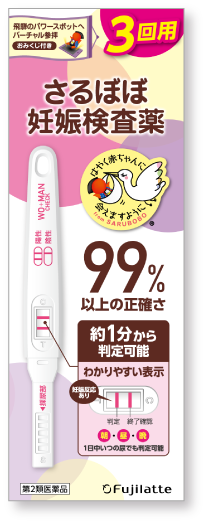
Sarubobo Pregnancy Test
A collaboration pregnancy test by Pip Corporation × Sarubobo, manufactured by Fujilatte. Available as a 3-test pack.

Illustration created by LifeAbroad for educational purposes · Based on the official package insert (sarubobo-kounotori.com)
When to Test
How to Use
- 1Open the foil pouch just before use. Remove the cap from the tip of the test stick.
- 2Hold the stick with the absorbent tip pointing down. Urinate directly onto the entire absorbent tip for about 5 seconds. Do not urinate on the result windows. OR collect urine in a dry, clean cup and submerge the entire absorbent tip for 5 seconds. Do not use urine that is highly turbid or contains foreign matter. If you drank a large amount of water before testing, hCG in your urine may be diluted — use first morning urine when possible.
- 3Replace the cap and place the test stick flat on a surface. Wait 1–3 minutes and read the result within 5 minutes.
Reading Your Result
First check that a line has appeared in the Control Window (C) — this confirms the test has run correctly. Then observe whether a line appears in the Test Window (T). The Test Window line may appear after a short delay — observe for up to 5 minutes. Do not read the result after 5 minutes have passed.
Tips
Important Notes
Detection sensitivity: 50 mIU/mL
The result may show positive even if you are not pregnant in the following cases:
- After menopause
- hCG-producing tumors (e.g., choriocarcinoma)
- Use of hCG-containing gonadotropin medications
The result may show negative even if you are pregnant in the following cases:
- Irregular menstrual cycle
- Miscalculation of your expected period date
- Very early pregnancy with insufficient hCG levels in urine
- Abnormal pregnancy (e.g., ectopic pregnancy)
- Fetal abnormality (e.g., intrauterine fetal death, missed miscarriage)
- Conditions producing very large amounts of hCG (e.g., hydatidiform mole)

WO+MAN CHECK
At-home pregnancy test by Fujilatte (不二ラテックス) — the original brand. Available as a 1-test, 2-test, or 3-test pack. Widely available at drug stores across Japan.

Illustration created by LifeAbroad for educational purposes · Based on the official package insert (fujilatex-healthcare.jp)
When to Test
How to Use
- 1Open the foil pouch just before use. Remove the cap from the tip of the test stick.
- 2Hold the stick with the absorbent tip pointing down. Urinate directly onto the entire absorbent tip for about 5 seconds. Do not urinate on the result windows. OR collect urine in a dry, clean cup and submerge the entire absorbent tip for 5 seconds. Do not use urine that is highly turbid or contains foreign matter. If you drank a large amount of water before testing, hCG in your urine may be diluted — use first morning urine when possible.
- 3Replace the cap and place the test stick flat on a surface. Wait 1–3 minutes and read the result within 5 minutes.
Reading Your Result
First check that a line has appeared in the Control Window (C) — this confirms the test has run correctly. Then observe whether a line appears in the Test Window (T). The Test Window line may appear after a short delay — observe for up to 5 minutes. Do not read the result after 5 minutes have passed.
Tips
Important Notes
Detection sensitivity: 50 mIU/mL
The result may show positive even if you are not pregnant in the following cases:
- After menopause
- hCG-producing tumors (e.g., choriocarcinoma)
- Use of hCG-containing gonadotropin medications
The result may show negative even if you are pregnant in the following cases:
- Irregular menstrual cycle
- Miscalculation of your expected period date
- Very early pregnancy with insufficient hCG levels in urine
- Abnormal pregnancy (e.g., ectopic pregnancy)
- Fetal abnormality (e.g., intrauterine fetal death, missed miscarriage)
- Conditions producing very large amounts of hCG (e.g., hydatidiform mole)

P-Check S
At-home pregnancy test by Mizuho Medy. Available as a 1-test or 2-test pack.

Illustration created by LifeAbroad for educational purposes · Based on the official package insert (mizuho-m.co.jp)
When to Test
How to Use
- 1Open the foil pouch just before use. Remove the test stick and take off the protective cap from the tip. Attach the cap to the opposite end of the stick and hold the thumb grip. Do not push the cap in too hard — if inserted too far, it may become difficult to remove.
- 2Hold the stick with the absorbent tip pointing down. Urinate directly onto the entire absorbent tip for 5 seconds or longer. Urinate from the front of the tip — do not urinate on the result windows or sides. OR collect urine in a dry, clean cup and submerge the entire absorbent tip for exactly 10 seconds. Do not submerge any part beyond the absorbent tip. Do not tilt the absorbent tip upward after applying urine. Do not apply urine a second time. Do not use urine that has been left standing for a long time, or urine that is highly turbid or contains foreign matter.
- 3Replace the cap over the wet absorbent tip, keeping the tip pointing down. Place the test stick flat on a surface and wait 1–3 minutes.
Reading Your Result
First check that a reddish-purple line has appeared in the Control Line (○) — this confirms the test has run correctly. Then observe whether a line appears in the Test Line (□). The line may be faint or dark — any line counts. Do not read the result after 10 minutes have passed.
Tips
Important Notes
Detection sensitivity: 50 IU/L
The result may show positive even if you are not pregnant in the following cases:
- After menopause
- hCG-producing tumors (e.g., choriocarcinoma)
- Use of hCG-containing gonadotropin medications (specific ovulation-inducing drugs)
The result may show negative even if you are pregnant in the following cases:
- Irregular menstrual cycle
- Miscalculation of your expected period date
- Very early pregnancy with insufficient hCG levels in urine
- Very high hCG levels due to pregnancy (this can rarely occur approximately 2 months or more after your last period)
- Abnormal pregnancy (e.g., ectopic pregnancy)
- Fetal abnormality (e.g., intrauterine fetal death, missed miscarriage)
- Conditions producing very large amounts of hCG (e.g., hydatidiform mole)
- Incorrect test procedure

Check One S
At-home pregnancy test. Available as a 1-test or 2-test pack. Features the Smart Stick design, which reduces plastic by approximately 63% and prevents urine spillage.

Illustration created by LifeAbroad for educational purposes · Based on the official package insert (arax.co.jp)
When to Test
How to Use
- 1Open the foil pouch just before use. Attach the cap to the back of the stick. Hold the stick with the absorbent tip facing down and urinate thoroughly onto the entire absorbent tip for about 2 seconds. OR collect urine in a clean cup and dip the entire absorbent tip for 2 seconds. Do not let the plastic body get wet with urine. Do not exceed 10 seconds in either method.
- 2Keep the absorbent tip facing down and cap the stick. Place it flat on a surface so the Judgement area (判定窓) is visible. Wait 1 minute. Do not hold it in your hand while waiting.
- 3First confirm a red line has appeared in the 終了 (Completion) area — this is the control line, confirming the test has run correctly. Then read the result in the 判定 (Judgement) area within 10 minutes.
Reading Your Result
Tips
Important Notes
Detection sensitivity: 50 mIU/mL
About your result:
- A faint line in the Judgement Area still counts as a positive result.
- A line may temporarily appear in the Judgement Area while urine is flowing through the stick — this is normal and is not your result.
- Avoid reading the result after 10 minutes have passed.
The result may show positive even if you are not pregnant in the following cases:
- After menopause
- hCG-producing tumors (e.g., choriocarcinoma)
- Use of gonadotropin medications
- High levels of sugar, protein, or blood in urine
The result may show negative even if you are pregnant in the following cases:
- Irregular menstrual cycle (calculate your expected date based on your previous cycle)
- Miscalculation of your expected period date
- Very early pregnancy with insufficient hCG levels in urine
- Ectopic pregnancy
- Fetal abnormality (e.g., intrauterine fetal death, missed miscarriage)
- Hydatidiform mole producing large amounts of hCG

Hi Tester N
At-home pregnancy test. Available as a 1-test or 2-test pack.

Illustration created by LifeAbroad for educational purposes · Based on the official package insert (hitester.jp)
When to Test
How to Use
- 1Open the individual foil pouch just before use. Remove the test stick and attach the cap to the opposite end of the stick.
- 2Hold the stick with the absorbent tip facing down. Urinate directly onto the entire absorbent tip from the front for 5 seconds or longer. Do not urinate on the Result Window or the sides. OR collect urine in a clean dry cup and submerge the entire absorbent tip for 10 seconds. Do not let anything other than the absorbent tip get wet.
- 3Keep the absorbent tip facing down, replace the cap, and place the stick flat on a surface. Wait 1 to 3 minutes. Do not re-apply urine. Do not point the absorbent tip upward. Avoid reading the result after 10 minutes have passed.
Reading Your Result
First confirm a reddish-purple line has appeared in the oval 終了 (Completion Window) — this is the control line, confirming the test has run correctly.
Tips
Important Notes
Detection sensitivity: 50 IU/L
About your result:
- A faint line in the 判定 (Result Window) still counts as a positive result.
- The entire Result Window may temporarily turn reddish during the test — this is normal. Wait until the color clears, then read the vertical line only.
- If the result is unclear after 1–3 minutes, check again within 10 minutes. If no line appears in the 終了 (Completion Window), the test may have been performed incorrectly — use a new test stick.
- Avoid reading the result after 10 minutes have passed.
- Do not re-apply urine to a used test stick.
The result may show positive even if you are not pregnant in the following cases:
- After menopause
- hCG-producing tumors (e.g., choriocarcinoma)
- Use of gonadotropin-containing ovulation-inducing medications
The result may show negative even if you are pregnant in the following cases:
- Irregular menstrual cycle
- Miscalculation of your expected period date
- Very early pregnancy with insufficient hCG levels in urine
- Very high hCG levels (this can rarely occur approximately 2 months or more after your last period)
- Ectopic pregnancy
- Fetal abnormality (e.g., intrauterine fetal death, missed miscarriage)
- Hydatidiform mole producing large amounts of hCG
- Incorrect use of the test
Just got a positive result? Our sister site Childcare in Japan — Just Found Out You're Pregnant? Here's What to Do First walks you through the next steps.