Having an internet connection is extremely important. Whether you just want to keep up with your friends and family, watch movies and TV shows, play video games, or conduct business, you need an internet connection.
Internet in Japan is world-renowned as some of the fastest, cheapest internet available in the world. Look through this section to learn more about the most popular ISPs in Japan, the types of internet service available, how fast they are, and what they typically cost.
Mobile Phone Services in Japan
In Japan, there are 4 major mobile service providers. You can click below to see the phones and services they offer in English.
Getting a Mobile Phone
When you go to get a mobile phone and create a service contract, you need to bring a few things with you. You will need:
- Personal Identification – For this, your passport alone is not enough, unless your passport is Japanese. You will need ONE of the following:
- Resident card AND passport
- Special Permanent Resident Certificate
- Japanese driver's license
- My Number Card (Notification card MAY NOT be used)
- Health insurance card AND ① Residential registration certificate or ② Public utilities receipt or ③ Printed matter issued by government or public offices (e.g. tax bill, pension notification, etc.)
- Identification booklet for the physically handicapped, welfare booklet, or identification booklet for people with mental disabilities
- Your credit card (issued by a Japanese bank) OR your ATM/Cash Card for your Japanese bank account
- Your personal seal (if you have one)
Choosing a Phone
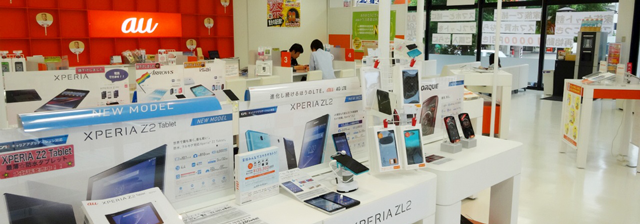
The majority of people these days have smartphones, but many people still use old style flip phones. The choices for flip phones, however, are far more limited than they used to be, so foreign language capable phones may not be available.
When it comes to smartphones, you will have many more choices, and a higher chance of the phone you want having foreign language settings. Be sure to check the placard by the phone model in the store to see if it has any languages other than Japanese listed. You can also check out the mobile service providers' websites to get an idea of your options before you go to the store.
In this day and age, it's a good idea to research phones anyway to make sure the one you get will last you 2 or more years.
Paying for Your Phone
In Japan, there is no such thing as a free phone with a new contract. You always have to pay, but the plus side to that is you can change your phone whenever you want, as long as you're happy to pay the balance on the old one and pay for the new one.
In general, there are two ways you can pay for your phone: Up-front and Monthly. If you choose Up-front, be ready to pay ¥60,000 or more, though sometimes there are discount programs for this payment type. For Monthly payments, you will be allowed to choose the number of months you'd like to pay, typically in 12-, 24-, and 36-month plans available.
If you change your phone before you have paid off your old one, you will be given the option to pay off the balance up-front or continue the payment until it would have otherwise finished. Your new phone's monthly payment will be tacked onto your bill as well, so keep that in mind.
Kakuyasu Smartphone
Kakuyasu Smartphone (格安スマホ) is a low-cost phone service, also commonly referred to as MVNO (Mobile Virtual Network Operator). Generally, service costs less than ¥5,000 per month, with some costing as little as ¥1,200 (not including the monthly payment for your phone).
What is it?
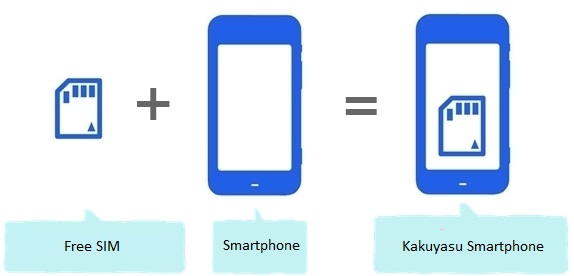
Kakuyasu Smartphone is not a company, but a concept. It revolves around the use of SIM-unlocked phones and a SIM card that utilizes the cell towers of a major mobile service provider. If you already have an unlocked phone, you can just purchase the SIM. Since 2021, all phones sold in Japan are required to be SIM-unlocked, so in most cases you can use your current phone with a Kakuyasu SIM card.
You can choose your monthly data cap, with available amounts as little as 500MB and often up to 10GB or more.
Why is it so cheap?
When you use a Kakuyasu Smartphone, you are not using proprietary mobile signals. You essentially borrow the signal of whatever tower is nearest you, so your monthly fee is closer to a type of rent. Because you are essentially 'renting' your reception, you don't have to pay a lot of the fees that proprietary users pay.
Pros and Cons
| Pros |
Cons |
- Very affordable
- Plans that can be tailored to a minimum of 500MB of data per month for low-data users
- No cancellation fees
- More affordable phones than standard carriers
- SIM cards can be exchanged overseas for prepaid SIMs when you travel
|
- High-data users may exceed plan limits and be charged a lot
- No service centers for help or troubleshooting
- May experience slower speeds or poor reception compared to major carriers, especially during peak hours
- No proprietary email address on your phone
- High-end phones and iPhones may have limited availability depending on the provider
|
Who is Kakuyasu Smartphone ideal for?
This kind of mobile service is ideal for individuals who have low data needs and don't make a lot of phone calls, or someone who cannot commit to a standard 2-year contract at a regular provider. It is also a good solution for those who cannot afford or do not care to pay for standard phone service, children and teens who do not need full functionality, or seniors who just need basic service.
Where can I get it?
Electronics stores, large department stores, and online.
If you cannot find the section for Kakuyasu Smartphone, look for 格安スマホ (kakuyasu sumaho) or ask an employee.
Vocabulary
| Japanese |
Romaji |
English |
| ガラケー |
Garakee |
Flip phone |
| スマートフォン |
Sumaatofon |
Smartphone |
| スマホ |
Sumaho |
Smartphone (casual) |
契約書
(けいやくしょ) |
Keiyakusho |
Contract |
携帯番号
(けいたいばんごう) |
Keitaibangou |
Mobile phone number |
バイリンガル機能
(ばいりんがるきのう) |
Bairingaru kinou |
Bilingual functionality (foreign language settings) |
充電ケーブル
(じゅうでんけーぶる) |
Juudenkeeburu |
Charging cable |
Internet in Japan
Japan is known for its lightning fast internet. While the speed and available providers will vary depending on where you live, there is more available to you in general as compared to other countries. Japan does not have a monopoly system for telecom companies, so you have a lot to choose from for internet service providers.
In Japan, you will typically choose a company to provide the necessary cables, modems, and routers, and another company for the actual internet service. The base company will usually be NTT or KDDI. So, for example, if you wanted to subscribe to a high-speed fiber optic service, the fiber optic cable, modem, and wireless router will come from the base company, and your actual internet service would come from a provider of your choice.
You can start with them and contract out to the provider, or contact the provider and they will apply to NTT or KDDI for you.
Popular Internet Service Providers
There are a lot of providers to choose from, but the most popular are the following:
- OCN
- So-net
- BigGlobe
- Yahoo BB
- AU / Docomo / Softbank
- Broad WiMax
Types of Internet Service in Japan
There are two main types of internet available:
- Fiber Optic — The fastest internet option available.
The base company (NTT, KDDI, etc.) will check with the owner of your building for 2 things:
- If there is already a fiber optic cable set up in your building (either from another user or if the owner installed one when the building was built)
- If the owner will allow minor construction on the building to allow installation of a fiber optic cable.
It typically takes about 1–2 weeks from applying to having service in your house or apartment, depending on your availability for installation, and how busy the installers are during your application period. You will have a modem, and if you want wireless, you can typically buy or rent a wireless router from the installing company.
Average speeds are 1–2 Gbps. Typically costs around ¥5,000 per month for service, more if you rent a wireless router or pay for a premium service or plan.
- WiMAX — Wireless-only internet that does not require installation or construction. This type of service has been gaining popularity due to its flexibility and quick set up. You can have internet access within a few days of applying, sometimes same-day. You will receive a wireless router that sets up quickly. The drawback of this type of internet is that you will choose a data plan similar to a mobile phone plan, where you have a data cap.
Typically costs between ¥4,000–¥5,000 per month for service depending on the service and plan you choose. Speeds vary by location and connection type.
Note: ADSL service in Japan was discontinued by NTT in January 2024 and is no longer available as a new option.
Most ISPs in Japan do not have English support, but a few do provide technical support in English. If you are not proficient in Japanese, it may be best to ask a friend or trusted colleague to help you with setting up internet.